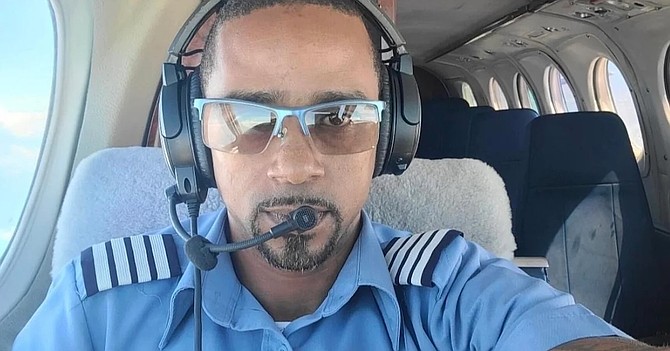
Ian Nixon
PILOT Ian Nixon, who was credited with helping all 10 passengers aboard survive after a plane ditched into the ocean, had his United States pilot’s licence revoked for life in 2009 after being convicted and imprisoned in Florida two years earlier for ‘conspiracy to supply an illegal substance’ into the US.
After serving his sentence, he returned to The Bahamas in 2011, where his US commercial pilots’ licence was converted to a Bahamian one and he landed a job with Pineapple Air as a commercial pilot.
In 2013, his employer received an email from the US Department of Civil Aviation (DCA) indicating his permit had been revoked and demanding the return of the document, according to a 2022 Supreme Court ruling.
The ruling by Justice Loren Klein showed Mr Nixon challenged the Bahamas Civil Aviation Authority’s suspension of his commercial pilot’s licence and airman’s medical certificate, as well as the Airport Authority’s revocation of his restricted-area security pass at Lynden Pindling International Airport. At time of press, any later decision made was not known.
The judgment adds a striking regulatory backdrop to Tuesday’s crash, when Mr Nixon reportedly piloted a Beechcraft King Air 300 that ditched about 80 miles off Florida after leaving Marsh Harbour, Abaco, for Freeport. All 11 people aboard survived after spending nearly five hours in open water.
In the Supreme Court case, Mr Nixon sought leave to bring judicial review proceedings over two aviation decisions that Justice Klein said, “in effect,” had removed his ability to fly.
The ruling said Mr Nixon was issued a United States Federal Aviation Administration pilot’s licence in 2002, which was converted to a Bahamian commercial pilot’s licence in January 2003.
Mr Nixon admitted he was convicted and sentenced in Florida in May 2007 for “conspiracy to supply an illegal substance” into the United States and was imprisoned there. His FAA licence was revoked for life in August 2009 because of the conviction.
After returning to The Bahamas, Mr Nixon said he renewed his commercial pilot’s licence in June 2011, received a permit in November 2012 to enter restricted airport areas, and obtained employment with Pineapple Air.
However, the court said his employer received an email in March 2013 from Andrew Bonaby, then security director of the Department of Civil Aviation, saying Mr Nixon’s permit had been revoked and demanding its return.
Mr Nixon later said he met an official in the Ministry of Transport and Aviation and was told the permit had been revoked because of his US drug conviction.
The first decision challenged in the court case was a February 1, 2018, decision by the Director of the Bahamas Civil Aviation Authority to suspend Mr Nixon’s commercial pilot’s licence and airman’s medical certificate pending the outcome of aircraft accident investigations involving him.
The second was the Airport Authority’s 2013 decision to revoke and withdraw his airport security permit and identification badge, which allowed him to access restricted “airside” areas at LPIA.
Justice Klein granted Mr Nixon an extension of time and leave to challenge the licence suspension, finding that the matter remained open because a suspension was temporary by nature and amounted to a continuing state of affairs.
The judge said Mr Nixon had an arguable case with a reasonable prospect of success concerning the licence suspension, though he stressed that judicial review concerns the legality and procedural fairness of a decision, not its merits.
The respondents accused Mr Nixon of leaving out important details. They alleged that when he applied for an ID badge in March 2013, he denied on the form that he had ever been convicted in a court in The Bahamas or elsewhere.
They said the Airport Authority later confirmed with US Customs and Border Protection that Mr Nixon had been arrested for importing dangerous drugs into the United States and had served time in federal prison.
The respondents also alleged that despite the revocation of his aviation documents, Mr Nixon continued certain operations in breach of applicable regulations and policies.
They claimed he continued flying despite restrictions, was helped by his wife, who worked with Executive Flight Support, to access restricted airside areas at LPIA, and used a “pattern of deceptive behaviour” to obtain ID badges for airports in Rock Sound and Grand Bahama.
The respondents further alleged that Mr Nixon continued flying without proper documentation until he crashed a plane in 2018.
Justice Klein said the licence and permit decisions were connected, but legally distinct.
He said a successful challenge to the licence suspension could make Mr Nixon eligible to apply again for an airport security pass, which would then have to be considered afresh.
The court ultimately granted Mr Nixon more time and leave to challenge the suspension of his commercial pilot’s licence, but dismissed his application to challenge the revocation of his restricted-area security permit.
The ultimate verdict in the case was unclear up to press time.




Comments
ted4bz 7 hours, 24 minutes ago
Well, everyone survived this flight, thanks to him anyway. Who knows what the outcome would have been if it was someone else.
TalRussell 5 hours, 7 minutes ago
After serving his sentence, he returned to The Bahamas in 2011, where his US commercial pilots’ licence was converted to a Bahamian one **and he landed a job with Pineapple Air as a commercial pilot.
**
BahamaRed 3 hours, 27 minutes ago
How is this relevant? How many people have been convicted of crimes in the USA and returned to The Bahamas and continued life. Unless he was a convicted murderer or sex offender this has no bearing. He obviously made a mistake, he paid the price and served his time. So I don't see why he needs to be punished in The Bahamas.
TalRussell 2 hours, 56 minutes ago
@BahamaRed, from reading this article, isn't there more than the conviction makes this case is still about uncleared matters - remaining, which wasn't cleared-up.
IF the plane is found to have entered US airspace/sea waters, his employer airline may now have a serious US problem?
His employer, seems not have been contacted for comment?
Whenever airport security is breached, tis a serious mattter of concern for whoever aiided in a breach.
And, yes, drugs do destroy lives...of which many have deaded from --- Yes?
ScubaSteve 23 minutes ago
He made a mistake and served his time in jail. Not a big deal. It shouldn't be a "life sentence." He paid his price and moved on with his life. Good for him!!
Sign in to comment
OpenID