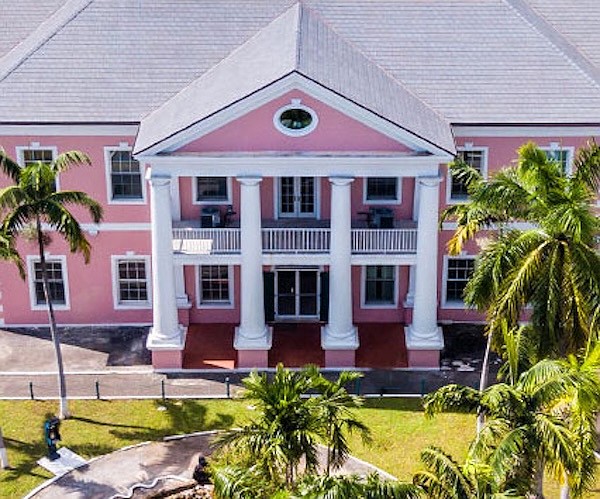
The Supreme Court building
By RASHAD ROLLE
Tribune News Editor
rrolle@tribunemedia.net
THE Supreme Court was forced to close yesterday after a downtown power outage that reportedly began on Friday exhausted and damaged its backup generator system, disrupting court schedules and prompting the Bahamas Bar Association to warn that the administration of justice had been “materially” compromised.
The Bahamas Bar Association issued a blistering condemnation of the persistent outages, saying critical judicial facilities had been closed, matters adjourned and litigants and witnesses turned away.
“When the doors of the Courts cannot open,” the association said, “the rights of citizens to be heard, to have their liberty preserved or vindicated, and to have their disputes resolved in a timely manner are placed in jeopardy.”
The association also condemned what it described as a failure by the relevant authorities and utility providers to maintain clear communication with the judiciary during the outages.
That failure, it said, prevented the judiciary from putting appropriate contingency measures in place and left court users, lawyers and the wider public without timely information.
“This is unacceptable,” the association said.
A senior judiciary official told The Tribune the court lost power at about 4pm Friday and received no communication from Bahamas Power and Light about the outage. The court’s generators continued operating throughout the weekend because officials did not know the interruption would persist, exhausting their fuel by Monday morning.
The official said after the generators were refuelled Monday at substantial cost, one of the main units developed damaged seals from running continuously since Friday. The generator repeatedly failed yesterday and had to be shut down and allowed to cool before technicians could repair it, forcing the Supreme Court to close.
The unexpected expense was not included in the judiciary’s budget and will have to be absorbed while it continues financing its other operations. The disruption has also created a scheduling problem for a court system whose calendars are largely fixed six to 12 months in advance.
Attorney General Wayne Munroe acknowledged that any loss of court time is a concern, although he pointed out that generators are not intended to operate continuously for 24 hours a day.
“Any wasted time is a concern,” he said. “In the past, you've had, say, AC problems, the past you've had electrical issues so anything that causes loss of any court time clearly is something that is not useful.”
The effects of the power problems were also being felt elsewhere in the downtown area.
A top Industrial Tribunal official said the Tribunal lost power Monday before electricity returned yesterday morning.
“Of course, it affects,” she said. “There's no electricity. There's no computers. There's no court. No AC. No water.”
She also complained about longstanding problems at the building, including an elevator that she said has been out of service for months, heat and mould.
“It's terrible,” she said. “That's all I could tell you.”
Despite those difficulties, she stressed that the tribunal has no backlog and remains a day ahead in its work.
Businesses were also paying heavily to remain operational.
Allen Williams, manager of Cafe Matisse, said its generator had been running continuously since Friday afternoon to protect thousands of dollars worth of inventory.
“From Friday to now,” he said, “probably about $1,000” had been spent on fuel.
Mr Williams said he had received no information directly from BPL and was relying on second-hand reports.
“Meanwhile, long as they down, we burning fuel,” he said. “Very expensive.”
BPL issued a statement yesterday referring to an outage affecting customers in the Bank Lane area that it said resulted from a cable fault near Rawson Square identified by Bahamas Grid Company technicians at about 2.30am on Tuesday.
The utility said BPL and BGC crews were working together to repair the fault and expected electricity to be restored by or before 1am today.
That response did not account for the loss of electricity the judiciary official and Cafe Matisse said began at about 4pm Friday.
Meanwhile, Commissioner of Police Shanta Knowles clarified that activity at Central Police Station was unrelated to the power problems.
“Central Police Station has been under renovations,” she said, explaining that extensive renovations are being carried out at the facility. She said people who need to make complaints can use the Tourism Police Unit on Parliament Street and the wharf while the work continues.
The closure of the Supreme Court yesterday extended a bruising summer for Bahamas Power and Light marked by repeated blackouts, load shedding, equipment failures and complaints about poor communication.
The latest disruption comes less than two weeks after a transformer explosion at Blue Hills triggered an island-wide blackout across New Providence that lasted seven hours or longer in some areas, and days after western communities endured five consecutive days of outages that left some residents sleeping in cars, throwing away spoiled food and spending hundreds of dollars on generator fuel. The outages have continued in recent days and have extended to some Family Islands.
BPL has blamed recent problems on a mix of cable faults, overloaded transformers, tripped feeders and breakers, damaged power lines, fires and unusually high demand. Its chief operating officer, Anthony Christie, acknowledged last week that the system was under strain and that some circuits and transformers were approaching capacity.




Comments
rosiepi 3 hours, 43 minutes ago
Industrial generators are designed to run past 100 hours let alone the 24 hours quoted by the Minister because if they could not our hotels, government entities, multi family residences wouldn’t invest in their purchase-and maintenance.
So it would be surprising given the prevalence, the need for generators here and the collective knowledge that implies for anyone reading this article to conclude that the BPL caused the damage described here. Not saying they’re not culpable for the ‘mismanagement’ of our money, the loss of trust given them.
No, the implication here seems to be that had the BPL presumed the system operators employed by Bahamian government entities to be so incompetent they should have “communicated” with the latter to ensure they followed the most rudimentary law of maintaining their generators.
“Do not operate without a steady supply of fuel.”
Sign in to comment
OpenID