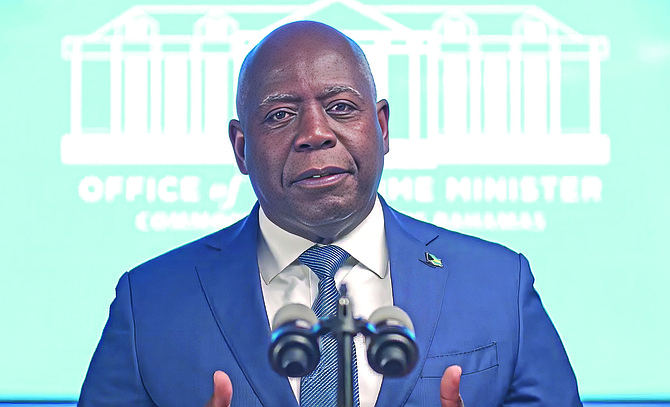
Prime Minister Philip ‘Brave’ Davis during his address to the nation August 17th, 2026.
By RASHAD ROLLE
Tribune News Editor
rrolle@tribunemedia.net
PRIME Minister Philip “Brave” Davis last night conceded he could not promise Bahamians an immediate end to the power cuts that have battered New Providence and parts of the Family Islands this summer, but pledged that generation capacity will return over the coming months as his administration replaces failed equipment and pushes ahead with a sweeping overhaul of the electricity system.
“I am not going to stand here and tell you that every light will stay on tomorrow,” Mr Davis said during a national address delivered against the backdrop of weeks of outages, including an island-wide blackout on July 30 and five consecutive days of disruptions in parts of western New Providence.
He also directly confronted the overtime controversy engulfing Bahamas Power and Light, calling a system that allowed three employees to collect more than $600,000 in overtime in a year an abuse and declaring it not credible that an employee could safely work 24 hours straight for three consecutive days.
“New engines, cables, transformers, solar and battery equipment alone will not save a company that is not run properly,” Mr Davis said. “And I will not stand here and ask you for patience while ignoring what needs fixing on the inside.”
The Prime Minister said BPL spent approximately $20m on overtime last year and singled out records first reported by The Tribune showing one employee claiming 18 hours on Christmas Day followed by 24 hours on each of the next three days — 90 hours over four consecutive days.
The Tribune revealed last week that three employees in BPL’s Fuel and Performance Department received a combined $601,295.16 in overtime between May 2025 and April 2026. Two received more than $200,000 each, with some monthly payments exceeding $20,000.
“It is not credible that a person works twenty-four hours straight, three days running, and does safe work,” Mr Davis said. “It is not fair to the ratepayer, who funds every dollar. And it is not fair to the honest worker, whose profession is tarnished by it.”
He blamed a breakdown in management, controls and oversight that he said stretched across administrations, rather than the wider BPL workforce.
“The overwhelming majority of BPL’s workers are decent, skilled Bahamians who keep our lights on and go out in storms when the rest of us are told to stay inside,” Mr Davis said. “They have my respect and my thanks. This is not about them.
“This is about a system that permitted this type of abuse.”
New rules have triggered a confrontation with the Bahamas Electrical Workers Union, which has filed a trade dispute and instructed members to work only their normal hours until further notice. Union president Kyle Wilson has accused the Davis administration of using the overtime controversy to distract from failures in the electricity system.
The overtime fight has erupted during one of the most difficult periods for the electricity sector in recent years.
New Providence suffered an island-wide blackout on July 30 after an underground cable fault caused a transformer failure at Blue Hills. In the days that followed, repeated outages left some residents sleeping in cars, throwing out spoiled food and spending hundreds of dollars on generator fuel.
Power problems persisted over the weekend, with outages reported in New Providence and parts of Abaco. Grand Cay residents faced another extended interruption after a seven-day outage the previous week, while Guana Cay suffered cable faults.
Against that backdrop, Mr Davis laid out a timetable for equipment that he said should strengthen generation and the electricity network.
Blue Hills GT2, which has been out since the spring, is returning to service, he said, along with the battery storage system used to reduce pressure during the evening peak.
Two engines at Clifton Pier are scheduled to return before the end of September, while a Blue Hills turbine undergoing a major inspection is expected back during the first quarter of next year.
The Prime Minister said the administration plans to begin phasing out 40 megawatts of rented generation in January, but only as permanent replacement capacity becomes available.
BPL has relied heavily on rental generation as its ageing fleet has struggled to meet demand.
Mr Davis said the transition away from rental units would occur only when permanent capacity has been tested and is ready.
He also said substation equipment, switchgear and high-voltage assets that failed this summer are being replaced rather than patched.
Remote monitoring is expected to go live at Clifton Pier this year, followed by Blue Hills, allowing faults to be diagnosed using data.
The first phase of liquefied natural gas is also expected to come online this year, eventually scaling to 190 megawatts of gas-fired capacity by late 2027. New pipelines are expected to replace one that is more than 40 years old, while combined-cycle plants at Blue Hills are scheduled to be commissioned during 2027 and 2028.
Mr Davis said the changes would eventually allow power to be produced at a fraction of today’s fuel cost.
But he repeatedly acknowledged that those projects will not eliminate the immediate risk of failures.
“There will be setbacks,” he said. “There will be equipment failures.”
He said temporary disruptions could also occur as old infrastructure is removed and new systems connected.
The Prime Minister devoted substantial attention to the distinction between electricity generation and the transmission and distribution network, arguing that adding generating capacity alone cannot guarantee reliable service.
Bahamas Grid Company has responsibility for New Providence’s transmission and distribution network, while BPL remains responsible for generation.
Mr Davis pointed to the July 30 island-wide blackout as an example, saying it was caused not by a shortage of generation but by an underground cable fault that led to the failure of a critical transformer.
The outage began in the early hours and lasted seven hours or longer in some communities, driving some residents from hot homes into cars, beaches and gas stations.
“It is not an excuse,” Mr Davis said of his explanation of the failure. “It is an explanation, because you are entitled to know why - although it does not ease the misery we all felt.”
He said underground faults are more difficult to locate than overhead problems because crews may have to trace them section by section and sometimes excavate to identify them.
Mr Davis also blamed record demand, extreme heat and ageing infrastructure for placing additional pressure on the system, saying electricity demand had broken the previous peak twice this season.
He said much of the country’s electrical infrastructure was built for a smaller population and economy, with some equipment and cables dating to before Independence.
The Prime Minister said more than 60 percent of generation equipment in New Providence needed replacement when his administration confronted the problem, rising to 80 percent in the Family Islands.
He said BPL was carrying more than $500m in debt and another $100m in unfunded pension obligations, while engineers estimated $500m in critical upgrades were needed to avert the risk of widespread infrastructure failure.
BPL was also renting engines at a cost exceeding $40m annually, he said.
Mr Davis used much of the address to defend his administration’s energy strategy, arguing that decades of temporary fixes had left the country with an antiquated system that now requires wholesale reconstruction.
He said Bahamas Grid Company has undertaken a $130m upgrade involving steel poles, larger conductors, protection devices, fibre communications, a looped transmission system and three new high-voltage substations.
Those substations reached mechanical completion in July and entered final testing and commissioning, he said.
Mr Davis said foundational work undertaken in 2025 was associated with a 45 percent reduction in outage frequency and a 35 percent reduction in outage duration compared with historical averages.
He acknowledged, however, that those gains are at odds with the experience of residents enduring repeated disruptions this summer.
“Those gains are real,” he said. “But the outages Bahamians are experiencing now are also real.”
Mr Davis said the lesson was not that the earlier work had failed, but that upgrades remain incomplete and improvements in reliability have not reached every community evenly.
The Prime Minister also announced plans to revisit the rules governing residential solar systems.
In consultation with the Utilities Regulation and Competition Authority, BPL, consumer groups and Bahamian solar installers, he said the administration will examine simpler application procedures, predictable approval times, wider access to bi-directional meters and the treatment of excess electricity generated by homes and supplied to the grid.
He said the administration will also accelerate the introduction of advanced electricity meters intended to help detect outages and give consumers more information about their electricity consumption.
Mr Davis said the electricity system the administration inherited was effectively “on life support”, but accepted responsibility for addressing it.
“The responsibility to act is ours,” he said.
He rejected continuing the traditional cycle of renting additional engines and patching failed equipment simply to survive another summer.
“We are not here to manage decline,” Mr Davis said. “We are not here to defend the status quo.”
He later returned to the scale of the challenge confronting the administration.
“This is the hardest infrastructure challenge our country has faced in fifty years of independence,” Mr Davis said.
And, after a summer in which thousands of Bahamians have again found themselves planning their lives around electricity cuts, the Prime Minister offered no quick promise that the disruption was over.
“You have waited long enough,” he said. “What we inherited is not what we will leave behind.”




Comments
Sickened 4 hours, 3 minutes ago
What is this... the PM talking sense?!?! He must of had a great vacation and had a come to Jesus moment.
licks2 2 hours, 50 minutes ago
Yall PLPs need to stop putting the PM is a "sticky": position and then expect him to cover yall ass when yinna do dumb and crooked stuff!! He is PM for all Bahamians. . .he has to put boots up yinna behinds when yinna try to raid the kitty for the nation right out in the open!!!! What the hell yinna expect when yinna try to "take him for light" in public!!
Do what we hire you for Mr. PM. . .the whole nation is behind ya!!
realfreethinker 1 hour, 56 minutes ago
A speech of distraction. Why would you have a national address and do not have any solutions for the problem? And the ironic part is so many people did not see it because of the lack of power
whatsup 1 hour, 37 minutes ago
Exactly, more BLAH BLAH BLAH
birdiestrachan 39 minutes ago
The Pm gave keys to people for homes on the out Island. But no matter what he said that Fnm crew and their newspaper would find fault You know The WE editorials. The power situation is a problem it is too bad the Fnm Government did not fix it when they were on power. Then it would not be a problem now.
Sign in to comment
OpenID