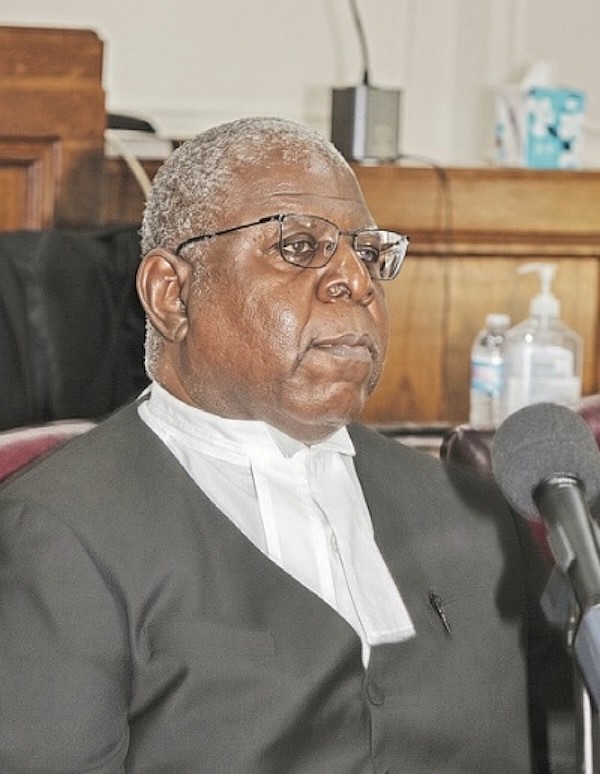
COURT of Appeal President Justice Milton Evans.
By DENISE MAYCOCK
Tribune Freeport Reporter
dmaycock@tribunemedia.net
COURT of Appeal President Justice Milton Evans has warned that mandatory retirement ages are draining the Bahamian judiciary of experienced judges, saying some are forced from the bench just as they reach their professional stride and later take their expertise to other countries.
Justice Evans said the retirement rules can strip the courts of institutional knowledge and contribute to what he described as “a brain drain”.
He raised the concern yesterday as the Court of Appeal sat in Grand Bahama for the first time in nearly two decades, with Chief Justice Ian Winder and Justice Gregory Smith among the judges participating in the two-day visit.
Justice Evans said judges do not arrive on the bench with complete knowledge but develop their expertise over years of service.
By the time some judges reach their professional stride, he said, the mandatory retirement age can force them to leave the bench, taking that accumulated experience with them.
Under the Constitution, a Supreme Court justice ordinarily holds office until age 65, although the Governor-General, acting on the Prime Minister’s recommendation after consultation with the Leader of the Opposition, may permit the judge to remain until no later than 67. A Justice of Appeal ordinarily retires at 68 but may similarly be permitted to continue until no later than 70.
Justice Evans pointed to retired Bahamian judges who have subsequently served in other jurisdictions where older judges are permitted to remain on the bench, including Dame Anita Allen and Justice Neville Adderley.
He also recalled the failure of a previous referendum that would have allowed Supreme Court and Court of Appeal judges to serve to older ages.
The retirement issue was put directly to voters in the February 27, 2002 constitutional referendum. One of the proposed amendments would have raised the normal retirement age for Supreme Court judges to 68, with possible extensions to 72, and for Court of Appeal judges to 72, with possible extensions to 75. Voters rejected the proposal decisively: 60,838 voted no, compared with 25,018 who voted yes — about 71 percent against
Justice Evans' comments came as the Court of Appeal held proceedings outside New Providence for the first time since 2008.
The panel is sitting in Grand Bahama on September 9 and 10 and hearing two criminal matters involving Freeport residents, including one concerning a person convicted of causing harm and another involving the sexual assault of a young woman.
Justice Evans described the visit as a “very special occasion” and said it was intended not only to hear cases involving Freeport residents, but also to give the public an opportunity to see the appellate court at work.
He said holding hearings in Grand Bahama allows defendants’ families and others connected to cases to attend proceedings and hear the arguments first-hand without having to travel to New Providence.
“That’s a benefit that persons in your province have,” he said.
Justice Evans also argued that greater public exposure to court proceedings was important because accounts of what takes place in court are not always accurate.
“When you read the different papers,” Justice Evans said, “the picture that is painted is not always accurate, and it’s usually given by persons who have spent no time within the court, so they don’t understand how it operates.”
He said the judiciary therefore believes the courts should be made as accessible to the public as possible.
Justice Smith said technology, including virtual hearings, cannot entirely replace judges physically visiting communities.
“Justice must not only be done,” he said, “but must be seen to be done.”
Justice Smith said virtual courts have proven effective, particularly since the COVID-19 pandemic, but there remains value in the “personal touch” of judges travelling to the Family Islands.
Chief Justice Winder said the Grand Bahama sitting formed part of a wider effort to give communities throughout The Bahamas meaningful access to justice.
He said Grand Bahama is uniquely positioned among the Family Islands because it has a complete court structure, including three Supreme Court judges, three registrars and four magistrates.
The judiciary is also seeking to expand court infrastructure elsewhere.
Chief Justice Winder said the Court Services Council has received approval and is completing a court structure in Eleuthera as part of efforts to reduce the need for Family Island residents to travel to New Providence for court business.
Virtual proceedings will continue to allow lawyers and litigants in Grand Bahama and elsewhere to participate remotely in matters that cannot be heard locally.
Justice Evans, however, stopped short of committing to regular Court of Appeal sittings in Grand Bahama.
He said the judiciary would like to hold them “as often as we can”, but additional financial resources and logistical arrangements are required.
The Court of Appeal has six members, and Justice Evans said bringing the full panel to Grand Bahama effectively means appellate proceedings cannot simultaneously take place in Nassau.
He said the longer-term objective would be to find a way for proceedings to take place in both locations.
Justice Evans also said the Court of Appeal is currently dealing with matters filed in 2026, although some older cases remain because of logistical difficulties.
He said only four judgments were outstanding when he checked the list before travelling to Grand Bahama, with one already completed and awaiting delivery.
The judges also addressed longstanding concerns over sentencing.
Chief Justice Winder acknowledged public debate over whether sentences are too harsh or too lenient and perceptions that judges sometimes impose inconsistent punishments for apparently similar offences.
He said the judiciary, in consultation with prosecutors, the legal profession, social services and other stakeholders, has developed its first set of sentencing guidelines.
The guidelines establish sentencing ranges and identify aggravating and mitigating factors for judges to consider, but Chief Justice Winder stressed that they have not yet been implemented.
Once introduced, judges will be expected to follow the guidelines and provide strong reasons when departing from them.




Comments
moncurcool 1 hour, 55 minutes ago
We need to implement that same retirement age for parliamentarians if we are going to restrict judges..
Sign in to comment
OpenID