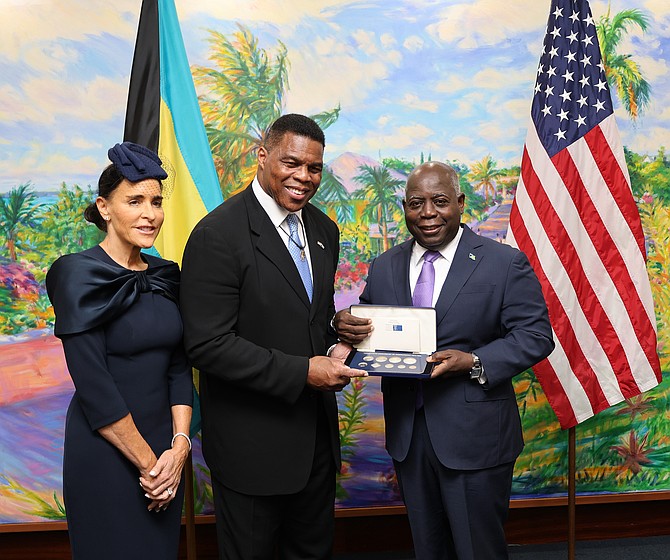
US Ambassador to The Bahamas Herschel Walker and his wife, Mrs. Julie Walker with Prime Minister Philip ‘Brave’ Davis during a courtesy call at the Office of the Prime Minister on December 9, 2025. (BIS Photos/Patrick Hanna)
By KEILE CAMPBELL
Tribune Staff Reporter
kcampbell@tribunemedia.net
US Ambassador Herschel Walker has warned that America “cannot accept the flow of drugs to our shores any longer”, as the diplomatic row over undercover US Drug Enforcement Administration operations in The Bahamas deepened and Attorney General Wayne Munroe raised the possibility that agents operating without Bahamian approval could have broken local drug laws.
Mr Walker urged the Davis administration yesterday to work with the US and again linked the dispute directly to the threat posed by drug trafficking.
“The Bahamian people know I am here to strengthen the relationship between our countries,” Mr Walker said. “I stand ready to work together to do that. I encourage the Bahamian government to work with its greatest ally.”
“We stand ready,” he said, “but we cannot accept the flow of drugs to our shores any longer. As the government of The Bahamas surely knows, drug trafficking is bad for the sovereignty of The Bahamas and the United States.”
Mr Walker had first addressed the issue last week after The Tribune contacted the US Embassy following an interview in which The Bahamas’ ambassador to the United States, Wendall Jones, revealed that officials had lodged a complaint with the US government over DEA operations in The Bahamas.
The unusually pointed exchanges follow revelations from US court filings that a years-long DEA investigation connected to accused drug trafficker Jonathan Eric Gardiner included undercover activity in The Bahamas without the knowledge of local authorities.
Mr Munroe argued yesterday that foreign agents participating in conduct that would ordinarily constitute a drug offence under Bahamian law could expose themselves to prosecution if their activities were not authorised.
“If you come to this country, and you meet with someone to supposedly import cocaine and transport cocaine to the US, that's conspiracy to possess, to import and export cocaine,” Mr Munroe said.
He said the normal practice was for foreign law-enforcement agencies to secure the cooperation of local authorities beforehand, with an understanding that undercover personnel would not be prosecuted for acts undertaken as part of an authorised operation.
Mr Munroe also invoked The Bahamas’ experience during the cocaine-trafficking era of the 1980s and 1990s, arguing that the country could not risk a repeat of the damage caused when large quantities of drugs moved through the archipelago.
“Historically, if you look back at the Iran-Contra affair,” Mr Munroe said, “the Americans admitted, Colonel Oliver Nott admitted, that they purposely used the Bahamas to transship 1000s of kilos of cocaine to the US to fund the Contras who were fighting the Sandinistas in Nicaragua.”
“That is what has happened in the past. We just do not want to see it happening again in our country, because what happens is some of the cocaine that they're moving through our country inevitably stays in our country, and it created a massive problem in this country in the 80s and the 90s with the cocaine epidemic and all that it has spawned. We do not want to see that happening again in the Bahamas.”
Mr Munroe said the government has also repeatedly sought the identity of “Politician-1” from US authorities but has received no answer.
“From the beginning, the foreign minister sent that inquiry to the US embassy,” he said. “It hasn't been forthcoming to date.”
Opposition Leader Michael Pintard yesterday described the dispute as a “dangerous moment” for The Bahamas, saying the FNM supported the defence of Bahamian sovereignty but was concerned about what the public confrontation suggested about relations with the country’s most important law-enforcement partner.
Mr Pintard accused the Davis administration of appearing more preoccupied with the implications of US drug investigations for politically connected people than with the underlying allegations of drug and gun trafficking.
He stressed that he was not declaring anyone guilty, saying those accused would have their cases determined in court.
He said disagreements with the US over the conduct of American agencies should be addressed diplomatically without allowing the wider relationship to deteriorate.




Comments
IslandWarrior 2 hours, 46 minutes ago
An Open Response to U.S. Ambassador Herschel Walker Regarding Bilateral Law Enforcement Operations
Ambassador Walker, your recent statements emphasising the need to strengthen the relationship between the United States and The Bahamas are noted, as is your assertion that the U.S. can no longer accept the flow of drugs to its shores. The Bahamas shares the position that drug trafficking poses a severe threat to national stability. However, a genuine partnership to combat this issue must be rooted in mutual respect for sovereignty and a transparent acknowledgement of the structural realities of the global drug trade.
To address this crisis effectively, the conversation must move beyond treating transit nations as the primary culprits and examine the economic engine driving the industry.
The Economics of Demand and the U.S. Dollar The global drug trafficking industry is not financed by the Bahamian dollar. It is underwritten by the U.S. dollar, driven by overwhelming U.S. domestic demand, and facilitated by international financial networks that often lead back to major global institutions. When a massive consumer market criminalises a highly demanded product, it effectively outsources the violence, corruption, and systemic instability to the nations positioned geographically between the supply and the buyer. The Bahamas bears the immense burden of managing the consequences and cleaning up the social fallout of a trade it neither produces nor consumes at scale.
Sovereignty and the Rule of Law The foundation of any international alliance is respect for the host nation’s legal framework. As Attorney General Wayne Munroe accurately articulated, foreign agents conducting undercover operations to transport narcotics—without the explicit a and coordination of the Bahamian government—are committing criminal acts under Bahamian law. Bypassing local authorities does not strengthen bilateral ties; it signals a disregard for our sovereignty.
The Weight of Historical Precedent The Bahamas cannot view unilateral U.S. operations in a vacuum. The generational damage inflicted on this country during the cocaine epidemic of the 1980s and 1990s remains a stark reality. As history has documented, including the admissions surrounding the Iran-Contra affair, geopolitical strategies employed by U.S. agencies have previously involved the transhipment of narcotics through our archipelago. The collateral damage—drugs remaining in the local market—spawned an epidemic that devastated Bahamian communities. We cannot and will not risk a repetition of that era.
ted4bz 5 minutes ago
The real perpetrators are now using drones of all kinds , not manned vessels.
Everybody knows that.
Sign in to comment
OpenID