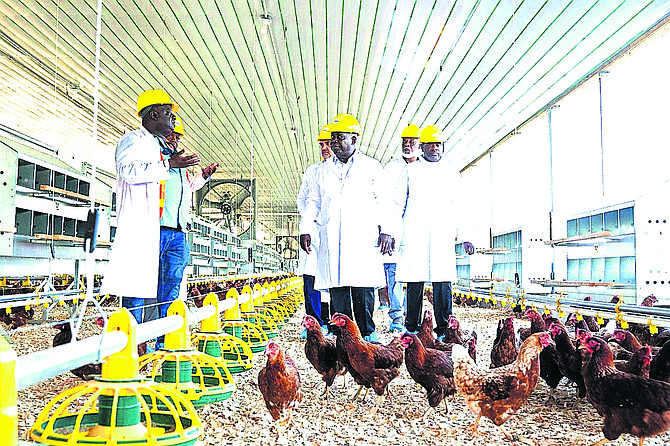
Prime Minister Philip ‘Brave’ Davis visits the Golden Yolk project along with government officials to observe the progress made. Photo: OPM
PRIME Minister Philip Davis said the government's Golden Yolk egg project has produced 200,000 eggs so far, more than three years after it was launched with the aim of ending the country's reliance on imported eggs.
During a visit to the project, Mr Davis said it has 10,000 laying hens in production and about 8,000 pullets, young hens that have not yet begun laying, being raised to add to its output.
"Our focus," Mr Davis said, "is to turn that capacity into a consistent supply of Bahamian-produced eggs, reduce our reliance on imports and create more opportunities for our people."
Golden Yolk eggs first went on sale at Super Value stores in April. At the time, officials said the country spends about $12 million a year on imported eggs and projected that the project would make The Bahamas self-sufficient in eggs within two years.
In 2024, Bahamas Agricultural and Industrial Corporation chairman Leroy Major said the project aimed to eliminate egg imports entirely and to sell fresh eggs for below $4.
In June, The Tribune reported that Golden Yolk eggs were selling for under $5 a dozen, down from a peak of nearly $15, but remained more expensive than imported eggs. Agriculture Minister Jomo Campbell said then that the quality of the local product more than justified the cost.
The Office of the Prime Minister said the project is part of a wider government strategy to replace more imported food with local products, keep more spending within the Bahamian economy, expand opportunities for farmers and reduce the country's exposure to disruptions in overseas supply.




Comments
Dawes 7 hours, 18 minutes ago
How much did it cost to get us to this. also as it costs more then imported why would people buy it unless it is much better? The idea of food security is great but we need to be realistic. It will always be cheaper to import most food items. In fact even most sea food (which we have a lot of) is cheaper to import then catch.
AnObserver 4 hours, 11 minutes ago
Lets do the math here. 200,000 eggs since launching in 2023. Over three and a half years, that is an average of 400 cartons of eggs per month. Eggs are $2/dozen. How many millions of dollars have we thrown at this in order to produce a business that grosses on average $1,000/month?
rosiepi 3 hours, 31 minutes ago
200,000 eggs produced over 3 years? Something is definitely rotten here! 10,000 layers will if adequately housed and properly fed produce over 2 million eggs a year. Half that number to 5000 hens and you’d get at least 1.25 million eggs a year…that’s about 4,000 eggs per day.
One would expect an inspection of this facility, this “government enterprise” would find inadequately trained workers (likely poorly paid), insufficient cramped housing without A/C, without hygienic controls to maintain healthy birds and lastly cheap fodder without the protein needed to stave off infection, let alone a healthy egg production.
So…where is the oversight to ensure the people’s funds aren’t wasted? Who’s minding the farm folks?
AnObserver 3 hours, 23 minutes ago
They can't afford oversight, they spent all their money on hard hats and lab coats.
Sign in to comment
OpenID