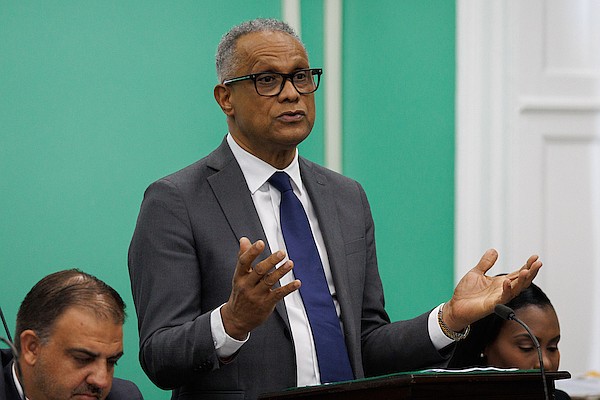
Minister of Health and Wellness Dr Michael Darville speaks in the House of Assembly on July 30, 2025. Photo: Dante Carrer/Tribune Staff
By JADE RUSSELL
Tribune Staff Reporter
jrussell@tribunemedia.net
HEALTH and Wellness Minister Dr Michael Darville yesterday sought to ease fears over incoming elderly-care laws, insisting relatives who genuinely cannot afford to care for an older person, or who are estranged from them, will not be criminalised.
"What it seeks to address is something very different: wilful neglect," Dr Darville said in Parliament yesterday as debate began on the bill. "That's what we are seeing as the poison in our society, wilful neglect and abandonment."
The Older Persons Rights, Protection, Care and Support Bill would place a general duty on next of kin to help an older person achieve an appropriate standard of living. That includes ensuring an older person in their care has a safe living environment, adequate food and water, clothing and other essentials.
Dr Darville said he had heard public concerns about how the duty would apply. Those concerns included cases where an elderly parent’s child lives abroad, where a relative lives on a Family Island while the parent receives care in New Providence, and where relationships have been broken for years. They also included relatives who are themselves elderly or disabled, or who lack the means to provide the care required.
“This bill does not criminalise poverty,” he said. “It does not criminalise geography. It does not criminalise estrangement or individuals who have lost contact with their loved ones. It does not criminalise genuine inability to provide care.”
Dr Darville said Princess Margaret Hospital has several elderly patients who have become boarders because family members refused to collect them.
“It has become so bad at our public healthcare institutions that people are bringing elderly people and admitting them into the hospital with fictitious names,” he said.
He said the problem places a financial burden on public healthcare. For years, PMH and Rand Memorial Hospital have been strained by relatives abandoning elderly patients brought in for treatment.
The bill defines next of kin as the nearest living relative by blood who is expected to assume responsibility for an older person’s care, support or decision-making when that person cannot do so.
One key provision covers elderly patients discharged from public hospitals. Where a next of kin previously provided care and took the older person to hospital, that relative would have to arrange to collect them from the ward once notified of their discharge. If the hospital transports the person home, the relative would have to receive them.
Those obligations form part of a broader regime for caregivers. Under the bill, every caregiver would have a moral and legal responsibility to provide reasonable care, act in the older person’s best interests, avoid abuse and neglect, administer prescribed medication or treatment properly and operate only within the authority legally given to them.
Minister of State for Social Services Bacchus Rolle, who led the debate, cited cases in which older adults were neglected by their families, financially exploited for their pensions or taken advantage of by strangers.
He said the bill would tackle financial abuse through a specific elder-exploitation offence, carrying a fine of up to $50,000, up to five years in prison, or both.
Mr Rolle said the bill is necessary but is not the sole answer. Laws can punish abusers and ensure accountability, he said, but only a cultural transformation can truly protect the country’s elderly. He called on the public to return to Christian values of honouring their elders.
Officials said the bill underwent public consultation, attracting more than 800 visits to the Bahamas Law Online website. Stakeholders included law firms, other professionals, faith-based communities, advocates and families.
However, Free National Movement MP Michela Barnett-Ellis said the bill contained no amendments despite the consultation.
Mrs Barnett-Ellis described the bill as ambitious but said a proper framework is needed to enforce it. Strong legislation too often stays on the books without being fully implemented, she said, because the mechanisms to give effect to its rights and protections are not in place. She cited the Ombudsman Act, the Independent Commission of Investigations Act and the Protected Disclosures Act as examples.
She also said the high cost of living has made elderly people increasingly vulnerable.




Comments
bahamianson 9 hours, 32 minutes ago
Add an additional long term care facility to the plans for the new hospital. We need a long term care facility that is totally free to the aging public. We need a hospice care facility that is totally free to the aging population.
Sign in to comment
OpenID