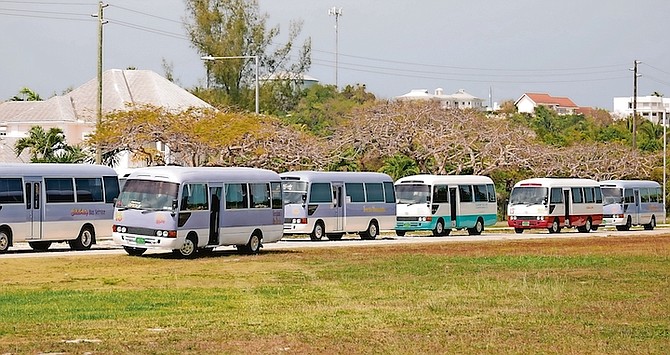
Jitneys near Super Value in Winton.
By ANNELIA NIXON
TRIBUNE Business Reporter
anixon@tribunemedia.net
JITNEY drivers and owners are threatening to shut down New Providence services unless the Government urgently addresses soaring diesel prices and approves a 33 percent increase in adult fares to at least $2.
The Bahamas Unified Bus Drivers Union (BUDU), together with the United Public Transportation Company’s (UPTC) president, Harrison Moxey, said drivers across routes one to 21A are on alert for formal instructions to suspend services, warning that rising fuel prices and operating costs have made it increasingly difficult to maintain a viable business and remain on the road.
Corvell Colebrooke, the BUDU’s general secretary, said the possibility of withdrawing services has not been taken lightly, but drivers can no longer sustain the cost of transporting commuters.
“The general consensus is this: Alongside with Mr Harrison Moxey of the Drivers Association, the drivers have officially asked that we ask him, and my president has agreed, Mr Moxey has agreed, for removal of service of the bus transportation,” Mr Colebrooke said.
“At this point in time, all routes from number one straight to route 21A - that’s the last and biggest route - all drivers are on the alert for the written orders that will be coming from president Rudolf Taylor and president Harrison Moxey.”
Mr Moxey said that with diesel costs at $8.25 per gallon, and further increases expected at some fuel stations as of yesterday, the jitney industry has been facing compounding financial pressures since the COVID-19 pandemic.
“We are at a very, very grave loss, and so we are taking this first step publicly to advocate to the Government that we need a bus fare increase, that we need an intervention for relief in our industry, before it totally collapses,” he said.
Mr Moxey said the UPTC has written to the Ministry of Finance outlining its proposed fare increase, with adult fares rising to no less than $2. He said the Association was prepared to leave existing fares for senior citizens and children unchanged.
The operators are also calling for government intervention to reduce the burden of VAT on fuel and other expenses, arguing that the current fare structure no longer reflects the cost of running a public transportation business.
Mr Moxey said operators have received exemptions on bus purchases but continue to face higher insurance premiums, maintenance costs and other expenses associated with keeping their vehicles roadworthy.
He said third-party insurance now costs more than $2,000, while bus tyres are approaching $200 each. The cost of regular servicing and maintenance had increased by more than 200 percent, he added. “The cost of the busses go up about $1,000 every year,” Mr Moxey said.
He added that the rising expenses were squeezing already narrow profit margins, leaving operators struggling to cover costs while maintaining services for commuters.
Mr Moxey said he had reduced the daily quota required from drivers, sacrificing about $200 per bus each month to help them take home more money to support their families.
“As an owner, you’re looking at the situation. You’re hearing the cries of the driver, but the problem is nobody is hearing the cries of us who have to operate and bear the expenses of the industry,” he said.
Mr Moxey warned that the industry cannot continue operating under current conditions, particularly as buses consume fuel throughout the day to transport passengers and keep air conditioning systems running.
He said the unions wanted to meet with the Government by Friday to discuss a way forward, appealing directly to Leon Lundy, minister of transport, Michael Halkitis, the minister of finance, and Prime Minister Philip Davis KC to treat the matter as urgent.
“People need to get to work, but we also need to survive,” Mr Moxey said.
Mr Colebrooke argued that the Government should consider removing VAT from fuel or reducing the price to bring costs down to between $5 and $6 per gallon. He said drivers are paying between $135 and $150 daily for fuel, with a significant portion of the cost attributable to government taxes.
“Government subsidises Bahamasair, BEC, the mail boats with fuel, with diesel, with jet fuel,” Mr Colebrooke said. “But how do you expect us to continue paying $135 to $150 per day?”
He added that jitney operators are not asking for handouts but need a sustainable operating environment, pointing out that public transportation was essential to Bahamians who cannot afford private vehicles.
Mr Colebrooke also criticised the Government for what he described as a lack of engagement with bus drivers since the May 12 general election, saying operators have yet to receive a meaningful response to their concerns.
“The industry cannot survive,” he said. “These prices too high. The price of oil is too high. The price of parts is too high.”
Reno Brown, a jitney driver, said he was prepared to participate in the proposed withdrawal of services, responding “I ready now” when asked whether he intended to join the action.
Kyle Albury said drivers are spending a substantial portion of their daily earnings on fuel and the amounts they are required to pay bus owners.
“If you got to spend $200 to put in diesel, along with the $150, which you got to make for the boss, that’s $300,” Mr Albury said. “That’s basically what all you making all day.”
Sanchez Dawkins said he recently helped another driver whose bus had broken down and ran out of fuel, adding that some operators could afford to put only $15 worth of diesel into their vehicles to complete a lap or two.
“I feel like at least we need an increase in the bus fare,” Mr Dawkins said, adding that he supported the unions’ decision to potentially withdraw services.
He warned that a widespread shutdown could disrupt school attendance, medical appointments and workers’ ability to reach their jobs.
“If you’re going to take the bus, please pay your bus fee,” Mr Dawkins said. “Please pay your bus fee in full. Correct bus fee. Come with your correct change.”
Mr Colebrooke said the unions have remained divided for too long, but are now united with franchise owners in seeking relief from the Government.
“That was long overdue,” he said. “We have been fractured for too long a time. We are unified as one. If the Government thinking that they're going to go play one side to the next, think again. Think again.”
Mr Moxey said the latest fuel increases have intensified a crisis that pre-dated the current spike, insisting that a temporary decline in diesel costs would not resolve the industry’s broader financial problems.
“We have been to this crossroad from 2020 with COVID with no relief,” he said. “Twenty-five cents does not cut it.”
Mr Moxey added that public transportation should be treated as an essential industry in government policy, warning that the failure of small operators will ultimately hurt the wider economy and the commuters who depend on them.
“This is the straw that could break the camel’s back right here,” Mr Moxey said.




Comments
AnObserver 7 hours, 27 minutes ago
So the busses are owned my private individuals. They pay for their own gas. They run their own businesses. Why does the government have any say in what the charge?
pt_90 5 hours, 29 minutes ago
They call them franchises for a reason. Think of a Wendy's frachise, they are private independent businesses but operate as licnesees of another so they follow the rules of that licnesee. Another way to look at it a private school has a set of rules under the MOE, the same way private businesses have wage and vacation rules, the govt owns the roads and can.regulate how those roads are run. In fact they are given an oligopoly and has state protection against barrier to entry. In exchange there are a set of parameters that they know of.
But simply put They are granted a license to operate on the roads under a certain set of circumstances. In exchange they have a set of rules. The jitney service is already chaotic and backwards imagine a bus showing up and you not having any idea what the guy will charge.
moncurcool 3 hours, 29 minutes ago
Does the government set the tuition of private schools?
bahamianson 6 hours, 50 minutes ago
Go on strike, shut the place down. We are tired of your threats. The government tries to control everything. It wants to control rent, bus fares, grocery prices, everything. We might as well become a socialist state. What it needs to do is control the spending of the population, so they can have money for their priorities. Why buy hair, nails , lashes , get eyebrows done, make up , shoes and an outfit, when you do not have a stove or fridge in your $1000 per month apartment? Priorities need to be taught to grown adults. Yet, they say they do not have money for a stove or fridge while spending over $1000 for one birthday night!
pt_90 5 hours, 30 minutes ago
.
ted4bz 5 hours, 14 minutes ago
He’s not lying. Those busses have an average of 29 seats. even if they go at full capacity each hour, it’s not paying off. Someone’s getting cut pretty deep, and it’s most certainly not the government and the gas dealers
Proguing 3 hours, 17 minutes ago
Why don't we ever hear them calling for a reduction in fares when the price of gas goes down?
Sign in to comment
OpenID