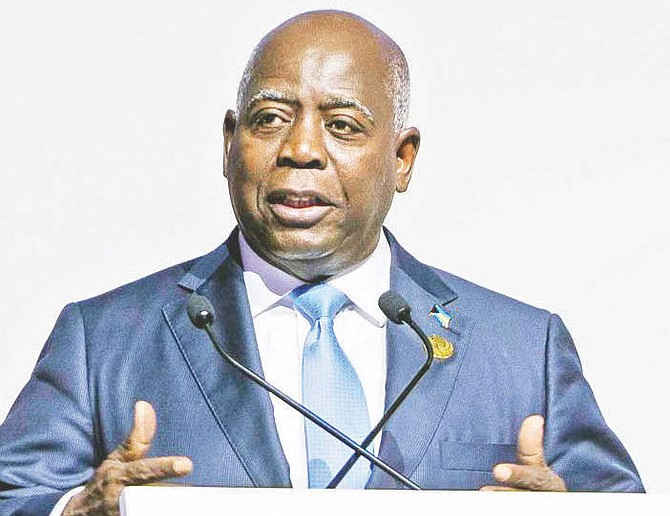
PRIME Minister Philip ‘Brave’ Davis speaks at COP31 in An- talya, Türkiye yesterday. Photo: Marvin Thompson/OPM
By RASHAD ROLLE
Tribune News Editor
rrolle@tribunemedia.net
PRIME Minister Philip Davis told world leaders at COP31 yesterday that “no-one is coming to save us” and that the global fight against climate change keeps stalling because the leaders who make pledges lose elections, see their coalitions collapse or have their budgets cut, and the governments that replace them arrive “with new priorities and amnesia”.
Delivering The Bahamas’ national statement to the United Nations’ annual climate conference in Antalya, Türkiye, Mr Davis said the world had misdiagnosed the problem. It was never a shortage of political will, he said, because every COP produces willing leaders who stand at the podium, make the pledge and mean it.
Instead, he said, the world has been “building a global response to an existential crisis based on individuals’ goodwill”.
“Individuals come and go,” he said. “That is the flaw at the heart of everything we have done.”
He said implementation is frustrated because today’s leaders inherit promises made by people who no longer hold power. His remedy was what he called permanence. Climate finance should flow automatically rather than be pledged. Commitments should be enshrined in treaty and law rather than in declarations and communiqués. The special circumstances of small island developing states should be embedded as “a structural fact, not just a category that has to be re-argued every decade”.
Mr Davis said each year is hotter than the last, emissions are still rising and hurricanes are more frequent and more ferocious. Low-lying states, he said, still have not received the support needed to stop them from one day disappearing beneath the waves. Countries like The Bahamas remain trapped in cycles of destruction and rebuilding because finance promised in one cycle does not arrive within it.
He said his opening line was a call to action, not a cry of despair.
Mr Davis was re-elected in May as the first Bahamian prime minister since 1997 to win back-to-back terms. He has sounded the same alarm at every UN climate conference since he took office in 2021. Antalya was his sixth, though he addressed last year’s COP30 in Brazil by pre-recorded message.
In Glasgow in November 2021, about ten weeks into his first term, he told leaders at COP26 that “we are out of time” and that “promises and agreements are easy; action requires courage”.
A year later at COP27 in Sharm el-Sheikh, Egypt, he made almost the same complaint he made this week. “Statements without binding commitments or enforcement mechanisms have been used again and again as a way to postpone real action,” he said. He warned that the alternative to action “consigns us to a watery grave”. He also said The Bahamas had not waited for the world to act, a forerunner of this week’s insistence that small states must save themselves.
At COP28 in Dubai in December 2023, he said “time is a luxury we do not have”. He asked how long vulnerable countries must wait for the new loss and damage fund to be capitalised and opened to them.
“Friends: we simply want to live,” he told that summit.
At COP29 in Baku, Azerbaijan, in 2024, he warned that the world was “dangerously close to a line beyond which there is no return”. He challenged leaders to bring the same zeal and money to climate change that they bring to wars and pandemics.
In his message to COP30, he said nations like The Bahamas were “bearing the weight of a crisis we did not cause”.
The seagrass pitch at the centre of this year’s speech is not new either. Mr Davis unveiled a blue carbon credit initiative at COP27, and at COP28 he told delegates that Bahamian seagrasses absorb more carbon than the Amazon rainforest.
In Antalya, he said the largest seagrass meadows on Earth lie beneath Bahamian waters. The Office of the Prime Minister puts their size at 53,657 square kilometres. He said the meadows draw carbon from the atmosphere every day, shelter the fisheries that feed Bahamian families and soften waves before they reach the shore.
“We in The Bahamas have learned lessons from our grandparents,” he said. “You take care of what takes care of you.”
The government has committed $25 million to the Bahamas Blue Carbon Programme. Mr Davis said significant investment had already gone into its scientific, legal and fiscal frameworks. He said The Bahamas now needs international partners “who will stay the course, whose commitment is not dictated by donor cycles or ideological trends”.
He said no country, large or small, can meet the crisis alone, and that self-determination should not mean each nation for itself.
“For a generation, the world has looked at Small Island States and regarded us as the first to follow,” Mr Davis said. “Look again. With our Blue Carbon Programme, we will be the first to lead.”




Comments
Dawes 4 hours, 35 minutes ago
Maybe if we as ran this country like there was a major climate change issue happening people would listen to us. However everywhere you go land is being bulldozed and cleared for the almighty dollar. Athol Island is now gone. Why would anyone give money to a country for climate change if said country isn't doing anything to mitigate their contribution except to say it is so small we can't do anything.
Sign in to comment
OpenID