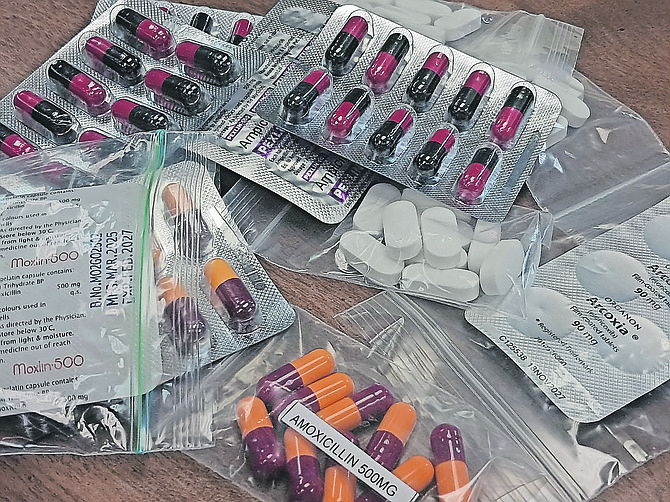
Unregulated prescription-only drugs purchased by Tribune investigators at pharmacies in The Bahamas without a prescription.
By ED FIELDS
IN THE Bahamas, as in many other countries, particularly those with large migrant populations, the unbanked, and high poverty rates, parallel economies thrive. They also flourish where there is demand for products that the well to do crave, such as painkillers, sedatives and weight loss drugs. These economies or markets flourish not only because they are tolerated, but because gaps in regulation, enforcement, and oversight make them profitable. And, sadly, it gives overlooked access. We often refer to this as the grey market, but really there is nothing grey about it.
Through our investigative efforts over the past several months, we have discovered that prescription medicines are being imported into The Bahamas via various channels, distributed and sold to customers/patients without prescriptions or knowledge of the customer’s physical or mental health. The individuals involved understand the risks yet continue to exploit weaknesses in the system for financial gain. The sale and purchase of pharmaceutical drugs that do not adhere to appropriate protocols in The Bahamas appears to be an unfair exchange. The pharmaceutical retailer has the supply of drugs, and the customer thinks they need the drug, so it a simple ‘cash and carry’ business. For some of those merchants, no identification is needed, no health background is required, and no prescription from a doctor is requested.
Such is the grey/black market of pharmaceutical distribution in The Bahamas. Common prescription medications like antibiotics, pain relievers, abortion pills, and even cosmetic products like skin bleaching creams are pouring into the country through official ports of entry despite the best efforts of Bahamas Customs. While some arrive in shipping containers, many more are brought in incrementally by travellers, making detection and control far more difficult. They are hidden in a myriad of ways including disguising them in products such as spices and other benign packaging.
Of particular concern is that many of these products (knock offs) appear to originate from unverified manufacturers in countries such as India, Pakistan, Mexico, and China rather than from the vast credible or internationally recognisable Pharma notables. Exacerbating the problem, practitioners and non-practitioners (aka bush doctors) alike are selling prescription medication to people in usually congested urban areas of the island, without a prescription, proper packaging, labelling, dosage instructions, or medical oversight to the possible detriment of the persons ingesting these drugs.
Our investigations revealed some very troubling facts about this not so invisible and apparent vibrant economy. The concerned and honourable medical and pharmaceutical fraternity, while acutely aware of these situations, feel that there is nothing much they can do to stem the wave of “prescription” drugs being dispensed over the counter (OTC) without strong and enforceable regulatory reform.
More troubling is the common belief or possibility that the body responsible for policing these pharmacies may be compromised due to internal conflicts of interest. It is alleged that there is at least one person involved in the oversight over these pharmacies which, are being run by Bahamian and non-Bahamian nationals alike, is connected to the very same entities which fall under their inspectorate.
Our investigations further revealed evidence of inconsistent pricing, inadequate labelling and errors in dosages dispensed. In one case, a patient visiting a pharmacy after attending a clinic was provided with the wrong dosage of medication, no instructions or labelling and a receipt that incorrectly named the drug altogether.
Perhaps most troubling is the normalisation of prescription medicines being sold without prescriptions. A sting conducted by the Tribune on August 8 of 2025 exposed how widespread this practice occurs. In the space of 90 minutes, a Tribune undercover operative was able to walk into three pharmacies located in New Providence and come out with powerful antibiotics, without even presenting a prescription. It could not be confirmed at the time whether the individual dispensing these medications at any of the three pharmacies were licensed pharmacists, which highlights yet another regulatory gap. The operative simply walked in and said that they had an ailment and asked for the antibiotics they wanted. In two of the locations, they received the antibiotics and pain killers to use along with the requested antibiotics. At one location, another customer even recommended that they ask for another drug. That person then ordered what they wanted and demanded the price they expected to pay.
In order to re-confirm our findings, three additional prescription drug “shopping sprees” were conducted on Thursday, January 22, Friday January 23, and as recent as Monday, January 26, 2026, where a total of ten (10) pharmacies were visited. Two of the establishments had been visited on August 8, 2025. In eight (8) of the total of thirteen (13) encounters we made, the drugs we asked for were obtained without issue. In one instance we asked for drugs for a “friend’ who was experiencing pain from endometriosis. In another instance a stronger drug than what we asked for was recommended and dispensed. Four (4) pharmacies refused out right to dispense wat we requested, and one dispensed a weaker over the counter version of what we asked for. See Prescription Shopping Spree
Dr. Gina Archer, Chief Pharmacist at the Ministry of Health and Wellness, says the situation is rooted in outdated and incomplete legislation. “The Bahamas currently does not have a national drug registration system,” Dr. Archer explained. “This limits what regulators can lawfully do when medicines are imported from unauthorised sources, brought in beyond what could reasonably be considered personal use, or sold as prescription only medicines without prescriptions.
“While there are legacy laws such as the Penicillin Act that regulate specific classes of medicines, the penalties are minimal and do not function as an effective deterrent in today’s market.”
According to Dr. Archer there is a solution on the way. The Medical Products Bill which is nearing completion is intended to modernise the system by establishing clear legal authority over which medicines may enter the country, who may import and distribute them, and how violations are investigated and penalised.
Dr. Marvin Smith, President of the Bahamas Pharmaceutical Association (BPA) has a much different view with respect to the legislation. His approach is that the legislation should focus on the manufacturers not on patent holders, so as to ensure generic medications are included.
“We have submitted to successive governments our view on this, and we could get what we need from manufacturers to move this process along tomorrow”, said Dr. Smith who was a former Deputy Chair of the Bahamas Pharmacy Council. Clearing manufacturers is a far simpler process than clearing products, as the manufacturers already indicate what should be a prescription versus over-the-counter product. He is of the opinion that by excluding generic drugs, prescription prices could increase significantly.
Smith acknowledges that there is a problem, which, in his view, is greatly hinged on the fact that only a handful of drugs are illegal to dispense under the existing laws. He is clear, however, that the BPA instructs its members to operate on the basis of best practices and that they would not defend those that are in breach of those best practices.
Dr. Smith also emphasised that in addition to the laws required, resources with respect to enforcement must be made available, including the hiring of independent inspectors. Currently the inspectors are part-time and are made up of pharmacists under the employment of pharmacies.
Prior to his budget presentation in July 2025, I met with the Honourable Dr. Michael Darville, Minister of Health and Wellness, and he was quite candid about the situation. “Ed, we have been plagued with this situation for decades and the only way that we can begin to address the situation is through legislative reform,” he said, acknowledging that laws on the books are inadequate. The Minister made reference to the soon to be tabled Medical Products Bill which will act as a more comprehensive set of laws, rules and regulations as it relates to the importation and distribution of prescription drugs.
Minister Darville especially expressed his alarm with respect to how antibiotics are distributed citing cause for concern as it relates to antimicrobial resistance (AMR). AMR is a major global concern due to its ability to make infections harder to treat which lends to increased risk of disease spread, severe illness, disability and death. Hence the rise of superbugs that can develop and not be responsive to a whole range of antibiotics or anti-viral medications.
Another issue highlighted by Dr. Darville is that drugs are entering into the country through sources that are not verified raising questions as to their efficacy and safety. Counterfeit medications have become a significant global health problem with antibiotics being the largest distributed. Various international watchdogs place the counterfeit drug market at nearly $100 billion. What is daunting with these counterfeit products is that either they contain too much of the active ingredients which can be toxic or even fatal for the individual, not enough active ingredient thereby contributing to drug resistance or none of the active ingredients at all contained in them, which of course is of no benefit to the patient. Hence the underlying ailment remains untreated.
A representative from a large pharmaceutical distributorship stressed the importance of tracking the importation of drugs from the manufacturer to the point of sale. “We have to track every step, including verifying temperatures on arrival, before the drugs can be give a release for sale”
The Bahamas Pharmacy Council is charged with the responsibility for the regulation of pharmacists, pharmacy interns, pharmacy technicians, pharmacies, manufacturers and distributors throughout the Archipelago. While this does not speak to the integrity of its members, there is an innate flaw in that the members are comprised mostly of practicing pharmacists. In a sense it is a self-policing body, like the Medical Association of the Bahamas or the Bahamas Bar Association. In a society as small as The Bahamas, there is often inherent or “incestuous” conflict of interest. The entanglements of relationships, whether familial, social or professional, are unavoidable.
I met with members of the Board of the Bahamas Pharmacy Council, chaired by Robert Sands (not the hotelier) and they recognise the issues and that they have been prevalent for almost a generation. It is obvious that while the Council’s existence fills a statutory requirement, the resources available to it do not allow it to function as a watchdog or enforcement body.
Meanwhile, in the absence of stronger laws, the Customs Department uses the resources it has at its disposal to combat the inflow of prescription drugs entering the country without proper authorisation. This largely relates to persons attempting to bringing in medications which are not labelled in English in amounts that go far beyond what can be considered for personal use.
Ralph Munroe, Comptroller of Customs, also points to the fact that when large quantities of medications or any products are imported to The Bahamas, the importer must present proper documentation showing business license, and tax compliance. In the case of medication, the importer must also show evidence that they are an authorised importer of these products. It should be noted that while all “registered” pharmacies are licensed to dispense medications, only a handful of companies are authorised to import these products.
The Tribune has obtained photographic evidence of these products entering the Bahamas in what appears to be large volumes through our airport(s) and seaport(s). If the prevalence of these products in the pharmacies and “on the streets” throughout country is any evidence of the size of the problem, then we have to seriously question if this decades long problem is solvable under any circumstances where the profits outweigh public health and safety.
As of publication of this article, the Medical Products Bill has not yet been tabled or circulated. Until comprehensive legislation is enacted, this quieter drug war will continue. One fought not in alleyways, and crack houses, but in medicine cabinets, clinics and pharmacies and in homes across the country.




Comments
hrysippus 6 hours, 39 minutes ago
The writer says; "The concerned and honourable medical and pharmaceutical fraternity,". It should also be noted that this fraternity is extremely lucrative, those involved are very much invested in protecting their exclusive franchise. This is the basis I suspect of their opposition to anyone else but themselves having control of dispensing medical marijuana.
Sickened 6 hours, 26 minutes ago
Investigative journalism here... in The Bahamas?!?!?!? Wow! This is excellent.
whatsup 6 hours, 13 minutes ago
Should have named Pharmacies and Pharmacists so they can lose their licenses
rosiepi 2 hours, 7 minutes ago
So Ralph Munroe Comptroller of Bahamas Customs told bald faced lies to this newspaper, given this paper possesses evidence to the contrary, ie. that all drug imports are documented etc etc. Heck anybody who’s shipped here knows that, I found out when my son totally our new truck and none of the airbags deployed- they’d been stolen. The same story with the vehicle I next imported!
And this newspaper has no business including in this article warning us of this fraud and corruption that, “the grey/black market of pharmaceutical distribution…some in shipping containers…are pouring into official ports of entry despite the best efforts of Bahamas Customs” The only “best efforts” is the business of corruption, thievery, kickbacks and worse for only way anything illegal passes through the Bahamas official ports of entry is because Bahamas Customs is so compromised.
And what has any of this to do with migrants? Don’t play that old game. The Bahamian people own these crimes, this corruption. If one wants real reform how is it that Christie’s old gang of thieves were re-elected to do their worst? People vote for who will give them money and favours or those who are easily bought.
Sign in to comment
OpenID