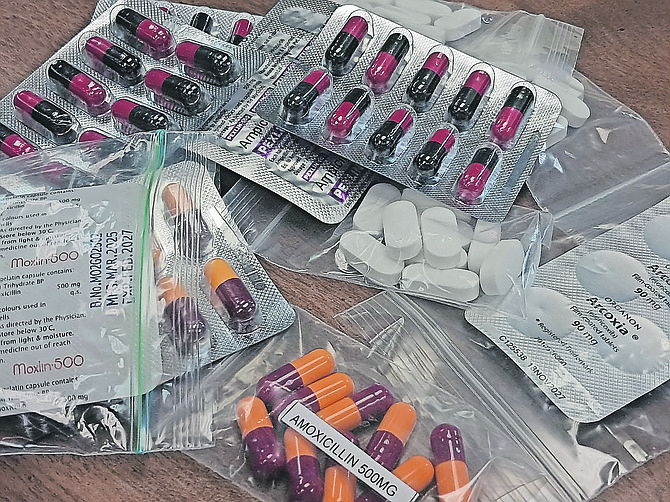
Unregulated prescription-only drugs purchased by Tribune investigators at pharmacies in The Bahamas without a prescription.
THE government has committed to long-promised legislative reform to clamp down on the illegal sale of prescription medicines after a Tribune investigation exposed how easily powerful drugs are being sold over the counter without prescriptions.
In a statement, the Ministry of Health and Wellness condemned the practice as “unlawful” and “unsafe”, which posed a “serious risk to public health”.
“The Ministry wishes to be clear; prescription medicines are regulated for specific purposes and are guided and guarded by regulated protocols,” the statement said.
“When medicines such as antibiotics, strong pain relievers, and other controlled products are dispensed without appropriate medical oversight, patients are placed at risk of adverse drug reactions, incorrect dosing, treatment failure, antimicrobial resistance, and exposure to potentially substandard or counterfeit products.”
The statement added that legislative changes are being advanced to modernise outdated and fragmented pharmaceutical laws that regulators say have left serious gaps in oversight and enforcement. The Ministry said it is working with the Bahamas Pharmacy Council and other agencies to ensure reports of illegal dispensing are investigated and addressed, and urged members of the public to report suspected breaches.
“The Ministry of Health & Wellness remains fully committed to protecting the health and safety of the Bahamian public,” said the statement.
The ministry’s acknowledgement of the problem follows this newspaper’s undercover investigation, which found prescription-only drugs could be purchased at multiple pharmacies in New Providence without presenting a prescription.
Senior figures in the pharmaceutical community did not dispute those findings, but said the situation reflects deeper structural failures that only strong laws, proper inspection and meaningful enforcement can fix.
Former chairman of the Bahamas Pharmaceutical Council and former president of the Bahamas Pharmaceutical Association Phillip Gray said yesterday: “Wherever there is the authentic, there is always the counterfeit or what goes against the standard, so we shouldn’t be surprised. As in every other profession, the untoward might happen, so we should put proper measures to minimise the activity.”
Mr Gray acknowledged that pharmacists have a duty to properly advise customers and admitted some are failing in that duty. He also pointed to the absence of pharmacovigilance — the practice of monitoring the effects of medical drugs after they have been licensed for use — in The Bahamas, noting the country is one of only three in the region without it.
“What we need is a proper inspectorate, along with all that is required, so that those who are in breach of the appropriate practices are dealt with,” Mr Gray said, adding that members of the public are also complicit when they seek out those willing to ignore proper protocols.
Bahamas Pharmaceutical Association president Dr Marvin Smith made a similar call for independent inspectors, updated legislation and firm sanctions backed by enforcement.
“We are not going to bury our heads in the sand,” Dr Smith said. “We should look at this as an opportunity to address some very real issues in a manner that places the industry and its practitioners in high esteem and educates patients on what the expectations are. This is an opportunity for those that are not operating to standard to clean up their act rather than to try to put up a defence when and where breaches are pointed out.”
Dr Smith also suggested that a portion of taxes collected on the importation and sale of medications be dedicated to funding a modern inspectorate.
The Tribune’s investigation showed that prescription medicines are entering the country through formal ports and informal channels, often from unverified overseas manufacturers, and being sold without prescriptions, proper labelling, dosage instructions or medical oversight.
An undercover operative on August 8, 2025, obtained antibiotics without a prescription at three pharmacies in under 90 minutes. Follow-up visits between January 22 and January 26 this year found drugs obtained without issue in eight of 13 encounters across ten pharmacies.
Chief Pharmacist at the Ministry of Health and Wellness, Dr Gina Archer, previously said outdated legislation severely limits regulators’ ability to act.
“The Bahamas currently does not have a national drug registration system,” Dr Archer said. “This limits what regulators can lawfully do when medicines are imported from unauthorised sources, brought in beyond what could reasonably be considered personal use, or sold as prescription-only medicines without prescriptions.
“While there are legacy laws such as the Penicillin Act that regulate specific classes of medicines, the penalties are minimal and do not function as an effective deterrent in today’s market.”




Comments
OMG 3 weeks, 1 day ago
Maybe investigate the nurse in eleuthera selling government medicine.
Sign in to comment
OpenID