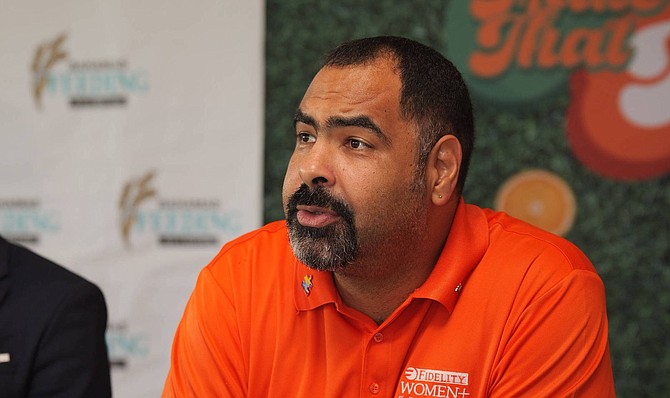
Gowon Bowe
By NEIL HARTNELL
Tribune Business Editor
nhartnell@tribunemedia.net
Bahamian bankers yesterday asserted that the 27 percentage point decline in private sector credit, as a proportion of national GDP, over the past 15 years is “no cause for panic” or “solely a sign of weakness” but demands a renewed focus on economic fundamentals.
Gowon Bowe, Fidelity Bank (Bahamas) chief executive, told Tribune Business that reigniting sustainable lending to households, businesses and consumers requires expanding the number of qualifed borrowers by further lowering unemployment and reviving “discipline” among Bahamians when it comes to savings and their personal finances.
Noting that many existing borrowers are “treading water”, and unable to access further credit because they are effectively maxed out and at their regulatory-permitted limits, he recalled that - while most Bahamian parents and grand-parents obtained their first loan to purchase a home - today’s generation are more likely to do so to acquire vehicles, consumer goods and go on holiday.
Mr Bowe’s call for a cultural, or mindshift, change when it comes to Bahamian saving and borrowing habits came after the International Monetary Fund (IMF), in its just-released Article IV consultation with The Bahamas, disclosed that this nation’s private sector credit - as a percentage of gross domestic product (GDP) or economic output - is at its lowest level in two decades.
The Washington D.C-based Fund, while acknowledging that growth was in the initial stages of revival, and The Bahamas was faring better than other Caribbean states, added that the 39 percent credit-to-GDP ratio hit at year-end 2024 was some five percentage points below pre-COVID levels in 2019 and 27 percentage points below the “peak” 66 percent mark achieved just before the 2009 global recession took hold.
“Growth in private sector credit was generally weak in The Bahamas following the global financial crisis and immediately after the pandemic,” the IMF said. “After strong growth leading up to 2008, driven by expansions in lending for residential mortgages and to consumers and businesses, private credit from banks peaked as a share of GDP in 2009, and in nominal terms in 2011.
“Credit growth declined sharply thereafter - more so than the Caribbean average - coinciding with factors such as periods of weaker economic activity, elevated non-performing loans and challenges associated with a domestic bank (Bank of The Bahamas). This credit slowdown was broad-based across all major segments and contributed to a substantial rise in domestic banks’ excess liquidity in the post-global financial crisis period.”
Acknowledging that some post-COVID recovery has taken place, the Fund added: “Private sector credit has rebounded since 2022 following a remarkable rebound in real GDP following Hurricane Dorian in 2019 and the COVID-19 pandemic. Strong lending to firms in transportation, distribution, professional services and tourism has underpinned rapid growth in business loans.
“A more modest growth in personal lending is also driving the credit recovery. During this period, domestic banks’ loan approval rates - particularly in mortgages - have recovered to pre-pandemic levels.
“However, the number of applications for mortgages, consumer loans and commercial credit, while higher than its 2020 trough, remained below pre-pandemic levels by 2024. Still, despite robust growth, private sector credit was at 39 percent of GDP by end-2024, five percentage points below 2019 levels and 27 percentage points below the 2009 peak.”
However, Tangela Albury, Commonwealth Bank’s chief financial officer, told Tribune Business that the 27 percentage point decline should not only be viewed as a weakness for the Bahamian economy. She argued that it is also a partial reflection of the rebound in Bahamian GDP and economic growth post-COVID, which means that credit is now being measured against greater output.
And Ms Albury also pointed out that Central Bank and regulatory policy is “supportive of a stronger lending environment” via measures such as the introduction of The Bahamas’ first-ever credit bureau and relaxed debt servicing requirements that borrowers must meet. The Commowealth Bank financial chief, though, agreed with Mr Bowe that the key to sustainable credit growth lies in expanding the pool of qualified borrowers.
The Fidelity Bank (Bahamas) chief told Tribune Business: “When you think about the way an economy generally works, it is the private sector and the consumer spending that stimulates all activities, and so from that perspective when we see a contraction in the actual spending and eligibility to qualify for credit that raises a concern.
“It’s not one that should create a panic; it’s one where we should start looking at the fundamentals that led to that contraction.” The roots, Mr Bowe said, lie in the aftermath of the 2008 financial crisis and subsequent 2008-2009 recession when unemployment surged, bank non-performing loans increased, economic growth emerging from the downturn was more “lethargic” than other nations and consumer loans were not going to business investment.
“From that perspective, when we see a contraction from a financial shock, the rebound is a much more protracted exercise because ultimately we know we’re having to correct the root causes that led to it,” he added. The Bahamas’ recovery from the events of 2008-2009 was previously branded “painfully slow” by the IMF, and Mr Bowe said this nation has not seen a “major economic stimulus” since Baha Mar’s construction and opening almost eight years ago.
Noting that today’s employed labour force numbers are lower, in raw terns, than those from 2019 before Hurricane Dorian and COVID-19, he added: “When you look at the credit growth, if we don’t have employment expanding so that new credit is coming on stream, we look at existing credit.” Many persons, he added, are “borrowing to make ends meet” and, as such, are “treading water” and not suitable candidates for new credit.
“We have to look at financial literacy among the young persons to discipline them, and their initial spending coming out of high school and college,” Mr Bowe told Tribune Business, “so that it is not to over-spend on a vehicle, spend on Christmas presents, a holiday or luxury goods. They need to use a credit card and make the payments, so that it becomes like a draw card and they build financial discipline and a payment history.
“They need to show they have accumulated savings so that they can put a down payment on a property. The first thing our parents or grandparents tried to buy was a house or land. The first major expense today is a vehicle which depreciates in value as soon as they drive off the lot.”
The IMF, though, agreed that the Bahamian credit environment is improving with non-performing loans, representing borrowings that are more than 90 days’ past due and on which banks have stopped accruing interest, now at their lowest levels for 17-18 years since the 2008-2009 recession.
“The rebound in private sector credit has coincided with falling trends in the non-performing loan ratio and lending rates, and policies may also have helped increase lending,” the Fund said.
“The non-performing loan ratio has continued to decline to its lowest levels since pre-global financial crisis, supported by the strong economic recovery, while provisions-to-non-performing loans have declined from their 2020 peak, in part due to a reversal in buffers built up during the pandemic.
“Lending rates, particularly on mortgages, have tended to fall in recent years. Policies may have played a role in the observed credit recovery, too, as the Central Bank relaxed some borrower-based measures associated with personal loans and it eased certain requirements for mortgages in 2022 and 2023, respectively.”
Ms Albury, too, acknowledged these developments, telling Tribune Business: “While the [credit-to-GDP] ratio is approximately 27 percentage points below its historical peak, this should not be interpreted solely as a sign of weakness in the lending environment. Firstly, in part, it reflects stronger economic output, particularly from the tourism sector. GDP growth compresses this ratio when banks maintain disciplined underwriting standards.
“The recent posture of regulatory policy has been intentionally supportive of a stronger lending environment. Measures such as the calibrated relaxation of debt-service ratio requirements and the introduction of the credit bureau are meaningful steps towards reducing information asymmetry and enabling lenders to make more informed credit decisions.”
But she added: “Fundamentally, however, sustainable credit expansion requires growth in the credit-eligible population. When debt service levels are already elevated, income growth is struggling to keep pace with inflation and borrowers carry multiple obligations, the pool of qualified borrowers naturally compresses.
“This dynamic can temper credit growth even when liquidity within the banking system remains strong and there is GDP growth. It is also important to recognise that a meaningful level of borrowing activity occurs outside of the traditional banking sector. Credit extended through non-bank channels is less visible in conventional measures of private sector credit, yet it still affects household leverage and repayment capacity.
“Understanding this broader credit ecosystem is therefore critical when forming conclusions about the overall state of lending in The Bahamas. Taken together, rushing to draw sweeping conclusions is not helpful. Rather, focus should be on educating borrowers on predatory lending practices, and moving from credit collection to borrower rehabilitation, then borrower credit restoration. This shift creates sustainable value to both the borrowers and the lenders.”




Comments
Use the comment form below to begin a discussion about this content.
Sign in to comment
OpenID