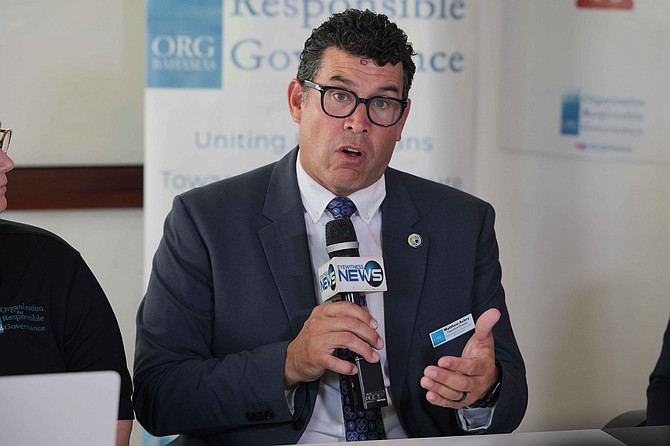
Matt Aubry Photo: Nikia Charlton
By JADE RUSSELL
Tribune Staff Reporter
jrussell@tribunemedia.net
THE desire to hide certain information from the public could be a factor in the Freedom of Information Act (FOIA) remaining largely unimplemented nearly eight years after it was passed, claims the Organisation for Responsible Governance (ORG).
Executive director Matt Aubry was speaking after the unsealing of court documents in the United States related to Jeffrey Epstein renewed debate about transparency and public access to information in The Bahamas.
Successive administrations have, for years, promised to implement the FOIA but failed to do so.
Mr Aubry told The Tribune yesterday that past governments have not viewed implementation of the legislation as being “politically valuable” and the desire to hide information could be a factor.
“I think that would probably be true for almost any government along the way that has done or made Freedom of Information happen,” he said.
“The reason that those laws are put into place is because generally there’s always been a historic thought related to most governments that information is power, and when too much information is out there, it’s going to be used in a challenging or disruptive way.”
Mr Aubry noted that Bahamians frequently speak about wanting fair opportunities, greater trust in government, and an end to access being influenced by political affiliation. He said these concerns are directly linked to Freedom-of-Information legislation and suggested that both the government and the public may need to shift their mindset to fully appreciate the value of unrestricted access to information.
When fully implemented, the Freedom of Information Act would allow citizens to access information held by public authorities, thereby improving government transparency and accountability.
More than 120 countries worldwide, including the United States, United Kingdom, Canada and Jamaica, have enacted Freedom-of-Information or access-to-information laws that give the public the legal right to request government records.
On January 30, 2026, the United States Department of Justice released more than three million pages of documents, 180,000 images and 2,000 videos related to Epstein.
In November, the US Congress passed legislation requiring the Trump administration to release all information it held from investigations into Epstein. The Department of Justice subsequently released two tranches of files in December 2025 and January 2026.
Although the Epstein files were not released under Freedom-of-Information laws, the disclosures have still fuelled broader debate about transparency and public access to information.
Mr Aubry said FOIA is often viewed as a sensationalist tool used to uncover government secrets, but its true value lies in levelling the playing field between the state and the public. He said government decisions should not only be scrutinised internally, but also withstand public examination.
While acknowledging that the government does publish financial information such as budget reports, Mr Aubry said more needs to be done to train citizens to understand those documents and how they affect daily life.
In June 2025, Prime Minister Philip “Brave” Davis confirmed that fully funding the implementation of the Freedom of Information Act and other anti-corruption mechanisms was not a priority for his administration.
The last Ingraham administration passed a Freedom of Information Act shortly before the 2012 general election, but did not set a date for its enactment. The Christie administration later overhauled the legislation but never implemented its provisions.
In May 2021, the Minnis administration appointed the country’s first Freedom of Information commissioner, but the department has remained chronically underfunded.




Comments
Use the comment form below to begin a discussion about this content.
Sign in to comment
OpenID