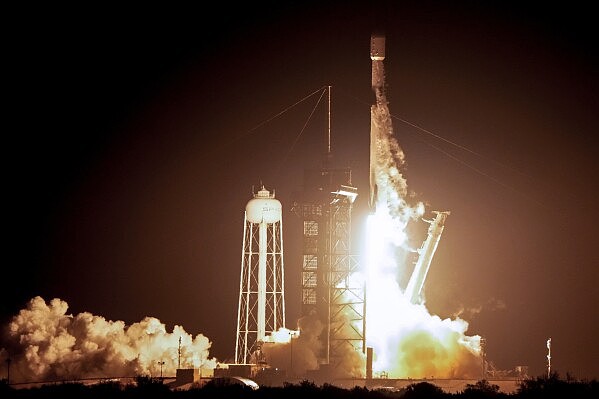
A SpaceX Falcon 9 rocket lifts off with a payload of a pair of lunar landers at the Kennedy Space Center in Cape Canaveral, Florida on January 15, 2025. Photo: John Raoux/AP
By LEANDRA ROLLE
Tribune Chief Reporter
lrolle@tribunemedia.net
SPACEX could resume booster landings in Bahamian waters as early as next week, pending final regulatory approval, Department of Environmental Planning and Protection (DEPP) director Dr Rhianna Neely-Murphy confirmed yesterday.
Dr Neely told The Tribune that environmental clearance has already been granted for the scheduled February 17 landing, but other regulatory approvals are still pending.
“There are actually quite a (few) bodies that need to sign off on their own regular regulation,” she said. “You have Foreign Affairs first of all, because this is two countries doing work with each other. You have civil aviation. You have BANSA and I’m pretty sure they don’t have all of their approvals as yet.”
SpaceX made its first landing at the Exuma Sound last year, with officials announcing plans for additional recoveries at the same location.
However, the government paused SpaceX landings due to fallout from a separate Starship explosion in March, which scattered debris near Ragged Island.
Officials later said no further landings would be approved until SpaceX completes an environmental impact assessment and submits a post-launch report.
An Environmental Impact Assessment released in September found the first landing produced “minimal” environmental effects, though it highlighted gaps in underwater noise measurements and recommended stronger monitoring and instrumentation for future missions.
When asked about further landings, Dr Neely-Murphy said no further applications are currently under consideration.
SpaceX officials have said that future landings would all use the Exuma Sound site and that SpaceX expects to perform “an additional 20 landings here in The Bahamas on the Exuma Sound landing site” once approved.
Concerning environmental concerns and questions about marine impacts and sonic booms. SpaceX engineer Sarah Gillis told The Tribune in November that an extensive environmental assessment, including modelling and monitoring before, during and after landings, indicates the activity should have minimal impact, with the main effect expected to be the brief sound of the sonic boom.
Meanwhile, US Ambassador Herschel Walker recently highlighted the economic potential of SpaceX Falcon 9 operations, saying space tourism could open up a market worth more than $1bn and position The Bahamas as a leader in the emerging space economy.




Comments
Use the comment form below to begin a discussion about this content.
Sign in to comment
OpenID