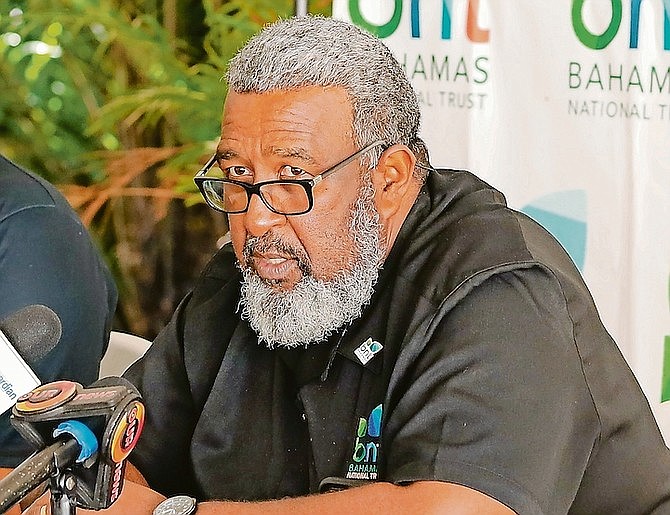
Eric Carey
By NEIL HARTNELL
Tribune Business Editor
nhartnell@tribunemedia.net
An ex-Bahamas National Trust (BNT) executive director yesterday argued that a seemingly large-scale investment project targeted at Eleuthera’s Governor’s Harbour, and featuring proposed mega yacht and “boutique” casino facilities, is employing a development model that has “never worked in the Family Islands”.
Eric Carey, an environmental advocate who now lives on Eleuthera, told Tribune Business that the initial “ideas” proposed by Jeff Jacobs, a casino and hospitality developer whose company owns numerous gaming facilities in the US, raises multiple concerns for residents and the Governor’s Harbour community due to the extra pressure it would likely impose on the island’s already-strained utilities infrastructure, environment and workforce.
Speaking after Mr Jacobs confirmed to this newspaper that the Government was “quite supportive” of his thoughts, which also include the development of “four to five ‘lock to leave’ communities; a “small hotel” with numerous restaurants; affordable worker housing; pedestrian trails and improved public beach access, Mr Carey argued that successive administrations have been overly-eager to embrace such mega resort-type projects in the Family Islands.
Noting that this stemmed from the so-called ‘anchor’ project for every island strategy, first initiated by the second Ingraham administration in the late 1990s before being extended further by its Christie successor, he said all have been seduced by promises of multi-billion dollar investments and the creation of hundreds of jobs without checking if they will really empower Bahamians.
Noting that the developer has confirmed to this newspaper the “snippets of information from early conversations Mr Jacobs would have have with people”, the ex-BNT chief said he was “not surprised” at the assertion the Government is “quite supportive” of such ideas given the scale of development that is being touted. He argued that while this may “look good on paper and on election platforms, it doesn’t translate anywhere in our country into real Bahamian empowerment”.
And Mr Carey also pushed back at assertions from Clay Sweeting, the central and south Eleuthera MP, that his letter raising concerns over Mr Jacobs’ plan was premature because no formal approvals process has begun and public consultation would have to take place. He, though, argued that public awareness must be raised early on because too often major investment projects are presented to Bahamians as a “fait accompli” and after they have already been approved by the Government.
“Our government, across administrations including this one, they have a tendency to go for large developments,” Mr Carey told this newspaper. “You hear Chester Cooper, the minister responsible for investments, talking about the billions and billions of dollars of investment. These large projects add to the appetite of the Government, which is for larger and larger developments for what they feel may be a huge economic impact.
“I’m not surprised the Government feels that way [but] we’ve seen this play out before. It never works in the Family Islands.” One such example is the Resorts World Bimini resort, together with its casino, which was recently revealed to be carrying hundreds of millions of dollars in debt and other liabilities on its balance sheet amid a bitter legal dispute between its two owners, RAV Bahamas (Gerardo Capo and his family) and Genting.
“The Government likes to embrace these large developments notwithstanding the fact there are very few examples which show they have been successful in really benefiting local communities in ownership and empowerment,” Mr Carey told Tribune Business. “The examples we have across our country are quite the opposite. The developer wins, most of the money leaves the country in large real estate sales.”
He added that many of the “hundreds of jobs” that a project such as the one proposed by Mr Jacobs will require will not be filled by Eleuthera residents. “They are going to have to bring people in,” Mr Carey said, noting that the island is already suffering from an affordable housing shortage. “Eleuthera has high employment.
“If you talk to people in the construction industry they’re finding it difficult to find Bahamians. A lot of my friends in construction will tell you they have to depend on Haitian labour to execute the projects they have bid on because they cannot find Bahamian labour.
“The Government approves projects that look good on paper, look good on an election platform, but don’t translate anywhere in our country into Bahamian empowerment.” Mr Carey, asserting that the concerns of Governor’s Harbour and Eleuthera residents are “justified” based on Mr Jacobs’ comments, said the latter has given no indication that the “public-private partnership” he is proposing would include broad-based Bahamian investor ownership.
He suggested that it likely meant the Government will have an ownership interest, and challenged whether this would be valued and based on the amount of Crown Land, which is held on trust for the benefit of the Bahamian people, being contributed to a Governor’s Harbour development. Mr Carey said Crown Land on Eleuthera is already “scarce”, especially given the demand for affordable housing by Bahamians.
He pledged to now reach out and contact Mr Jacobs, and see if he will keep to his promises to involve Governor’s Harbour residents and local communities at every step of his plans, taking into account their concerns and views, to ensure it remains environmentally and financially sustainable.
And Mr Carey said he will also seek confirmation of whether the plans include development of an 18-hole golf course, and the use of Crown Land for such a purpose, arguing that this would not represent the best use of such assets while also potentially causing environmental harm to the water table and by ocean run-off. He was also not alone in his concerns.
Another Eleuthera resident, speaking on condition of anonymity, told Tribune Business: “The people in Governor’s Harbour feel this is not the right scale and not the right tone for what made Eleuthera what it is. He [Mr Jacobs] has been buying up a lot of land in the Governor’s Harbour area. There is a lot of concern. How do we keep what we have without throwing it by the wayside.
“This is a situation where it would really not be appropriate to jump at something that would be taking place right in the historic settlement of Governor’s Harbour. This is the seat of the first government of The Bahamas. This is an historic community. There needs to be some consideration of what the social impact from such a large-scale development would be, and the infrastructure. Eleuthera is already struggling with water and power, and these kinds of things - mega resorts and golf courses - are not exactly conducive to that. As a country, we have to get beyond these developments that are imposed on local Bahamian communities.”
And Casuarina McKinney- Lambert, executive director of the Bahamas Reef Environmental Educational Foundation (BREEF), and another Eleuthera resident, told Tribune Business: “People in Central Eleuthera are understandably concerned about a proposal for a large scale golf course, mega yacht marina and casino development that could fundamentally change the character and environment of the historic community of Governor’s Harbour. Development must align with what is socially and environmentally sustainable.”
Mr Carey, meanwhile, responding to Mr Sweeting, said: “I would say we need to ask questions before any decisions are finalised. By the time most major developments make it before the community with issues of density, infrastructure impact, impact on workers, access to public beaches, they are already locked in in Heads of Agreements.
“What happens is it comes before community members as a fait accompli. It is largely put to people as ‘take it or leave it’. That’s how it works. I would challenge Mr Sweeting, the director of investments, to prove otherwise where a major development is brought to the people, concerns are expressed and changes made according to the concerns and discussion with the community.”




Comments
Use the comment form below to begin a discussion about this content.
Sign in to comment
OpenID