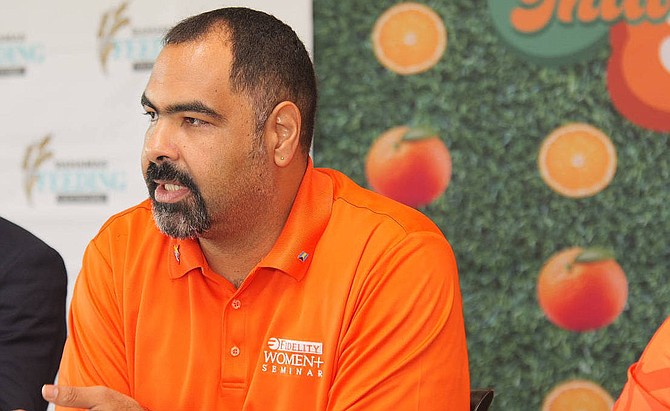
Gowon Bowe
By EARYEL BOWLEG
Tribune Staff Reporter
ebowleg@tribunemedia.net
THE chairman of the Clearing Banks Association has sharply criticised the Davis administration’s decision to remove VAT from unprepared food sold in grocery stores, calling the move “an uninformed and an understudied or not sufficiently studied exercise” that sacrifices fiscal discipline for political appeal.
Gowon Bowe, Fidelity Bank’s chief executive, noted the policy delivers the same tax relief to higher-income earners as it does to those struggling most, a blunt approach he argued fails to target cost-of-living pressures effectively while risking long-term revenue stability.
He questioned who the measure was truly designed to help, noting that VAT applies across a wide range of goods and services beyond groceries, including fuel and utilities. In that context, he said, the policy resembled a “hacksaw” rather than a targeted “scalpel”.
“If,” he said, “I'm giving the same benefit to the person who is fortunate as I am to the person who's less fortunate, is this the most appropriate approach whilst maintaining fiscal responsibility? And my answer to that personally is no.”
His comments followed Prime Minister Philip Davis’s announcement on Monday night that VAT would be completely removed from food sold in grocery stores, a major policy shift the government said was aimed at easing persistent cost-of-living pressures.
Mr Bowe pointed out that the Davis administration, while in opposition, had criticised the Minnis administration’s approach to VAT, which involved a mix of exemptions and rate increases. After taking office, Mr Davis himself referenced an International Monetary Fund review that found the exemption-heavy VAT regime reduced efficiency, lowered revenue and increased administrative and compliance costs.
Against that backdrop, Mr Bowe questioned the consistency of the new policy direction, particularly alongside measures such as the reintroduction of the RISE programme, which he described as effectively increasing Social Security contributions through a rebalancing of tax collections.
“In the proposed scenario,” he said, “the government is basically giving a tax exemption to all and sundry. The question is, will the less fortunate among us be happy with the most fortunate among us getting the same tax benefit, which will result in the government of the day having to increase taxes on all of society in order to make up for any shortfall?”
He also questioned the practical impact of the VAT removal, arguing that the savings on grocery bills would be marginal when set against rising costs elsewhere.
He said: “We say, just as an example, we have a situation where ultimately the grocery bill is $100, and now it is $10 in VAT that is paid. Even if the entire grocery bill was zero in terms of VAT, the actual benefit would only be $10 and the question is, will that $10 saving in one set of taxes compensate for the cost of fuel, compensate for the cost of other services that are being incurred, and other cost of other goods, because we don't live by bread alone?”
Mr Bowe described tax policy as a “zero-sum game”, warning that revenue forgone in one area must eventually be recovered elsewhere. He argued that while tax cuts are sometimes justified to stimulate economic activity, this measure was not designed to boost productivity and would do little to assist those under the greatest financial strain.
“The Bahamas is doing better than it was coming out of COVID because the economy had refloated but it is not performing at its optimum, and the reason it's not is because we continue to make decisions the way this particular VAT decision was made, by popular vote, as opposed to studied analysis,” he said.
He argued that 2026 should focus on consolidating economic gains rather than prematurely harvesting them, warning that repeated short-term policy shifts undermine the country’s ability to achieve sustained growth.




Comments
birdiestrachan 1 month, 2 weeks ago
Mr Bowe is a smart man perhaps they should get his views on certain matters. He means the Bahamas well
ohdrap4 1 month, 2 weeks ago
He should really cut the crap. The number of less fortunate a increases by the day. And the social services devices are limited and temporary.
The rich are not going out there to stock up on food, because 5% makes no difference.
The blanket exemption will help the average person who pays more than half of their earnings in rent for as long as the exemption lasts. While social workers will discriminate who gets 50 dollars for three months.
empathy 1 month, 2 weeks ago
Mr. Bowe is making sense!
DonAnthony 1 month, 2 weeks ago
Mr. Bowe uses himself as example, when his income is likely in the top 1% of wage earners in the Bahamas. Of course this tax cut is not necessary or even meaningful for him, but what about the other 99% of Bahamian wage earners to whom it does matter a great deal? Do we really think this tax cut is not beneficial to the vast majority of the middle class and especially poor Bahamians? Or do we really expect all these tens of thousands of persons to swamp our inefficient social services to look for and receive the help they need to feed their families? That is laughable and disingenuous. Food expense for the vast majority of Bahamians is their largest monthly expenditure, it is a need and not a want, and vat and all taxes should be eliminated on all food as much as possible.
Dawes 1 month, 1 week ago
Is it really that bad to ask the question. A quick look at AML shows sales over $200 million, assuming the vast majority is food (80%) then that would be $160 million. This is $16 million less (or $8 million at 5%), Super value would be more. Where is Government going to get that revenue. I don't think those who need the cut are buying ribeye, but someone buying that will also get the cut. Why? Why not revamp breadbasket and put those VAT free, making sure it is a healthy option for people. Then all else is VAT. Otherwise where are Government going to make up the revenue decrease? Its not as though we have a surplus now.
ohdrap4 1 month, 1 week ago
The guy who has a million dollar home gets his 300000 property tax exemption and pays property tax only in 700000. But begrudges the rice and mackerel eater 5% vat.
The govt can get this money back by elimination property tax exemption on all homes over 300000. That is zero sum.
Dawes 1 month, 1 week ago
I said have certain items VAT free. On Real property get rid of the upper limit, if you get rid of the $300,000 exemption then if you are in a $300,005 you are getting a full hit.
Socrates 1 month, 1 week ago
Mr. Bowe keeps pushing "Robin hood' economics.. take from the rich, gve to the poor. the well off spend more money, contributing more tax revenue so why shouldnt they equally benefit from any breaks?
Sign in to comment
OpenID