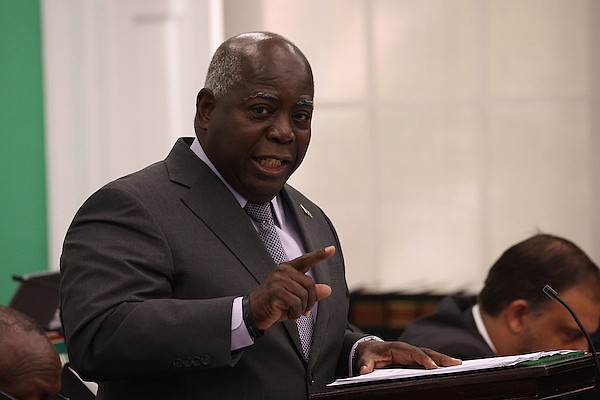
Prime Minister Philip Davis speaks in the House of Assembly on October 29, 2025. Photo Dante Carrer
By LEANDRA ROLLE
Tribune Chief Reporter
lrolle@tribunemedia.net
PRIME Minister Philip “Brave” Davis and Opposition leader Michael Pintard yesterday offered sharply different assessments of the government’s carbon credit agenda as Parliament debated new legislation intended to consolidate climate policy and monetise The Bahamas’ environmental assets.
Mr Davis said the Davis administration is positioning the country to benefit responsibly from carbon markets without “selling or unsustainably monetising” the environment, while Mr Pintard acknowledged the potential of carbon credits but warned that years of promises have yet to translate into clear results or revenue.
“It is past time the world recognises the valuable role our seagrass meadows play in absorbing carbon from the atmosphere,” Mr Davis said. “And if they aren’t going to recognise that value on their own, then it is up to us to put in the work to establish and quantify that value in a way that the world cannot ignore.”
“But I want to be clear: we are not selling or unsustainably monetising our environment. This value existed all along.”
Mr Davis said the government is establishing a framework that ensures the world recognises The Bahamas’ environmental contributions while rewarding continued protection of natural resources. He said there is a growing global demand for carbon credits that represent genuine environmental benefits, creating an opportunity for The Bahamas to generate revenue while safeguarding national interests.
“This is a game-changer that will make a major difference in our climate adaptation and resilience agenda. The potential of Blue Carbon Credits represents Bahamian innovation and excellence at its best, and it also directly challenges the age-old narrative that our nation lacks natural resources,” he said.
His comments came as MPs debated the Climate Change and Environmental Advisory Unit Bill 2025 and the Climate Change and Carbon Market Initiative (Amendment) Bill 2025.
The legislation consolidates climate policy and finance responsibilities within a single unit, addressing fragmentation across ministries that has slowed decision-making.
“Through this Bill, we are also formalising inter-ministerial coordination by giving the unit oversight of committees related to climate policy, climate finance, carbon markets, and sustainable development,” Mr Davis said.
“This ensures that climate considerations are integrated into decision-making rather than addressed after damage has already occurred.”
The first bill clarifies The Bahamas’ obligations under the Paris Agreement, designates the advisory unit as the central point for international climate engagement, strengthens reporting, and improves access to financing. It also establishes governance and regulatory oversight for carbon markets, including rules for mitigation activities, validation of outcomes, and bilateral and multilateral agreements.
The second bill aligns existing carbon market legislation with the new governance structure, transfers responsibility for international climate reporting to the Prime Minister, and assigns financial administration of carbon market revenues to the Minister of Finance. It also strengthens reporting between the National Emissions Registry and the Prime Minister.
Mr Davis described the legislation as a significant step toward institutionalising climate change policy and carbon credit management, arguing that proactive governance can turn resilience into opportunity.
“We could continue with the policies of the past, reacting after disaster strikes and borrowing to rebuild what was already lost. Or we can build systems strong enough to reduce harm before it happens and smart enough to turn resilience into opportunity,” he said. “One path leaves us permanently exposed. The other gives us agency.”
Mr Pintard said the Free National Movement supports efforts to properly value and monetise carbon credits, but expressed concern that the Davis administration has repeatedly oversold the initiative without delivering transparency or measurable outcomes.
He recalled that the Climate Change and Carbon Market Initiatives Act and the Carbon Credit Trading Act were passed in 2022 with major promises.
“We are very much concerned that, even more so, they have not provided the clarity Bahamians need, the updates that we deserve on what has happened since 2022 and 2023,” he said.
Mr Pintard criticised what he described as an emphasis on speeches and press releases over tangible results, arguing that climate resilience must be measured by action rather than rhetoric.




Comments
TalRussell 3 weeks, 5 days ago
I'm just not getting the "Redshirts'?"
They've allowed themselves to get trapped in what's obviously defined by "Yellahshirts'" as their 2026 National Election's narrative, set so it benefits its chief architect.
Why not usehatever graceperid, before election-time so as to address what's constantly 88.8% of the time going on in the everyday minds of the colony's popoulaces'-at-large?
Maybe their Leader's, coming be more days in job...bald-headedness' IS too by "Yellahs'" design.
Sign in to comment
OpenID