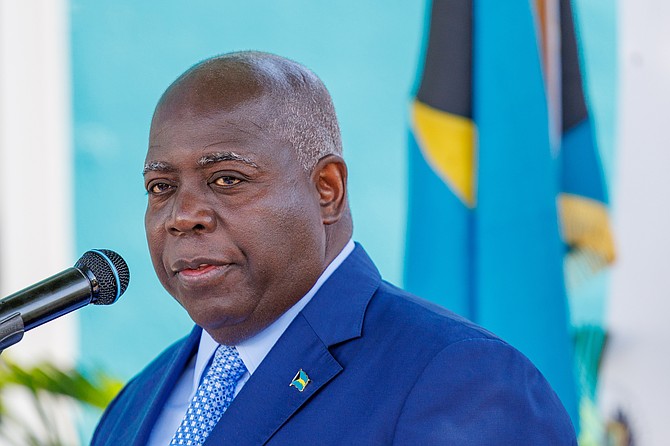
Prime Minister Philip Davis. Photo: Dante Carrer/Tribune Staff
By RASHAD ROLLE
Tribune News Editor
rrolle@tribunemedia.net
BOTH the Davis administration and the Grand Bahama Port Authority rushed yesterday to frame the arbitration ruling in their favour, each presenting the decision as a major victory even as the outcome leaves a far more complicated picture.
In a national address last night, Prime Minister Philip Davis portrayed the decision as a historic turning point that confirmed the Port Authority must make payments to the Government and cemented the state’s authority over Freeport.
“Tonight, we can celebrate a historic victory for our country,” Mr Davis said.
He told Bahamians the tribunal had confirmed that the Grand Bahama Port Authority is liable to make payments for the remainder of the Hawksbill Creek Agreement, which runs until 2054, and said the ruling marked a new chapter for the island.
“For the first time, an independent tribunal has ruled that the Grand Bahama Port Authority is liable and must make payments to the Government and the people of The Bahamas – until the year 2054.”
Mr Davis framed the ruling as part of a broader struggle over sovereignty and the balance of power in Freeport, invoking the legacy of Majority Rule and the long-standing debate over the Hawksbill Creek Agreement.
“The Tribunal confirmed that Freeport is part of The Bahamas, under Bahamian law – not a separate island governed by private rule.”
The Prime Minister also emphasised that most of the Port Authority’s counterclaims against the government had failed and said the next phase of the arbitration would determine how much the GBPA must pay.
“The initial ruling was a victory for us, because it established liability for them,” he said. “They have to pay up.”
He said the government would now pursue determining the amount owed to Bahamian taxpayers, suggesting it could be more or less than the $357m originally claimed.
“It could be more than the $357 million in our initial claim – or it could be less,” he said.
Mr Davis also invoked the legacy of Sir Lynden Pindling, recalling a notable 1969 speech in Grand Bahama in which the country’s first prime minister criticised an arrangement that left the island’s second city under private control.
Earlier yesterday, Attorney General Ryan Pinder hosted a press conference rejecting the Port Authority’s characterisation of the ruling after the GBPA issued its own statement claiming victory.
Mr Pinder argued that the tribunal’s findings confirmed the government’s authority in Freeport and established the Port Authority’s liability to make payments under the Hawksbill Creek Agreement.
PLP candidates in the upcoming general election also celebrated the decision on social media, describing it as a victory for the Prime Minister and the government’s approach to the dispute with the Port Authority.
The Port Authority, however, issued its own statement yesterday morning portraying the ruling in very different terms.
In its statement, the GBPA described the outcome as a decisive victory after the tribunal dismissed the Government’s claim in full.
“A landmark arbitration victory for the Grand Bahama Port Authority (GBPA), its licensees, and the people of Grand Bahama has seen the government’s $357 million so called ‘reimbursement’ claim under Clause 1(5)d of the Hawksbill Creek Agreement (HCA) dismissed in full and the GBPA’s position under the HCA clearly reaffirmed,” the GBPA said.
The Port Authority emphasised that the tribunal rejected the government’s argument that the GBPA owed hundreds of millions of dollars under the clause relied on in the claim.
“The Arbitration Tribunal fully rejected the government’s argument that it was owed hundreds of millions of dollars by GBPA under Clause 1(5)d.”
The GBPA also highlighted one of the few issues on which it succeeded in the arbitration: the tribunal’s finding that the government breached its obligations by failing to approve environmental bye-laws proposed by the Port Authority.
“The Government was declared in breach of the HCA for this failure,” it said.
According to the GBPA, the tribunal has directed the parties to make submissions on a possible damages award related to that breach.
The Port Authority said the ruling removed uncertainty that had hung over Freeport during the arbitration proceedings and would help restore confidence among investors and businesses.
“This is more than a legal victory. It is a stabilising moment for Freeport.”
It also suggested the government should have avoided bringing the claim in the first place.
“We have advised the government repeatedly since June 2016 that this claim was wrong and would fail. It was not a good use of time or public resources,” the GBPA said.
Despite the sharply different interpretations of the ruling, both sides struck conciliatory notes about the need for cooperation moving forward.
The Port Authority said genuine collaboration between the government and the GBPA would be necessary to advance Grand Bahama’s development and ensure both parties meet their obligations under the Hawksbill Creek Agreement.
Mr Davis similarly spoke of the possibility of a new relationship with the Port Authority, describing the ruling as an opportunity to move beyond what he called an outdated status quo in Freeport.




Comments
Use the comment form below to begin a discussion about this content.
Sign in to comment
OpenID