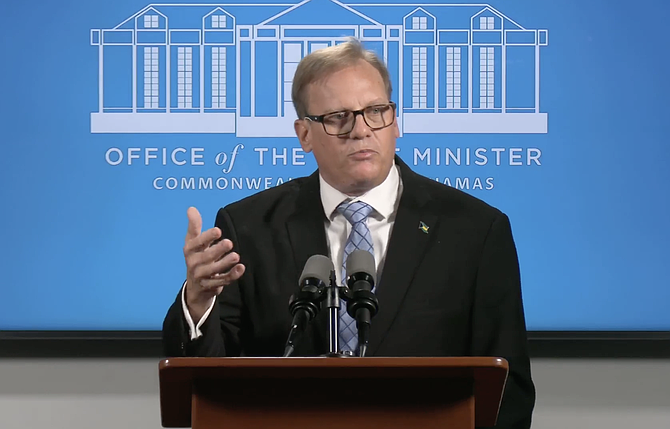
Attorney General Ryan Pinder
By NEIL HARTNELL
Tribune Business Editor
nhartnell@tribunemedia.net
The Attorney General yesterday hailed the rejection of the Grand Bahama Port Authority’s (GBPA) $1bn damages claim against the Government while accusing it of trying to enrich itself at the expense of Bahamian taxpayers.
Ryan Pinder KC, speaking after arbitrators rejected seven of the eight counter-claims launched against the Government by Freeport’s quasi-governmental authority, asserted that the move “would have had significant fiscal implications for the country” had it succeeded and asserted that the verdict represents “good news for all Bahamian taxpayers”.
The Government’s top legal adviser, who was joined by Ginger Moxey and Dr Michael Darville, current and former Grand Bahama ministers, told a media briefing at the Prime Minister’s Office that the arbitrators’ decision will also benefit taxpayers moving forward because it affirmed that the GBPA owes an annual “liability” to pay money to the Public Treasury for the Hawksbill Creek Agreement’s remaining 28-year term (see other article on Page 1B).
This is stipulated by the “review mechanism” contained in the 1994 deal between the GBPA and then-Ingraham administration, which Mr Pinder yesterday said “remains operational, and its provisions enforceable, notwithstanding it has not been enforced for many years”.
The arbitrators, in their ruling, found: “The tribunal considers that it is self-evident that the Government can invoke the review for future years because it is inherent in the GBPA’s argument, and in the tribunal’s conclusion, that paragraph three has replaced clause 1(5)(d). That paragraph three, and therefore the review, remains fully enforceable. In any event, there is no basis for contending that the review is inoperable simply because it has been allowed to lie dormant by the Government.”
While any sums due and owing by the GBPA to the Government now have to be determined by the two parties via negotiation or, if talks fail, arbitration, Mr PInder asserted that - in rejecting the quasi-governmental authority’s counter-claim - the three-strong arbitration panel of Sir Anthony Smellie KC, its chairman, and Lord Neuberger and Dame Elizabeth Gloster, had also ruled that the GBPA does not have “the exclusive right” to govern the 230 square mile Port area and that its claims of government interference are misconceived.
“The Government has a right to legislate, regulate and participate in governance,” the Attorney General said. “This is an historic event with the interpretation of Freeport, the Hawksbill Creek Agreement, and the relationship between the GBPA and the Government dating back more than 70 years. This is an historic result. In any event, we are glad that there is a definitive basis for the inter-relationship between the Government and GBPA as far as the management and governance of Freeport.”
Mr Pinder based his assessment of “an historic” outcome - one repeated by his Cabinet and ministerial colleagues - on the arbitrators’ rejection of the GBPA’s counter-claim that there had been “multiple breaches on the part of the Government of their duties owed to the GBPA” under the Hawksbill Creek Agreement’s terms. He described its dismissed allegations as “very substantial” not just for Freeport’s governance but that of the wider Bahamas given that Freeport’s quasi-governmental authority had, in effect, asserted it had the exclusive right and authority to oversee business licensing, Immigration, Customs, utilities and property sales/land development without any involvement from the Government.
“The GPBA’s counterclaim against the Government was for substantial damages for wrongfully interfering in the administration of Freeport. This is a complaint which the GBPA has made repeatedly against the Government for many years, and one which the Government has always rejected. The GBPA now brought its complaints by way of a counterclaim in the arbitration, in which it originally claimed a sum of $1bn - $1bn- in damages against the Government. That was the GBPA claim.” Mr Pinder said.
“GBPA’s case that it has the sole right to administer Freeport and to deal with licensing, Immigration matters, Customs matters, utilities and utilities regulation, land purchases, development/environmental approvals, all of this was claimed by the GBPA as their exclusive right in Freeport. Every one of them was rejected by the tribunal.
“The tribunal also rejected a complaint by the GBPA that the Government had wrongfully diverted investment projects from Freeport to other areas of Grand Bahama. That was a claim within the arbitration proceedings. Again, a claim by the GBPA that was rejected. The tribunal expressly held that the Government’s caution about the Weller/Pegasus development ‘cannot be criticised’, meaning that the Government had a right - and was well-grounded - in its approach to use caution about the project, and that the Government was entitled to prefer investment projects for other areas of Grand Bahama outside Freeport.”
Mrs Moxey hailed the arbitration verdict as confirming that “the Government has a binding say in the administration, management and regulation of the city of Freeport. Administration of the Port area is not fully vested in the GBPA. This is the first time that any administration has challenged the GBPA in this manner for the benefit of Grand Bahama”.
However, several Freeport private sector contacts yesterday told Tribune Business that - for all the talk of an historical decision - it appeared that the arbitration verdict has largely maintained the status quo in the city especially since areas such as Customs and Immigration are still controlled by the relevant government agencies. Foreign business and investor licensing approvals also still go through Nassau, leading some to argue that nothing has changed and that the verdict has brought little clarity and certainty to Freeport’s governance and administration long-term.
“All these things are in place already and have been for a long time,” one businessman said of the areas cited by Mr Pinder. “It’s nothing new.” Another added that the ruling, despite rejecting the Government’s $357m payment demand, had given it “a pathway to actually collect” from the GBPA, with Prime Minister Philip Davis KC last night signalling the Government intends to make a renewed claim for possibly more than that initial sum.
However, one Freeport contact added: “The ruling doesn’t actually do anything for the people of Freeport. It’s like a pyrrhic victory for the Port Authority and a slap in the face for the Government, but is anything going to really change? Nothing is going to happen. Nobody benefits from this. Nothing changes.”
Mr Pinder, though, described as “a big one” the upholding of the legal requirement - set out in the International Persons Landholding Act - mandating that all foreign real estate buyers register their Bahamian property and land purchases with the Investments Board. The GBPA had sought a declaration that this did not apply in Freeport, but the arbitrators rejected this.
“Now, this even broadens the scope of the Government’s authority in Freeport,” the Attorney General argued. “The Planning and Subdivision Act is now clearly applicable to Freeport. This is much broader and the Government has legislative authority to regulate land development in Freeport.” Similarly, he added that the decision also upheld that the Environmental Planning and Protection Act applies in Freeport and can be enforced by the Department of Environmental Planning and Protection (DEPP).
Mr Davis was conspicuous by his absence from yesterday’s media briefing, instead opting to give a national address. Mr Pinder said: “The importance of these findings in favour of the Government cannot be understated. The GBPA’s attempt to exclude the Government from any involvement in the administration of Freeport would have a significant governance impact on Freeport, and its attempt to secure huge amounts of taxpayer money for itself - over $1bn in their claim - by way of damages on this basis would have had significant fiscal implications for the country.
“The partial award affirms that administration of the Port Area is not exclusively vested in the GBPA. At most, at most, the GBPA retains specific contractual and administrative responsibilities. But these operate alongside – and subject to – the Government’s continuing powers and the cession of approval of licensing, Immigration, Customs and other matters to the Government, as agreed by the GBPA as long ago as 1968, and that will remain the case for the remainder of the Hawksbill Creek Agreement.
“The clarity in law has been given that the Government has regulatory and legislative authority over actions in the Port area… The Government’s focus will therefore be on progressing the outstanding issues to secure payment from the GBPA for the benefit of the taxpayer. The arbitration tribunal has brought clarity to long-standing disagreements between the Government and GBPA on the governance of Freeport, and it is hoped that any outstanding issues can be resolved between the parties in a sensible way. If not, we go back to arbitration.”




Comments
Use the comment form below to begin a discussion about this content.
Sign in to comment
OpenID