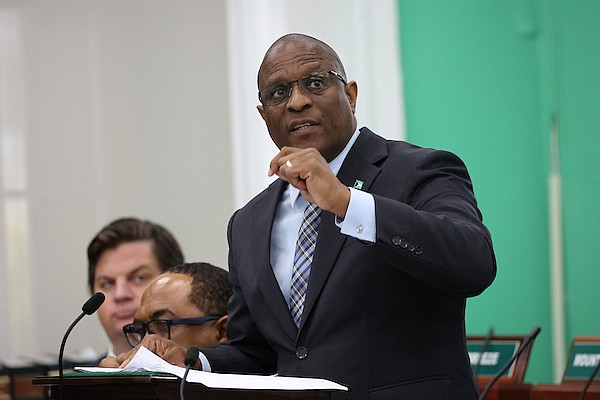
Opposition Leader Michael Pintard speaks in the House of Assembly on March 26, 2025. Photo: Dante Carrer/Tribune Staff
By NEIL HARTNELL
Tribune Business Editor
nhartnell@tribunemedia.net
The Opposition’s leader has doubled down on concerns over the Government’s energy reforms by asserting it is “very likely” that Bahamas Power & Light’s (BPL) base tariff will be increased after the upcoming general election to ensure it remains financially viable.
Michael Pintard told Tribune Business in a recent interview that the sums the Davis administration has agreed to pay Bahamas Utility Company (FOCOL Holdings) and Bahamas Grid Company/Island Grid for New Providence’s baseload generation and transmission and distribution grid overhaul, respectively, make it almost inevitable that BPL’s base tariff has increase for the latter to sustain its business.
Bahamas Grid Company and its manager, Island Grid, have been given control of all New Providence electricity grid-related revenues, including a “first lien” or right of security over this income plus a minimum rate of 5.5 cents per kilowatt hours (KWh) for the first six years of their initial 25-year deal. This will likely carry through to around April 2031.
Meanwhile, included among the 3,200-plus energy reform documents is a “generation power purchase price build-up” showing that Bahamas Utility Company, a subsidiary of BISX-listed FOCOL Holdings, will need to charge 4.625 cents per kilowatt hour (KWH) during the first stage of its baseload generation project to cover some $50m of fixed and variable operations and maintenance expenses, plus a “capacity charge”.
Adding the 5.5 cents and 4.625 cents charges together, as Mr Pintard and the Opposition have done, totals 10.125 cents per kilowatt hour. The Free National Movement (FNM) leader is thus arguing that this combined compensation to Bahamas Grid Company/Island Grid and Bahamas Utility Company will have to come out of BPL’s base tariff to pay for both electricity purchased and grid management and upgrades.
This 10.125 cents, though, accounts for between 81 percent to 88.8 percent of BPL’s existing base tariff depending on which measure is used. The Opposition, and Tribune Business sources, recently suggested BPL’s average base tariff was around 12.5 cents per KWh prior to the Government’s introduction of the Equity Rate Adjustment tariff structure, which dropped this to 11.4 cents after the first 200 KWh hours were made free for all consumers.
As a result, with such a large chunk of BPL’s base tariff going towards paying Bahamas Grid Company/Island Grid and Bahamas Utility Company, Mr Pintard is challenging how the state-owned utility will be able to cover its remaining cost responsibilities and remain financially solvent without a base tariff increase.
BPL, which will effectively function as Bahamas Grid Company’s and Bahamas Utility Company’s customer-facing billing and collections agency, has also been left to service its $500m legacy debt and operate its own remaining generation assets. However, the Government has not explained how BPL will finance maintenance and repairs to the hundreds of milles of wires, poles, cables and sub-stations that represent Family Island transmission and distribution.
And, with BPL carrying a bloated workforce given its shrunken role in the energy sector, including the 123 New Providence transmission and distribution staff not switching to Bahamas Grid Company, Mr Pintard argued to this newspaper that the only way the state-owned utility can remain financially sustainable is to drastically slash its workforce, increase the base tariff or both.
Asserting that it is “very likely” the Government will have no choice but to increase BPL’s base tariff, the Opposition leader said the Davis administration will likely wait until after the general election to do this if returned to office.
“This international situation [Iran and the Middle East] has been made worse by what the Government did,” Mr Pintard told Tribune Business, “because they don’t have the revenue streams to subsidise the Family Islands. We expect that after this election they plan to pull the trigger on increasing costs; not just in the Family Islands but in general.”
The Government’s Heads of Agreement with Bahamas Grid Company makes clear that changes to BPL’s tariff and rate structure are critical to the success of the energy reforms. Clause 6.9 states: “The parties hereto acknowledge and agree that critical to the successful implementation of the project is the realignment of the current rate structure in place at BPL.”
It adds that a key objective is “to produce a rate structure that maximises the potential cost savings for BPL’s customers, particularly residential customers”. All sides, including the Government and Bahamas Grid Company, agreed to engage in talks on “reviewing the existing rate structure and making such adjustments” as deemed necessary.
The Heads of Agreement’s clause 6.8, meanwhile, stipulates that no changes to BPL’s tariff structure can be made without consulting Bahamas Grid Company first, and that both it and Island Grid have the right to recover any reduction in the income that they earn.
However, Bahamian energy consumers may not see an increase in their total electricity bills and costs even if BPL’s base tariff is increased. This is because it does not represent the all-in cost of electricity, which also includes the fuel charge. This accounts for 50-60 percent of the full bill, and represents a pass-through that is 100 percent paid by households and businesses.
The Government’s energy reforms are likely based on any required BPL base tariff increase being more than offset by a reduction in fuel costs, resulting from the switch to liquefied natural gas (LNG) and solar energy, and reducing - even eliminating - the more expensive and dirtier heavy fuel oil (HFO) and automated diesel oil (ADO) used by BPL’s generation assets currently.
Jobeth Coleby-Davis, minister of energy and transport, in her last response to Mr Pintard accused the Opposition leader of “mixing up costs” associated with BPL’s base rate and the fuel charge to derive numbers that are inaccurate. In particular, she asserted that the 4.625 cents per KWh did not relate to baseload generation but also incorporated “a large portion of what used to be straight fuel costs”.
However, the “generation PPA price build-up” makes clear that fuel costs are not included in calculating the 4.625 cents per KWh. “Above are generation costs only and exclude any fuel costs which would be a pass through to BPL,” a footnote specifically states.
Mrs Coleby-Davis nevertheless asserted: “On New Providence, the 4.625 cents per KWh being referenced is the energy price under a power purchase agreement (PPA). Under the updated Electricity Act, that PPA price, together with the solar PPAs and the remaining HFO and ADO generation, forms part of the overall cost of producing electricity for the system. That overall production cost is known as the levelised cost of energy.
“For a customer, the levelised cost of energy appears on the fuel line of the bill. The fuel line has always been a pass through. It does not go into the base tariff. It does not fund salaries. It does not pay for day-to-day operations or maintenance. The base rate and the fuel charge are two separate categories that serve different purposes.
“There will still be other fuel charges, but the 4.625 cents replaces a large portion of what used to be straight fuel costs with the remaining fuel exposure managed at a lower rate through a hedging programme. This structure is what allows the projected $97m in savings for consumers as the system moves fully into LNG and more efficient plant,” the minister added.
“Those savings appear inside the fuel component of the bill, not in the base rate. When the 4.625 cent PPA price is folded into a ‘structural shortfall’ calculation and then compared to revenue figures that exclude the related fuel collections, two different buckets are being mixed together and the conclusion that flows from that kind of math is simply wrong.”
Mrs Coleby-Davis said the energy reforms, and especially the outsourcing of generation to solar providers, are designed to end BPL’s long-time structure of subsidising Family Island costs by New Providence. “Every year it spends more than $50m to subsidise electricity in the Family Islands,” she added.
“On many islands, the real cost of producing one kilowatt hour of electricity is not the 20 or 30 cents people see on their bills, but somewhere between the high 30s and the 90s (cents) once you include fuel transport, labour and the inefficiencies of very small generators. BPL has been renting about 32 mega watts (MW) of generation at roughly $25m a year.
“More than 80 percent of the current fleet will reach end of life within five years, and immediate replacement needs sit above $80m before you even add renewables. On top of that, the company spends millions every year on sludge handling, environmental clean-up and emergency repairs. That is the system that had to be fixed.”
Mrs Coleby-Davis appears to be saying that, once utility-scale solar is in place, Family Island residents and businesses will see the true cost of power generation - no longer subsidised by New Providence - in their bills. However, phasing out HFO and ADO fuels in favour of solar and LNG is again likely being relied upon by the Government to either lower or at least keep the total all-in energy cost flat.
Yet Mr Pintard added: “The obvious question remains unanswered: Do BPL’s projected revenues actually cover the minimum purchase and transmission obligations locked into these agreements?
“If the answer is yes, the Government should publish the full business plan showing how these payments are sustained without increasing rates or accumulating losses. If the answer is no, the Bahamian people deserve to know who will pay the difference and for how long.”




Comments
Use the comment form below to begin a discussion about this content.
Sign in to comment
OpenID