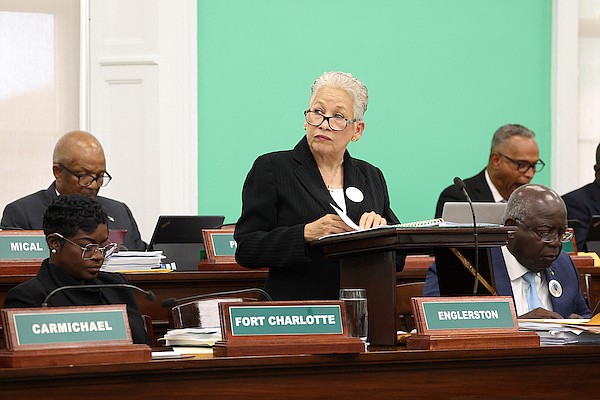
Minister of Education and Technical and Vocational Training Glenys Hanna Martin during her contribution to the Budget Debate in the House of Assembly yesterday. Photo: Dante Carrer/Tribune Staff
By RASHAD ROLLE
Tribune News Editor
rrolle@tribunemedia.net
THE Davis administration has tabled a sweeping Education Bill that would lower the compulsory school age to four in one of the most significant overhauls of the education system in more than 60 years.
The bill would also formally regulate home schooling, impose mandatory accreditation on private schools, tighten financial oversight of public schools and introduce a national curriculum with measurable learning outcomes.
If passed, the Education Bill, 2026, would repeal the 1962 Education Act and replace it with a modern legal framework built around regulation, accountability and enforceable standards rather than broad ministerial discretion.
Children would have to start school earlier. Under the current law, compulsory school age begins at five. The new bill would make school mandatory at age four, requiring any child who turns four by September 30 to be enrolled.
Compulsory attendance would continue until 16, unless a student meets graduation requirements earlier. That effectively pulls pre-primary education into the compulsory system for the first time, shifting the burden onto parents a year earlier.
Home schooling would also become regulated under the legislation.
The existing law allows parents to ensure their children receive education “by regular attendance at school or otherwise,” but it does not define homeschooling or set statutory standards. The new bill changes that.
For the first time, home schools would be formally recognised as one of three school classifications: public, private, and home. Parents who choose to educate their children at home would be required to meet prescribed standards, follow approved requirements and submit to monitoring.
The government would have the authority to terminate a home schooling arrangement if it fails to meet legal requirements.
Private schools, which must now register with the government, would also face mandatory accreditation. The new bill gives the National Accreditation and Equivalency Council of The Bahamas responsibility for accrediting schools operating in the country.
All private schools and independent tertiary institutions would be required to register. Schools already in operation would have six months to apply if not currently registered.
More significantly, schools operating for at least one year could apply for accreditation, and the law creates a structured accreditation pathway. Operating without registration would carry fines of up to $10,000.
A national curriculum would be mandatory under the bill.
The 1962 Act gives the minister authority over schools, but it does not create a statutory national curriculum with enforceable learning outcomes across the system.
The new bill imposes a duty on the ministry to develop a national curriculum and requires schools to comply with and implement it. It also establishes learning outcomes for both public and private schools.
School boards would face financial scrutiny and would be required to comply with the Public Finance Management Act. Principals would serve as accounting officers.
Funds allocated by the ministry, as well as funds raised or donated, would be subject to prescribed management rules.
The minister could appoint a licensed public accountant to audit a school board’s accounts. Audit reports would be transmitted to the Minister of Finance and laid before Parliament.
The existing law provides for school boards, but the financial oversight mechanisms were far less defined. The new framework embeds public finance accountability into school-level governance.
In addition, compulsory attendance enforcement would be updated.
The bill retains the power to issue school attendance orders if parents fail to enrol their children. Failure to comply would constitute an offence. Attendance officers would have defined jurisdiction and powers, and schools would have clearer reporting obligations for truancy.
The old act organised education into three stages: primary, secondary and further education.
The new bill creates four formal stages: pre-primary, primary, secondary and post-secondary/tertiary education. It clearly defines age bands and school categories, including junior high, senior high and all-age schools.
It also allows for special education, alternative education, adult education and education delivered in cooperation with penal or rehabilitation institutions to be formally integrated into the system.




Comments
bahamianson 3 hours, 9 minutes ago
Yeah, teachers are now babysitters because girls and boys whom engage in pleasure are irresponsible. So, let the church , school and society take care of the children. Let us not hold the watless gal and guy accountable. Ya tink the teachers do not have a family to go to , hey?
Sign in to comment
OpenID