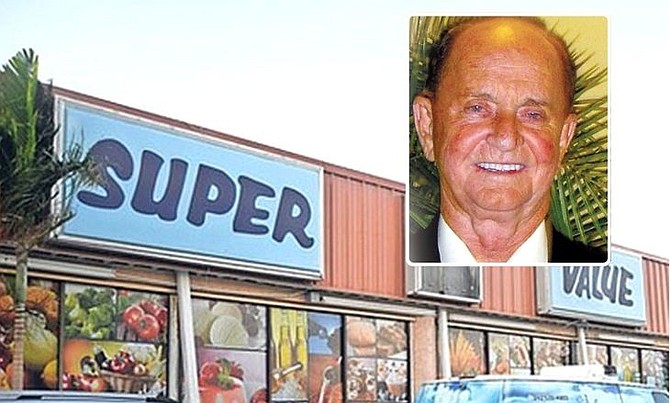
Super Value principal Rupert Roberts
By NEIL HARTNELL
Tribune Business Editor
nhartnell@tribunemedia.net
Food merchants fear the “workload” created by new tax rules will make it “impossible to comply” with timely and accurate VAT filings, Super Value’s owner is warning, while asserting all would be “hunky dory” if the elimination of tax on uncooked foods is made “simpler”.
Rupert Roberts told Tribune Business it would be far easier for the Government to make uncooked foods ‘zero rated’, as opposed to VAT ‘exempt’, from April 1, 2026, onwards amid rising concerns over how his 13-store supermarket chain and other retailers will “manage our next VAT returns”.
And his concerns were echoed by Dionisio D’Aguilar, the former AML Foods chairman, who argued that the Davis administration will create an administrative and compliance “nightmare” for the industry if it proceeds with the current plans and structure for its latest bid to ease cost of living pressures for Bahamian households.
The Government’s decision to treat the elimination of VAT on uncooked foods as VAT ‘exempt’, as opposed to ‘zero rated’, has added fresh complexity to food stores’ monthly and quarterly VAT filings by creating a new and separate category of goods they will have to break-out and account for in their submissions to the Department of Inland Revenue (DIR).
Mr D’Aguilar, also an ex-minister of tourism and aviation, told this newspaper that merchants will now have to determine which products are VAT ‘zero rated’, ‘exempt’, or attract a 5 percent or 10 percent levy. He explained that they will have to undergo this process for all of the hundreds, if not thousands, of products they carry on their shelves, thereby increasing both the time and money that has to be devoted to tax administration and compliance.
“I spoke to someone else in the food business, and they were of the view that this is really going to add an enormous amount of complexities and stress in the business of running food stores because you are now going to have items that are VAT exempt,” Mr D’Aguilar added.
“You are also going to have items that are ‘zero rated’, you are going to have items that are taxed at 5 percent VAT, and you are going to have items that are taxed at 10 percent. When you get your supplies in, that can be pages and pages of items, and thousands and thousands of SKUs (stock keeping units). This is a nightmare because you have to go through all of your invoices to determine what is what.”
The proposed ‘exempt’ treatment for uncooked foods, which is to take effect from April 1 as part of the Government’s move to eliminate the present 5 percent VAT rate attached to such products and slash this to zero, means food stores as well as pharmacies and gas stations - any business that sells them - will no longer be able to recover the tax they themselves pay on all input expenses related to these items.
Super Value’s Mr Roberts told Tribune Business it would be far better for uncooked foods to be treated as ‘zero rated’, meaning no VAT would be paid at any stage of the supply chain and merchants would not be liable to pay the tax on their inputs, as a way to ease the cost and compliance burden for the Bahamian private sector.
Voicing similar concerns to Mr D’Aguilar, he said: “The way I see it, merchants have to accept they have a new tax and the public is going to have a savings on groceries. But it just creates such a workload that I don’t know how we’re going to be able to manage our next VAT returns.
“The merchants need to have another meeting to simplify VAT. If they [the Government] can do that, it will be hunky dory.” Mr Roberts, reiterating that merchants’ point of sale (POS) systems can be adjusted for the uncooked food VAT elimination “the night before, and the button touched on the appropriate day”, agreed that all food stores will now have to closely examine all their invoices to ensure products are placed in the right category for VAT returns.
Confirming that he has discussed the issue with Super Value’s management and Chad Sawyer, his business partner at Maxwell’s Supermarket in Abaco, Mr Roberts added: “What merchants fear is the workload. If they could make it simpler for everyone, everyone would be happier, and it would enable implementation so that we don’t fear the VAT returns - that we’d be late with them or it would be impossible to comply.
“I think [the Ministry of Finance] would give the merchants another hearing and see if we can simplify all this by making it zero rated in some kind of way… one way or another. The Government might not get as much tax, but the consumer doesn’t know anything except that they are getting savings. Everything that we do in the background does not affect them. Let’s work it so the consumer gets what the Government promised, the Government gets their revenue, and merchants get simpler VAT returns to put in.
“That’s the big problem everyone sees now. If we have all this computerisation [at Super Value] and it’s impossible to do it, what about Fox Hill Grocery and other smaller stores? It must drive them crazy. I wish they would give them another meeting and see if we can simplify this. I don’t see why [the Government] will not oblige and keep everyone happy.”
Besides adding to tax administration complexity and costs, applying VAT ‘exempt’ treatment to uncooked foods means merchants will be unable to reclaim a significant portion of the tax paid on their input expenses. If a food store’s sales mix features 60 percent uncooked foods, this means it cannot recover the same proportion of VAT that it pays out on its light bill, rent and other overhead expenses and running costs.
Debra Symonette, Super Value’s president, last week told Tribune Business this could cost the food store chain between $300,000-$400,000 per month, or up to $3.6m to $4.8m per year. Mr Roberts confirmed that the food store chain’s sales are split 80/20 in favour of food, with non-food products in the minority, while Maxwell’s is closer to 50/50 after it went into hardware after Hurricane Dorian.
“We’ve been going through that,” Mr Roberts told Tribune Business of Super Value’s calculations on how much VAT it will now be unable to recover. “All of our rents, all of our BPL bills, all of our insurances. There’s so much that we couldn’t recover. We have to accept that. We don’t know how long this will last because it could change after the election.”
Mr D’Aguilar, meanwhile, added: “Making items VAT exempt means you have to calculate what percentage of your sales are tax exempt, and every you cut an invoice to pay your suppliers you have to reduce the VAT by the percentage those items make up of your food sales. You have to enter every invoice and adjust it by that percentage, reduce the VAT by the percentage of your exempt sales. That’s another nightmare.”
He argued that this converts VAT from the long-standing global concept that it is a tax fully paid by the end-consumer into a business expense. In response, Mr D’Aguilar said of food merchants and other uncooked food sellers: “They are just going to have to jack up their prices. The consumer might think the price is going to come down by 5 percent, but the business has to compensate for the fact they can no longer deduct VAT paid to their suppliers in its entirety.
“That becomes a real expense for them, and the only way to recover that expense is to jack up their prices. You are reducing the tax by 5 percent on one hand, but then the business has to recover the VAT it pays to its suppliers that it now cannot recover, and the only way to recover those VAT expenses is to increase prices. I dont know who the brain surgeon is who thought that one up, but it’s going to result in increased prices.
“With this election coming up, you may want to stand on your bully pulpit and say we’ve made these items VAT free, but food stores will have to compensate for these increased VAT expenses by increasing prices. It’s an election gimmick. It may be a marginal decrease [in prices] for consumers, but nothing to justify the noise they are making. By making it exempt, you are only making it more complex for people in business.”
Mr Roberts, meanwhile, argued that The Bahamas was moving further and further away from the low-rate, broad-based VAT model that this nation first implemented in 2015. This, he said, went against the strategy to “never let it unravel in any shape or form”, and added: “Minnis was the first one that did it, and this government has now followed suit.”




Comments
birdiestrachan 2 hours, 47 minutes ago
I will have to speak to Michael Halkitis. He cares about poor Bahamians. Unlike the rich people in this article.
birdiestrachan 2 hours, 45 minutes ago
Mr Roberts did you call Dr sands.??
birdiestrachan 2 hours, 45 minutes ago
Mr Roberts did you call Dr sands.??
observer2 2 hours, 16 minutes ago
… after Brave finish with me I’ll just be eating uncooked corned beef to escape VAT, or just eat Wendy’s every day
Sign in to comment
OpenID