By FAY SIMMONS
Tribune Business Reporter
jsimmons@tribunemedia.net
A Cabinet minister said the near-doubling of the Government’s year-end payment arrears to $242m at 2025’s close does not signal it is in financial trouble as he dismissed the Opposition’s concerns.
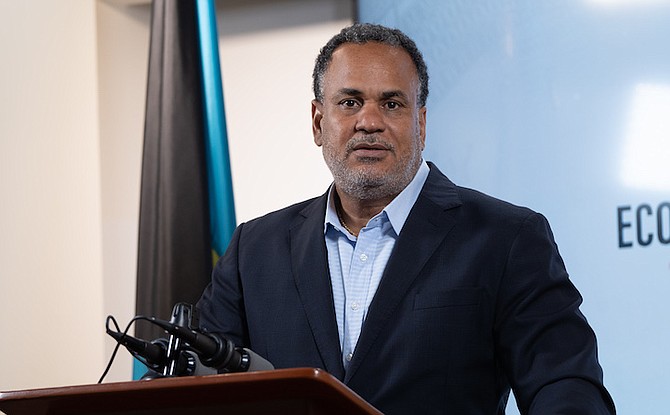
Michael Halkitis, minister of economic affairs, said the existence of outstanding payments such as arrears and unpaid invoices is a normal part of government operations as new services are continuously rendered while others are being paid.
“Every day the government works,” said Mr Halkitis. “Every day you have some vendors who are being paid, and you have vendors who are rendering services that require payment. As a result, every day the Government is paying off bills and incurring new ones.”
He explained that the Ministry of Finance also has a responsibility to verify that goods or services were properly delivered before invoices are settled. “A very important function of the Ministry of Finance is to make sure that when someone presents a bill, the work has been done and the Government has received value for money,” Mr Halkitis said.
He stressed that there is an important distinction between arrears, which represent significantly overdue obligations, and normal outstanding payables, which simply reflect bills awaiting payment at a given moment.
“There’s a difference between arrears and outstanding,” he said. “Arrears means you’re way back. Outstanding means you’ve rendered a service and I have to pay it. That’s simply a snapshot at a particular time.”
Unpaid invoices and arrears owed by the Government increased by 97.6 percent, or almost $120m, year-over-year to hit $241.898m as a year-end 2025, the mid-year Budget disclosed.
Documents tabled in the House of Assembly revealed that sums owed to suppliers, vendors and other purveyors of goods and services to the Government had increased significantly and almost doubled compared to the $122.425m shown to have been due exactly one year before on December 31, 2024.
Arrears had more than doubled, increasing by 142 percent from the prior year’s $25.006m to just over $60m, while invoices outstanding and due from SOEs had risen ten-fold from the prior year’s $10m. Capital spending invoices, too, had jumped from just under $5m to almost $60m - a near 12-fold increase - although those related to recurrent spending were around just one-quarter of the prior year’s total.
But, according to Mr Halkitis, the Government continues to settle its obligations while new ones arise as part of routine operations. “There’s no cause for concern. We move to liquidate them as soon as possible,” said Mr Halkitis.
Responding directly to suggestions that the existence of outstanding bills means the Government is financially strained, the Mr Halkitis dismissed the idea. “The Government can’t be broke,” he said.
Mr Halkitis added that recent legislative changes have significantly increased transparency around the public finances. He pointed to the updated Public Financial Management Act 2023, which requires more frequent and detailed reporting.
“One of the benefits of the Public Financial Management Act we passed in 2023 is that it provides for the disclosure and publication of a tremendous amount of information that previously the public would not know about,” he said.
The legislation mandates monthly, quarterly and mid-year reports outlining the Government’s fiscal position and financial activity. According to Mr Halkitis, these reporting requirements mean the public now has far greater visibility into government finances than in the past.
The 2025 year-end figures showed that close to three-quarters of the $242m, or a combined $176.606m worth of unpaid invoices and arrears, were owed by just five government ministries and entities. The one with the largest liabilities was shown to be the Ministry of Works, which commissions and funds large-scale infrastructure and public works projects. It was shown as owing $46.327m in unpaid invoices that fall under capital expenditure, plus a further $21.562m in arrears, for a total $68.095m.
The Water & Sewerage Corporation was shown as owing $38.185m in unpaid invoices, while the Ministry of the Public Service had $18.251m in arrears, and $6.111m in invoices awaiting payment, for a total $24.362m on its books as at year-end December 31, 2025. That, though, represented a major 63.8 percent decrease on the $67.262m that the latter was said to be owing at year-end 2024 - with unpaid invoices having been reduced significantly from the $49.171m outstanding then.
Others shown to have built-up significant accounts payables at year-end 2025 were the Public Hospitals Authority (PHA), operator of the Princess Margaret Hospital (PMH), Rand Memorial Hospital and Sandilands Rehabilitation Centre, which was owing $22.609m via a combination of $16.689m in unpaid invoices and $5.919m in arrears. Bahamasair, too, had some $23.355m in outstanding invoices that required paying.
The mid-year Budget documents show that, in total, the Government owed $20.993m in invoices classified as recurrent spending; $59.936m in unpaid invoices relating to capital spending; and accumulated collective arrears worth $60.542m, while state-owned enterprises such as the PHA, Bahamasair and Water & Sewerage owed the largest collective sum at just over $100m.
These figures represent a one-time snapshot of the Government’s accounts payables, or sums due and owing to outside third parties, meaning that they do not represent a continuous trend and the situation may have changed significantly over the past two months.
However, the near-$120m year-over-year increase is likely to reinforce the suspicions of many in the Bahamian business community - especially those owed major sums by the Government for some time - that it is having critical cash flow and liquidity challenges when it comes to paying its bills in full and on a timely basis.




Comments
Use the comment form below to begin a discussion about this content.
Sign in to comment
OpenID