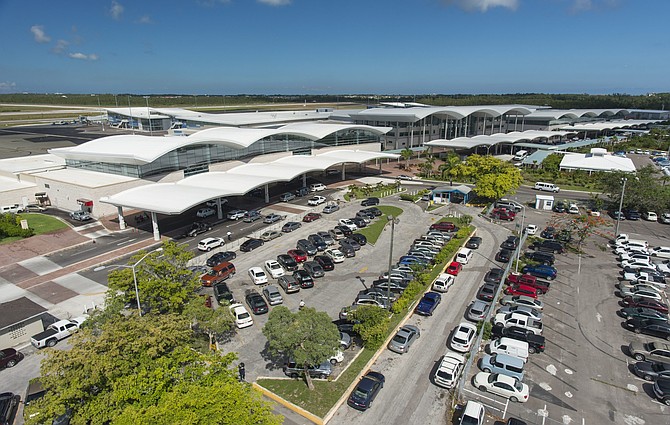
An aerial view of the parking lot at the Lynden Pindling International Airport (Photo: LPIA)
By NEIL HARTNELL
Tribune Business Editor
nhartnell@tribunemedia.net
Bahamian aviation operators yesterday warned travellers to brace for an up to 10 percent hike in air fares due to surging fuel costs with these increases set to be introduced “uniformly” by all carriers to prevent “making a mess of the marketplace”.
Anthony Hamilton, president of the Bahamas Association of Air Transport Operators, told Tribune Business that the sector is forecasting an initial 55-60 percent jump in aviation fuel costs with local privately-owned carriers waiting for Bahamasair to increase its ticket prices before they follow suit with similar rises.
He explained that the industry’s “conventional practice” has been for all carriers to adjust air fares at the same time, and by similar magnitudes, so as to prevent price “gouging” by rogue operators seeking to exploit the situation and avoid “creating a stir” for an industry that works on slim margins of just 2-3 percent.
And Mr Hamilton told this newspaper that Bahamian aviation is also mulling whether to “lobby” the Government for the temporary “waiver”, or elimination, of VAT on aviation fuel to relieve some of the increased cost burden for both carriers and the travelling public - many of whom will have to “bite the bullet” and pay higher ticket prices for essential travel to and from the Family Islands.
Aviation and jet fuel are among the oil-related offshoots most impacted by hikes in global crude prices once they work their way fully through the supply chain. Oil prices, as measured by the Brent crude index, had yesterday increased by 38 percent since the Middle East conflict broke out at end-February to around $100 barrel, and aviation industry insiders previously told Tribune Business that - if these costs double - aviation fuel typically troubles.
Mr Hamilton said that while Bahamasair has yet to increase its ticket prices, such a move is inevitable and only a matter of time, with the whole sector “looking at between a 55 percent to 60 percent” increase in fuel costs as foreshadowed by the national flag carrier.
He added that all Bahamian airlines are set to follow its lead in not just increasing air fares but breaking fuel costs, charges and surcharges out as a separate line item on the ticket so passengers have transparency over how much extra the Middle East conflict is costing them.
“It’s not the overall ticket; it’s the fuel portion of the ticket that is predicted to increase in the range of 55-60 percent,” Mr Hamilton told this newspaper. “We are going to wait for Bahamasair. Once Bahamasair implements, we’ll implement that simultaneously. We have a balanced response from the sector, otherwise it creates a stir, and to avoid gouging.
“Normally, fuel jumps in cents, but this is dollars: It’s about $2 per gallon. What that translates into.. it translates to about an 8-10 percent increase in the overall ticket price because of the fuel component increasing 55-60 percent. Overall, it’s an 8-10 percent increase in the cost of tickets.”
Mr Hamilton said the Bahamian aviation industry’s “conventional practice” has been to respond collectively to fuel-related cost and inflationary pressures, with carriers increasing prices by similar amounts at the same time, “otherwise it makes a mess of the marketplace”.
Voicing hope that the disruption and oil price volatility from Iran’s conflict with the US and Israel will be temporary, he added: “The best we can do is respond rather than reacting, and that’s what we’re setting out to do. The other thing for consideration is potentially lobbying the Government to hold VAT with regard to fuel.”
Mr Hamilton disclosed that the Bahamian aviation industry may initially seek VAT’s temporary elimination on aviation fuel as opposed to simply capping it at existing levels. “If we can get relief in that regard it will be welcome,” he said. “Drop the VAT. The first option is waiving the VAT on the fuel portion of the ticket. The ideal situation is to waive it.
“When you consider domestic travel, in particular, and the burden on citizens, we’d rather not have it. The state should carry it by eliminating the VAT portion. We have to face this and, rather than sitting, we need to take action. We’re seeking to be responsive and proactive, and seek any solution appropriately with regard to it.”
Aviation operators yesterday told Tribune Business they had been informed that fuel prices are set to increase later this week. One added that fuel prices at Odyssey Aviation, the fixed base operator (FBO), had increased by almost 34 percent between pre-war January 2026 and the present, rising by $1.84 per gallon from $5.43 to $7.27 per gallon.
“Obviously rates will go up, and margins will get smaller, but every other country seems to be adjusting fuel taxes to mitigate it, yet I don’t ours will do anything,” one source said. “Our prices have gone up but we have not seen a reduction in demand yet.” They suggested that the impact from escalating travel costs, and rising fuel prices, will likely be felt after the upcoming Easter holidays as many persons will have already booked tickets prior to the outbreak of Middle East hostilities.
Mr Hamilton, meanwhile, said Bahamian carriers have agreed to split out fuel costs as a separate ticket line item so that passengers can better understand what is occurring. “We’ve agreed to treat it as a separate line item so that it can be properly recognised for what it is; the impact is as a result of the fuel,” he added.
“The changes will be reflected in the price in terms of what’s happening in the marketplace. We’ll maintain consistency in the marketplace and not have too much variation that doesn’t disadvantage the public. We’ll be guided by that in terms of this uniform approach in light of the domestic market in particular. The thing is we are an archipelagic nation, so most people will have to bite the bullet. That’s why we have to be uniform in our approach so that there is no gouging in our marketplace response.”
Western Air previously told Tribune Business that air fares will “inevitably” increase after the carrier was told its fuel costs will quickly spike by more than 40 percent due to the Middle East conflict’s impact on global oil prices. Domestic travel to and from the Family Islands, as well as tourism and air freight, all stand to be affected by this.
A veteran pilot and Bahamas flying ambassador yesterday warned that this nation’s lucrative private pilot and aviation market will not be immune from the fuel cost impact. Rick Gardner, director of CST Flight Services, which provides flight co-ordination and trip support services to the private aviation industry, told Tribune Business: “The consensus is that it will trickle its way through.
“I think it will have an impact, but we don’t know how long this thing will last and how high the price of crude oil will go. How big an impact, I can’t tell you. People are going to start looking at the numbers. Jet fuel and aviation gas are already more expensive in The Bahamas than the US. The higher you raise the bar, the fewer that are willing to jump over it, but how many will be less willing, I don’t know.
“It will work its way through the system. A lot depends on how long the spike stays. People may be willing to absorb it if they have a trip planned to The Bahamas, but if it stays high they may not plan another trip. It’s a trickle down effect. When you are burning 150-200 gallons of fuel an hour it adds up fast.”




Comments
Use the comment form below to begin a discussion about this content.
Sign in to comment
OpenID