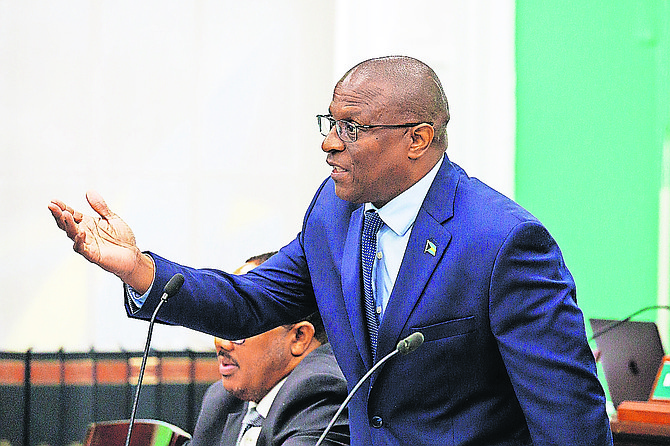
FNM leader Michael Pintard
Hon. Michael Pintard, M.P Leader, Free National Movement
Chairman, Public Accounts Committee
DURING a recent sitting of the House of Assembly, a minority member of the Public Accounts Committee raised concerns about the procedure used to issue a summons for the Attorney General to appear before the Committee.
Let me address that issue first. In issuing the summons, the Committee acted on the advice of the Committee Secretary, who is also the Clerk of the House of Assembly, and Parliament’s in-house Legal Counsel.
We did not invent a procedure or act without guidance. We sought advice from the parliamentary officers responsible for assisting the Committee in carrying out its work, and we acted upon that advice. If there are legitimate questions about the procedure, those questions can and should be addressed. Parliamentary procedure matters.
The Committee must follow the rules, just as the Government must follow the law. But a larger constitutional principle is at stake. The Westminster tradition deliberately places the chairmanship of the Public Accounts Committee in the hands of the Opposition and, in The Bahamas, provides for Opposition majority representation on the Committee.
This arrangement is intended to ensure that the Government cannot use its parliamentary majority to frustrate independent scrutiny of public expenditure. It would defeat that purpose if the Government’s representatives could effectively prevent the Committee from compelling an unwilling witness to attend simply by refusing to support a summons.
The interpretation of the applicable parliamentary rules must be consistent with the Committee’s ability to perform its oversight responsibilities. We must not allow a disagreement over procedure to overshadow the much larger issue. Why is the Public Accounts Committee being prevented from obtaining answers about the movement and expenditure of hundreds of millions of dollars of public money?
The Committee is investigating the National Investment Fund and, in particular, the authority under which the Ministry of Finance transferred and expended funds through an account at the Central Bank of The Bahamas bearing that name. The questions are neither frivolous nor politically manufactured. On 16 September 2026, the Minister of Finance delivered a statement to Parliament in which he acknowledged that questions had arisen concerning the authority under which the Fund’s resources were administered.
He told Parliament: “The Government has sought settled advice from the Office of the Attorney-General concerning the interaction between the Public Finance Management Act, the National Investment Funds Act and the relevant parliamentary authority. We acted in accordance with that advice.”
That is an important admission. The Government says it acted on legal advice. The Committee is asking questions to establish what authority was relied upon and whether public funds were administered in accordance with the law.
Yet, when the Attorney General appeared before the Committee, he declined to answer certain questions on the ground of legal professional privilege. He has also advised his predecessor, former Attorney General L. Ryan Pinder, KC, not to appear before the Committee because his evidence might breach that privilege. There are two issues here that the public should understand.
First, the office of Attorney General does not carry a blanket immunity from parliamentary scrutiny. The Attorney General is the Government’s chief legal adviser, but that position does not automatically exempt the officeholder from answering questions about the administration of public affairs or the expenditure of taxpayers’ money.
Legitimate protections exist for confidential legal advice, Cabinet confidentiality, and information whose disclosure may harm the public interest. Those protections must be respected where they properly apply. But they are not the same as a general right to refuse parliamentary questioning. Not every question asked of an Attorney General requires the disclosure of privileged legal advice.
There is a difference between asking an Attorney General to reveal confidential legal advice and asking factual questions about the work undertaken by the Office of the Attorney-General. Who prepared the parliamentary Resolution? When was it prepared? What steps were taken to establish whether the National Investment Fund was operational? What public records exist concerning the transfer of funds?
These are legitimate areas of inquiry. Whether privilege applies must be considered in relation to the particular question and the information sought. The mere fact that a question is directed to an Attorney General does not make the answer privileged. Second, the Government has the ability to address the privilege issue directly.
Legal professional privilege exists to protect the client, not to provide a personal shield for the lawyer. Where the Government is the client, the question of whether privilege should be waived is one for the appropriate authority acting on its behalf.
That brings us back to the Minister of Finance. Having publicly relied upon advice from the Office of the Attorney-General to explain the Ministry’s actions, the Government should now agree to waive any applicable privilege or convention of confidentiality necessary to allow the Committee to examine that advice. This is especially important because the Minister’s own statement acknowledged that the Fund’s governance arrangements were not fully operational when the Ministry proceeded to administer the resources.
The Minister also told Parliament: “The Government does not suggest that a worthy public purpose removes the need for proper governance.” He was right. The Government’s claim that the money was spent on roads, airports, public buildings, and other projects does not answer whether the funds were transferred and spent in accordance with the law. Indeed, establishing precisely how those funds were used is itself part of the Committee’s investigation. Good intentions do not replace legal authority.
Nor does the eventual use of public money excuse a failure to follow the procedures Parliament established. The Minister went further in his statement, declaring: “Public benefit and accountability are complementary obligations. The stronger the public investment, the stronger the systems of oversight, reporting and assurance must be.” I agree with every word. But accountability cannot be something we praise in Parliament and resist when Parliament attempts to exercise it.
The Public Accounts Committee is one mechanism through which Parliament examines the use of public funds. Its responsibility is not to protect the Government or the Opposition. Its responsibility is to the Bahamian people. We have not concluded that wrongdoing occurred.
We are attempting to establish the facts. If the Government is confident its decisions were lawful, it should welcome the opportunity to demonstrate that through the evidence.
The Minister of Finance also made a specific promise: “The Government intends to fully cooperate with the Chairman of the Public Accounts Committee on this matter.” That promise must mean something. Full cooperation cannot mean providing only the information the Government is comfortable releasing. Nor can it mean relying on legal advice to justify decisions while preventing the Committee from examining the basis for that justification.
We have therefore requested that the Government waive any applicable privilege or convention of confidentiality to allow the current and former Attorneys General to provide the evidence the Committee needs to discharge its responsibilities.
If the Government refuses, it should explain that refusal to the Bahamian people. Let us return to the procedural issue raised in the House of Assembly. If there is a procedural defect in the issuing of a summons, let it be identified and addressed. The Committee has no interest in disregarding Parliament's rules. But correcting a procedural issue, if one exists, does not make the underlying questions disappear. It does not explain why funds were transferred into an account bearing the name of a statutory Fund whose governance arrangements were not yet fully operational.
It does not establish the legal authority under which those transactions occurred. And it does not relieve those who made or advised upon those decisions of the responsibility to account for their actions, subject to any properly applicable legal protections.
The issue is not whether the Attorney General should be treated unfairly. He should not.
The issue is whether the Bahamian people should be denied answers about how their money is handled. They should not.
Parliamentary oversight is not an inconvenience to be managed. It is an essential part of democratic government. The Public Accounts Committee will continue its work, guided by the law, the rules of Parliament and its responsibility to the people of The Bahamas.
The Government has promised cooperation. We are asking it to keep its word.




Comments
Use the comment form below to begin a discussion about this content.
Sign in to comment
OpenID