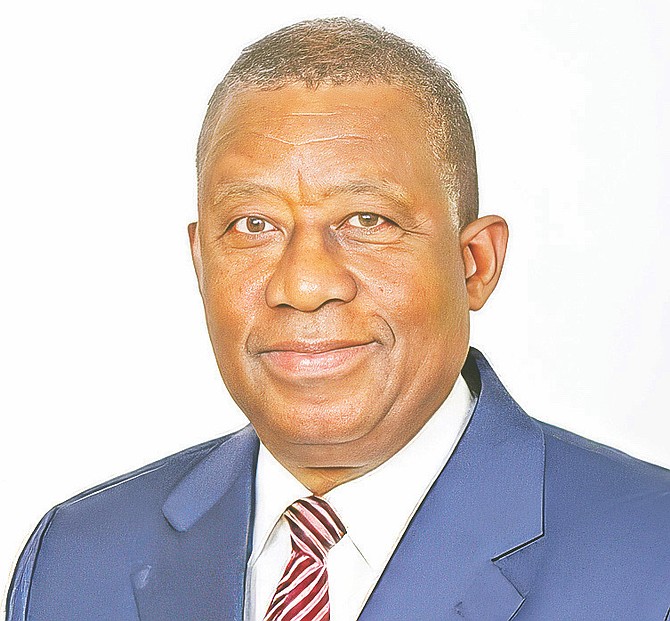
Former Central Bank Governor James Smith
By RASHAD ROLLE
Tribune News Editor
rrolle@tribunemedia.net
JAMES H. Smith, who guarded the Bahamian dollar for a decade as governor of the Central Bank and was trusted by prime ministers on both sides of the political divide, died on Saturday. He was 79.
As tributes spread across social media, many remembered him as an honourable man, a statesman and a distinguished gentleman.
Prime Minister Philip Davis called him “a national treasure”, saying his loss would be felt across public life and in the country’s financial institutions.
Former Attorney General Sean McWeeney, who sat on bank boards with him for many years, said Smith was “as smart as a whip and as honest as the day is long”.
Mr McWeeney also spoke of Smith’s late wife, Portia, a pioneer at the College of The Bahamas, now the University of The Bahamas, which named a building in her honour. He said the couple had been, without ever meaning to be, “one of the premier evenly-yoked power-couples in the country”, she in tertiary education and he in banking and finance.
“Although much of James’s success still lay before him when Portia died, his closest friends would observe that he was never quite the same after that,” Mr McWeeney said. “Happily they are now together again.”
Smith was educated in Canada at the University of Alberta, the University of Windsor and Ryerson University, earning bachelor’s and master’s degrees in economics and a diploma in financial management. He came home to serve in the Ministry of Finance, first as Secretary for Revenue and later as Permanent Secretary, helping to shape the fiscal policy of the newly independent nation. He also represented The Bahamas as Alternate Governor at the International Monetary Fund.
He became governor of the Central Bank on February 1, 1987, under Sir Lynden Pindling, and held the post until January 1997. During that time, he also chaired the Paradise Island Bridge Authority.
Central Bank Governor John Rolle said Smith’s thoughtful leadership and calm demeanour steadied the economy and financial sector through domestic challenges and international stress. The first war in Iraq hit while local banks were already short of liquidity. Under Smith, the Central Bank first capped deposit rates to calm what Mr Rolle described as “the destabilising competition for funding resources”. When the war broke out, it added a limit on consumer credit growth to protect the foreign reserves.
The economy recovered gradually. The consumer credit restrictions were lifted by 1993, and the interest rate controls were removed in 1994.
Mr Rolle said Smith also inspired the localisation of the Bank of Montreal, which became Bank of The Bahamas, as Bahamian ownership of the banking sector grew. He invested in training, personally mentored staff to become better economists, regulators and technicians, and presided over the creation of one of the first public art gallery spaces in The Bahamas, still housed at the Central Bank.
“In all of his future pursuits,” Mr Rolle said, “James remained a Central Banker, a friend and counsellor to its leadership.”
Under Hubert Ingraham, Smith served as Ambassador for Trade for five years until April 2002. He chaired the services negotiations for the Free Trade Area of the Americas, and led or joined trade and investment missions to countries including Canada, the United States, China, Japan, South Korea and Dubai. He also chaired the Bahamas Maritime Authority from 1997 to 2002.
In 2002, Perry Christie appointed him to the Senate and the Cabinet as Minister of State for Finance, with responsibility for day-to-day fiscal affairs, budget planning and the financial services industry. He retired from public office in 2007.
“Few Bahamians have earned such confidence across the political divide,” Mr Davis said. “He earned it through competence, discretion and loyalty to country.”
Mr Davis said Smith’s appointment as minister had steadied confidence in the financial sector, at home and abroad, at a delicate moment. He said that when he carried the finance portfolio during his own first term, he came to understand how much the country’s financial stability owed to the foundations laid by Smith’s generation.
In a Facebook post, Deputy Prime Minister Chester Cooper said he and Smith shared a warm and respectful relationship even as competitors in financial services. He recalled that as Minister of State for Finance in early 2007, Smith approved the deal that allowed Mr Cooper, then 36, and his business partner John Wilson, then 42, to acquire British American. Mr Cooper said Smith did so without hesitation, pleased to see young Bahamian entrepreneurs take ownership in the industry.
“That was the measure of the man,” Mr Cooper said. “He believed in Bahamian ownership, Bahamian enterprise and the potential of our people.”
Mr McWeeney said Smith was a calming influence in turbulent economic times, and the quintessential technocratic minister who never let partisanship get in the way of what he believed was best for the country. On macroeconomic issues, he said, no one in The Bahamas commanded more respect.
“He was in a class by himself,” Mr McWeeney said.
He said Smith was a long-time member of a think tank chat group but seldom posted because he had a strong aversion to controversy. Instead, he would send private messages to members about whatever was being discussed.
Mr McWeeney, who served with Smith on the board of Scotiabank and on several Swiss-based bank boards, called him the personification of the good, solid, independent non-executive director: always thoroughly prepared and always taking an active part.
After leaving public office, Smith chaired Colina Financial Advisors Limited (CFAL) and sat on the boards of several banks and the Bahamas International Securities Exchange. CFAL, where he was chairman emeritus and part of the company for more than 25 years, said he had a remarkable ability to make everyone he spoke with, from senior managers to those just starting their careers, feel seen, heard and valued.
“He was, in every sense, a gentleman,” the company said.
Smith was appointed a Commander of the Most Excellent Order of the British Empire (CBE) in 2000. In 2017, the financial services industry gave him its Lifetime Achievement Award. He was also a trustee of the Governor General’s Youth Award and of the Anglican Diocese Pension Fund.
“We honour him best,” Mr Davis said, “by keeping faith with the standards he set: prudence with public money, integrity in public office and devotion to the national interest.”




Comments
Use the comment form below to begin a discussion about this content.
Sign in to comment
OpenID