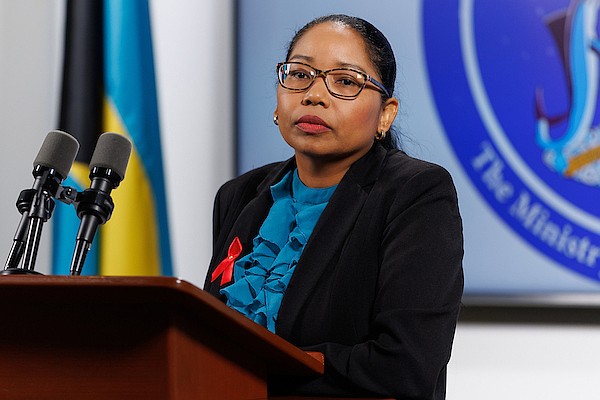
Director of the National HIV/AIDS and Infectious Disease Programme at the Bahamas Ministry of Health Dr Nikkiah Forbes speaks during a press briefing on the status of HIV and other sexually transmitted infections in The Bahamas at the Office of The Prime Minister on July 17, 2025. Photo: Dante Carrer/Tribune Staff
By EARYEL BOWLEG
Tribune Staff Reporter
ebowleg@tribunemedia.net
THE Bahamas has reduced mother-to-child transmission of HIV to two percent or less, achieving a key international benchmark that removes it as a significant public health threat, health officials said yesterday.
Dr Nikkiah Forbes, director of the National Infectious Diseases Programme, said the country has received certification for the elimination of mother-to-child transmission of HIV, joining 12 countries worldwide to reach the milestone.
She said the designation does not mean transmission has been reduced to zero, but that cases are now so rare they are no longer considered a public health emergency.
The certification followed a review of strict international indicators, including transmission rates, perinatal HIV incidence, antenatal care coverage, HIV testing during pregnancy and access to treatment for pregnant women living with HIV.
Between 2022 and 2024, The Bahamas met or exceeded all targets. Perinatal HIV incidence stood at 0.2 per 1,000 live births, below the 0.3 benchmark, while antenatal care coverage reached 98.3 percent. HIV testing during pregnancy was recorded at 97.5 percent, and more than 95 percent of pregnant women living with HIV received antiretroviral therapy.
Over that period, there were only two cases of perinatal transmission among nearly 10,000 live births. An in-country assessment conducted in October also reviewed programme services, verified data, assessed laboratory testing and gathered feedback from patients.
Dr Forbes said the focus now is on maintaining the gains through early antenatal care, consistent testing, improved surveillance and targeted outreach to vulnerable groups, including migrants.
She said preliminary data suggest the country is making progress toward the goal of eliminating AIDS by 2030. In 2024, 95 percent of people living with HIV knew their status, 78 percent of those people were receiving treatment, and 91 percent of those on treatment achieved viral suppression.
However, she acknowledged gaps remain in expanding access to treatment and said efforts are underway to decentralise antiretroviral therapy across more clinics in the public healthcare system. She also noted that pre-exposure prophylaxis remains underused despite increasing uptake.
“PrEP is going up but I do want to say that prep is underutilised everywhere,” she said. “For those that are listening, PrEP is a medication. It is a prevention strategy for people who are HIV negative, who have an increased risk of getting HIV, and that could be someone who's had an STI in the past six months to a year, someone who may have multiple partners and is not always using condoms, someone who has one partner but thinks that their partner may have multiple partners and is not always using condoms.”
Health and Wellness Minister Dr Michael Darville said the certification reflects the performance of healthcare workers and the strength of the national health system.
“This certification requires not only quality clinical services, but also the ability to monitor performance and verify results. The capacity will remain critical as we maintain this high level of standard across both the public and private healthcare setting,” he said.
“This certification is not a one-time accomplishment. It is a standard that must be maintained that means continued investment in our workforce, reliable access to diagnostics and treatment and strong supply chains and sustain coverage of services across all of our islands that are inhabited.”
He also recognised the contribution of former Health Minister Dr Perry Gomez, the first director of the National AIDS programme, who died in 2023.
Dr Eldonna Boisson, PAHO/WHO representative for The Bahamas and Turks and Caicos, said the achievement reflects years of sustained work and partnership.
“It's an opportunity to reflect on the work that brought us here. The hard long work, and to recognise the systems and the partnerships that sustain progress and to reaffirm our shared responsibility to protect the health of mothers and children. Today, we celebrate lives protected, futures secure, and a nation that has shown what leadership in public health looks like.”
Prime Minister Philip Davis, in a video message, said the milestone reflects a national commitment to protecting the health of mothers and children.




Comments
bahamianson 1 month, 1 week ago
Weird! Reducing is not ending. Ok, we get credit for reduce because it had to be a lot of work from our professionals, but it is not ended, it is greatly reduced.What are you writing? Stop urinating on us and telling us it is raining. Just print the truth!
Sign in to comment
OpenID