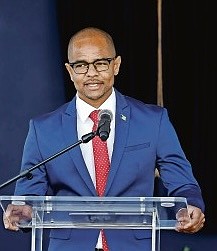
Sebastian Bastian
The Bahamas will seek to leverage Estonia’s “model for e-governance” to “accelerate” its own roll-out of digitised public services, a Cabinet minister has affirmed.
Sebas Bastian, minister of innovation and national development, in a statement said a just-signed Memorandum of Understanding (MOU) with the Baltic state establishes a long-term partnership and co-operation that will help to advance digital transformation and innovation in The Bahamas.
Besides learning from Estonia, regarded as being among the world’s digital society and government leaders, the agreement will also seek to foster Bahamian entrepreneurs and creativity in this sector so that the country builds increased capacity.
Mr Bastian said Estonia's experience provides The Bahamas with an invaluable opportunity to learn from one of the world's leading digital governments. "Estonia has really been the model for e-governance in their advancement in digital identity, interoperable frameworks and how modern governments work,” he added in the statement.
“As The Bahamas looks to move in that direction, having a country that has travelled that road and has the experience, the learnings and even the missteps to share helps us move faster. Being able to draw on that technical support allows us to take out some of the guesswork and accelerate our efforts as we modernise government for the Bahamian people."
Mr Bastian said that while the partnership is technology-based, its success will ultimately be measured by the opportunities it creates for Bahamians and the country's ability to build lasting national capability.
"Success isn’t simply importing technologies from all over the world and being adopters of AI (artificial intelligence), but being developers and builders. Capacity building is what success looks like and, most importantly, success looks like sovereignty,” he explained.
“We want our people building these technologies, operating them, owning them, deploying them and exporting them. Sovereignty means capacity. It means access. It means oversight. It means true ownership of government and private sector data and protections, and we felt Estonia understood and supported that vision."
Mr Bastian signed the MoU with Liisa-Ly Pakosta, Estonia’s minister of justice and digital affairs, on the sidelines of the 41st annual CANTO regional communications conference and trade exhibition.
The agreement establishes a framework for collaboration between the two countries in the exchange of knowledge, technical expertise and best practices across a range of digital transformation priorities, including digital government; interoperability; digital identity; artificial intelligence; cyber security; digital infrastructure; institutional capacity; and citizen-centred public services.
The deal also provides for technical exchanges, study visits, workshops and partnerships involving government, industry and technology stakeholders in both countries. The agreement builds on discussions started just one month earlier during the United Nations (UN) global dialogue on AI governance in Geneva, where Mr Bastian met Estonian officials to explore opportunities for strategic co-operation in AI, digital government and government modernisation.
The Ministry of Innovation and National Development described Estonia as recognised worldwide for having one of the globe’s most advanced digital societies. It added that the Baltic state is viewed as a pioneere for secure digital identity, interoperable government systems and citizen-centred digital public services.
Through the partnership, the ministry said The Bahamas will seek to leverage Estonia's experience as it pursues digital transformation and builds the institutional capacity needed to support a modern, efficient and future-ready government.
Ms Pakosta said Estonia views the partnership as an opportunity for both countries to learn from one another while advancing inclusive digital transformation.
"Estonia is a small country and we value co-operation globally because we believe there should be no digital divide, and that every country should have the opportunity to benefit from digital transformation,” she said.
“We see this co-operation not as showing others how to do things, but as learning from each other. Estonia is a good partner because we not only share our successes, but also our mistakes so they can be avoided. We are very practice-oriented, results-oriented and open in our co-operation."
Ms Pakosta added that the ultimate measure of success for the partnership will be the tangible improvements it delivers for Bahamian citizens, businesses and future generations.
"The success of this partnership will be when your citizens feel that services are becoming more efficient and better, and when your companies feel they have more opportunities. Most importantly, your young people should know they have a bright future in their own country because it is digitally advanced and creates opportunity,” she said.
The Ministry of Innovation and National Development said that, for The Bahamas, the partnership represents an important milestone in work to modernise government, strengthen national capability in emerging technologies and position the country to compete in an increasingly digital global economy.
Mr Bastian said: “The Ministry's approach is grounded in the belief that innovation must ultimately translate into better public services, greater economic opportunity and stronger national competitiveness for Bahamians.
“The speed with which this partnership has progressed, from our initial discussions in Geneva to today's signing, reflects the shared commitment of both countries to moving from dialogue to meaningful impact. We are grateful to the Republic of Estonia for its friendship and willingness to share its expertise, and we look forward to working together to develop practical solutions that reflect The Bahamas' unique needs and priorities.”
The signing forms part of the Ministry of Innovation and National Development's broader international engagement strategy, which seeks to establish practical partnerships that support government modernisation, responsible AI adoption, digital transformation and the development of future-ready skills for Bahamians.




Comments
Use the comment form below to begin a discussion about this content.
Sign in to comment
OpenID