By RASHAD ROLLE
Tribune News Editor
rrolle@tribunemedia.net
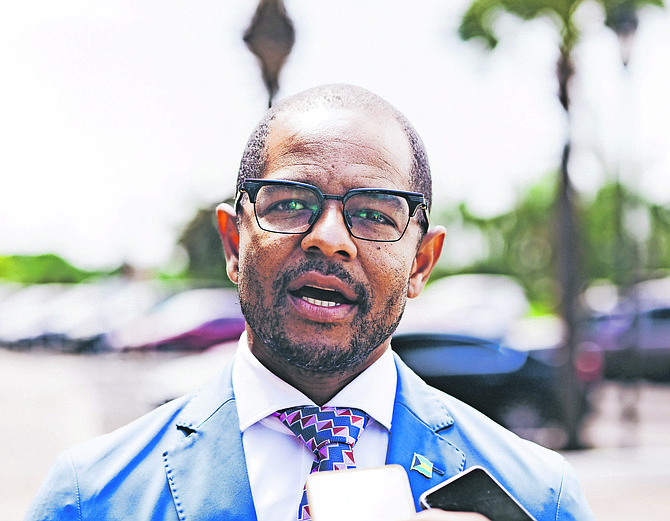
THE Bahamas should not allow foreign technology companies or consultants to control critical government systems in ways that leave the country unable to audit them, retrieve its data or switch providers, Innovation and National Development Minister Sebastian Bastian said yesterday, warning that technological dependence could become a modern form of “digital colonialism”.
Mr Bastian, in a wide-ranging address to the Rotary Club of Southeast Nassau on “The Power of Sovereignty”, argued that political independence is no longer sufficient to guarantee a country meaningful control over its affairs as governments, businesses and citizens become increasingly dependent on digital infrastructure, cloud services, algorithms and foreign technology providers.
“The next form of colonialism,” he said, “may not arrive with soldiers.”
Mr Bastian said it could instead come through systems countries cannot inspect, algorithms they cannot question, contracts they cannot exit and essential services they can use but cannot control.
“Digital colonialism begins,” he said, “wherever convenience becomes dependency.”
The minister's remarks amounted to a call for The Bahamas to exert greater control over the technology underpinning government services and critical infrastructure, including by ensuring that the country can audit systems, retain access to its information, recover from cyberattacks and move away from providers when necessary.
Mr Bastian stressed that he was not advocating that the State own every cable, data centre, cloud system or piece of software, nor was he arguing against foreign investment or international technology partnerships.
However, he said where national life depends on technology, The Bahamas must maintain lawful authority, secure access, alternatives when systems fail, technical competence, audit rights and an ability to change providers.
“That is the balance,” he said, “open, but not exposed; connected, but not captured; partnered, but never powerless.”
Mr Bastian singled out submarine telecommunications cables as critical national infrastructure, saying approximately 99 percent of global Internet traffic travels through them and that they carry commerce, banking, government communications, education and health information.
For an archipelagic country, he said, cable routes, landing points, available capacity, maintenance, diversity and emergency restoration should be treated as matters of national resilience.
“No single failure,” he said, “should isolate our people or paralyse our economy.”
He made a similar argument about data centres and cloud infrastructure, pointing to the growing dependence of civil registration, customs, taxation, social assistance, health records, education, payments, ports, licensing and emergency response on digital systems.
Mr Bastian said governments must be able to determine whether those services could continue if connectivity failed, whether they could migrate systems if a vendor changed its terms, whether they could recover after a cyberattack and whether the country's data and expertise would remain after a contract ended.
“If someone else can switch off the systems that run your country,” he said, “you have digitised dependence — not development.”
He called for diverse digital routes, backup capacity, tested recovery plans, stronger cybersecurity, trusted hosting arrangements and a clear national assessment of which digital assets are critical.
The minister was particularly pointed about the procurement of technology used to run essential government services.
“Government should never buy a black box it cannot audit, secure, operate, or leave,” he said.
Mr Bastian said contracts for critical systems should require open standards, data portability, cybersecurity protections, continuity, audit and exit rights, trusted backups and meaningful transfers of knowledge.
“This is not technical housekeeping,” he said. “This is statecraft.”
He warned that a government could own its buildings and employ thousands of public officers but still effectively depend on technology controlled elsewhere.
Mr Bastian said it could even pass laws in Parliament while lacking the technical capacity needed to put those laws into effect.
Digital government, he said, should therefore be treated as public infrastructure that is reliable, interoperable, secure, inclusive and accountable to Bahamians.
The speech did not announce new legislation, procurement rules, spending or a new government programme, but laid out principles Mr Bastian said should govern the country's approach to technology and digital development.
He also extended his warning about technological dependence to the private sector, saying hotels depend on booking platforms, retailers on payment processors, creators on social networks and small companies may store invoices, customer information and ideas in a single cloud account.
Mr Bastian said those technologies create opportunities but also concentrate power, leaving companies vulnerable when algorithms change, fees increase or accounts are suspended.
“A business that needs an algorithm's permission,” he said, “to reach its own customers does not fully own its market.”
He called on businesses to maintain direct relationships with customers, protect intellectual property, retain usable copies of their data, strengthen cybersecurity and diversify payment and sales channels.
Mr Bastian also called for Bahamian technology companies to receive opportunities to undertake significant work, gain access to capital, protect their intellectual property and sell their products and services abroad.
While saying The Bahamas should continue welcoming international investment and pursuing partnerships with global companies, he argued that major technology agreements should produce benefits extending beyond access to a product or service.
“Every major technology agreement,” he said, “should leave us with more than an invoice and a login.”
He said such agreements should leave skills, infrastructure, local suppliers and institutional knowledge in the country and, wherever possible, Bahamian intellectual property and ownership.
The minister placed particular emphasis on building local technical expertise, warning that merely purchasing technology would not eliminate dependence if Bahamians remained unable to operate, repair, adapt or secure it.
“A nation cannot outsource,” he said, “what it never learned to do.”
Mr Bastian said capacity building should be incorporated into technology contracts from the outset and major digital projects should create apprenticeships, certifications, trained public officers, experienced engineers, vendor-neutral documentation and opportunities for local firms.
He said The Bahamas needs software developers, cybersecurity professionals, data scientists, cloud architects, network engineers, artificial intelligence specialists, entrepreneurs and public officers capable of governing technology.
That skills pipeline, he said, should extend from schools through technical training, university and employment opportunities and include New Providence, Grand Bahama and the Family Islands.
Mr Bastian also urged the country to develop technology aimed at areas where Bahamians have direct experience, identifying inter-island logistics, hurricane preparedness, marine protection, financial services, tourism, health, food security, digital government and the creative economy.
He said Bahamian software should ultimately serve Caribbean markets, local cybersecurity companies should be able to protect international clients and creators should retain ownership of digital content.
“We must not generate the data,” he said, “while someone else captures all the value. The Bahamas must not simply log into the future. We must help code it.”
Mr Bastian framed the challenge as the modern extension of the country's independence project, contrasting the political sovereignty achieved in 1973 with what he described as the need for digital sovereignty today.
He said responsibility for achieving that goal extends beyond the government to telecommunications providers, banks, educational institutions, technology companies, regulators, investors, entrepreneurs, parents and ordinary citizens.
He urged businesses to consider whether they could continue functioning if their principal digital platform failed and ministries to determine who controls their systems and whether Bahamians are capable of operating and developing them.
Schools, he said, should consider whether they are merely teaching students to use technology or equipping them to create it.
“The generation of 1973,” he said, “secured the right to govern our land.”
“Our generation,” Mr Bastian said, “must secure the right to govern our digital future.”
Meanwhile, Economic Affairs Minister Senator Jerome Fitzgerald also warned yesterday that the Caribbean risks a new era of “digital colonisation” unless governments take greater control of data, technology infrastructure and artificial intelligence.
Speaking at the CANTO conference, Mr Fitzgerald said Caribbean nations risk becoming dependent on foreign-owned digital systems while data, profits and decision-making remain overseas.
“The Caribbean is entering the digital age through an architecture that risks reproducing the central logic of the colonial age,” he said, warning of “extraction without ownership, participation without power, and dependence presented as development”.
Mr Fitzgerald called for a Caribbean Digital Sovereignty Compact setting common regional standards for data centres, cybersecurity, cloud contracts and disaster recovery. He also proposed regional cloud and cybersecurity capabilities and technology contracts requiring open standards, independent audits, Caribbean-controlled encryption and knowledge transfer.
He said the World Telecommunication and ICT Policy Forum, scheduled for New Providence from September 1 to 4, gives Caribbean governments and regulators an opportunity to develop a united position on digital sovereignty.




Comments
realfreethinker 3 weeks ago
Here we go . The fix is in. Can anyone say " Island Luck
Cobalt 3 weeks ago
I agree with Mr. Bastian in theory but in practicality I don’t.
As it currently stands, Bahamians haven’t demonstrated the ability to consistently operate and manage complex technologies needed to support fluid infrastructure. Brief example, take a look at BPL. The simple fact is, our people nor its government has invested or laid the educational and developmental framework necessary to meet today’s technological demands. We simply have not built that foundation. Technological concepts and frameworks need to be built from the ground up. As far as I know the Bahamas doesn’t produce any computer programmers, electronic coders or software engineers. These people are the actual scientists needed to build and connect these complex computer systems. And because we don’t have these human resources readily available, we end up having to outsource these jobs to North America or Europe. The best we can hope for is to establish various over-site committees to monitor operations and regulate profits.
bahamianson 3 weeks ago
Yeah and we voted No against the Numbers boys and the plp ignored our votes. You should be the ladt to talk. You are in every thing teying to control everything. The fnm candidate could not out donate you because you have millions. It is a travesty that you won the seat coming from an irregular numbers racket.
hrysippus 2 weeks, 6 days ago
No other article of clothing says "I admire British colonialism" as much as a necktie. Mr Bastian appears to be wearing an particularly expensive example.....
JohnQ 2 weeks, 6 days ago
Really, our sovereign entity is incapable of providing reliable electrical service.
birdiestrachan 2 weeks, 6 days ago
Bahamianson as soon as.people stop buying numbers the business will close See what you can do about that The government receive.some money from taxing them
screwedbahamian 2 weeks, 6 days ago
Since the government receives soo much taxes on them selling a fallacy dream to the destitute population of winning loss money back from the number houses makes it okay, then Drug trafficking, Prostitution, Human trafficking, Money Laundering and Smuggling weapons should be regularized and just think of all the tax money they will bring in to spend and the business people becoming law makers.
TalRussell 2 weeks, 6 days ago
Is it safe to turn drug trafficking, prostitution, human trafficking, money laundering, and smuggling weapons into regular activities and just think of all the tax money they will bring in to spend even greater amounts on government stuff and sundries'—yeah?
Sign in to comment
OpenID