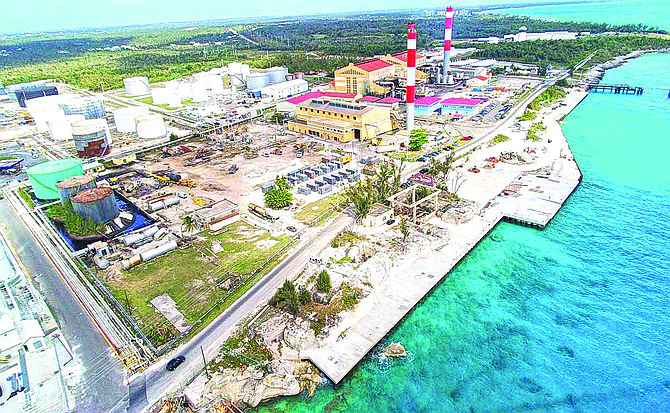
BPL Clifton Pier Plant
By LEANDRA ROLLE
Tribune Chief Reporter
lrolle@tribunemedia.net
ABOUT $20m a year has been spent on overtime at Bahamas Power and Light, the Davis administration confirmed yesterday, calling the level “unacceptable” and “unsustainable” after a review identified what it described as unusual patterns and anomalies in overtime practices.
The disclosure followed The Tribune’s exclusive report on internal BPL records showing that three employees in the fuel and performance department collectively received more than $600,000 in overtime between May 2025 and April 2026.
The records, produced following a probe into overtime expenses, showed monthly overtime payments to the three employees ranging from about $20,000 to $25,000, with the sums exceeding their annual base salaries several times over.
However, while the administration has outlined measures intended to prevent similar patterns in the future, it remains unclear who approved the payments already made, why they were allowed to reach such high levels or whether anyone will ultimately be held accountable.
The Tribune sought answers yesterday from senior BPL officials and members of its board. Those who could be reached declined to comment, while others did not respond to repeated calls and messages up to press time.
The government said any suspected irregularity would be examined and that action would be taken, in accordance with the law, if wrongdoing, negligence or a failure of oversight is established, whether involving an employee, manager, director or another responsible officer.
It said, however, that BPL would not prejudge anyone or reach conclusions before the facts were properly established.
The revelations have intensified scrutiny of BPL’s overtime practices and raised broader questions about management oversight at the utility.
Former Works Minister Desmond Bannister, who had ministerial responsibility for BPL under the Minnis administration, blamed management failures and questioned whether the company had sufficient professional capacity.
“There’s no way that amount of overtime would accumulate at BPL if they didn’t have management challenges,” Mr Bannister said.
He said the scale of the overtime also pointed to shortcomings in BPL’s ability to maintain its operations.
“If they had the abilities that they — the professional skills that they needed,” he said, “this would never come up.”
Mr Bannister acknowledged there may have been overtime anomalies during his tenure but said nothing occurred on the scale now being reported.
In its statement yesterday, the Davis administration said it had spent several months engaging through BPL’s board and executive leadership with the Bahamas Electrical Workers Union, the Bahamas Electrical Utility Managerial Union and other stakeholders over the need for a more transparent, accountable and sustainable overtime system.
The administration acknowledged that overtime is sometimes necessary to maintain reliable electricity service, respond to emergencies and protect public safety.
However, it said an overtime bill approaching $20m – as The Tribune revealed yesterday - annually imposed an unreasonable burden on BPL’s finances and, ultimately, the Bahamian public.
The administration said the changes were not designed to prevent legitimate overtime or deny workers compensation that had been approved.
Instead, it said the objective was to ensure overtime was necessary, fairly allocated, properly authorised and fully documented, while reducing excessive working hours and fatigue-related risks to employees, their colleagues and the public.
The government said BPL wanted to ensure that the “unusual patterns and anomalies” identified during its overtime review did not recur.
It said the review was focused on strengthening BPL’s systems and processes rather than targeting individual employees.
The government also placed specific responsibility on BPL’s management going forward, saying managers and directors would be responsible for properly authorising, documenting, monitoring and reporting overtime within their areas.
The overtime changes have triggered opposition from the Bahamas Electrical Workers Union, which has instructed members to work only their normal hours and leave afterwards.
The union has also filed a trade dispute, arguing that the changes breach its industrial agreement.
“We will not stand for these injustices,” the union said in a notice to members.
It instructed workers to perform “NORMAL WORKING HOURS ONLY” and afterwards “GO HOME.”
The Bahamas Electrical Utility Managerial Union, which represents middle managers, has also pushed back against suggestions that workers should bear responsibility for excessive overtime.
“Employees should not bear the public blame for overtime that was required, authorized, approved, monitored and paid through established management processes,” BEMU said.
The managerial union said it supports accountability, oversight and responsible management but argued those principles must apply at every level of the organisation.
It also objected to the public release of sensitive employee information, saying such information should be handled responsibly and in accordance with applicable privacy and data-protection laws.
BEMU stressed that BPL operates around the clock and said overtime is unavoidable in some circumstances because of emergencies, system failures, restoration efforts, maintenance, staffing shortages and other operational demands.
“BPL operates 24 hours a day, seven days a week, 365 days a year,” the union said.
It said continuity of operations is required because the company provides an essential service.
BEMU argued that where a department has been understaffed and employees have consistently worked excessive overtime for months or years, the appropriate response is to assess staffing levels, workloads and manpower requirements rather than blame workers.
The Davis administration acknowledged the right of union leaders to oppose or raise concerns about the changes and said it would not speculate about the motives of union representatives who disagreed with them.
It said “constructive dialogue” would continue and legitimate concerns would be considered, but maintained that it had a responsibility to protect workers, safeguard public funds and ensure BPL operates safely, transparently and in the national interest.
The administration said it expects the changes to be implemented consistently and fairly across BPL and expects cooperation from management, employees and union representatives.
The dispute comes during a difficult summer for BPL, which has faced repeated power outages and criticism over the reliability of electricity supply across New Providence.
It also comes amid a changed electricity landscape in which Bahamas Grid Company manages New Providence’s transmission and distribution network, while BPL remains responsible for generation and continues to work alongside BGC.
That division of responsibility has raised questions about what impact, if any, the BEWU work-to-rule posture could have on restoration work.
BEWU president Kyle Wilson said the separation between BPL and BGC does not mean BPL employees are no longer involved in transmission and distribution work.
He said a significant portion of overtime is owed to BPL employees who have been assisting BGC.
Mr Bannister also defended workers against being made scapegoats for wider operational problems.
He criticised the Davis administration’s decision to terminate the Wärtsilä agreement and bring in BGC, which he said had no prior experience in the area.
“So you have these minimal number of BPL workers who have to fill in on all these things,” Mr Bannister said.
“These guys are going there,” he said. “They’re doing their best in circumstances that are not good at all.”
He said management should have identified any problems long before the present controversy.
“They should not be scapegoats,” Mr Bannister said. “And if there was challenges, people who manage them ought to have known that a long time ago. It doesn’t come up overnight.”




Comments
birdiestrachan 1 hour, 54 minutes ago
Mr banister and Mr Wilson have to admit that the overtime pay is excessive. But it depends on if they are honest or not.
birdiestrachan 1 hour, 37 minutes ago
Well you know Mr banister papa sold Btc and Btc does not work it may not be as obvious. But it does not work it is a waste of money paying for Btc service
DaGoobs 1 hour, 20 minutes ago
Clearly the people in Government are not following the shambles that BPL as a so-called "power producer" has become. On their WhatsApp channel, they report daily outages somewhere or other in New Providence and many times in more than one location. If the power system is so bad that it is breaking down daily, then the natural thing is that the company will incur overtime pay in having their workers go out and work on fixing the problem. After all, which one is worse - no electricity or a bunch of electrical workers being paid overtime pay to get the system back on? If successive governments had spent their time and found the money to repair, replace and rejuvenate the antiquated electricity systems that BEC/BPL has, then we might not find ourselves in the current predicament. First, they tried to fix the problem by bringing in Power Secure but that didn't last. Then they decided to change the name and raise money by issuing rate reduction bonds but they didn't have the guts to go through with that so it died a quiet but expensive death. Then they decided to sell off or set up Bahamas Grid Company but that hasn't worked out yet and the question remains if it ever will. Meanwhile, we the paying public suffer with what has to be the highest rate of power production inefficiency in the Western Hemisphere while sitting around waiting and hoping that Frankie Wilkson's LNG plant is somehow the answer.
Proguing 31 minutes ago
Now I know why my BPL bill is so high!
Sign in to comment
OpenID