BY FAY SIMMONS
TRIBUNE Business Reporter
jsimmons@tribunemedia.net
A UNION president yesterday accused the Government of using Bahamas Power & Light’s (BPL) overtime costs as a “distraction” from the wider problems plaguing the electricity sector as the Davis administration branded the near-$20m annual bill as “unsustainable and unacceptable”.
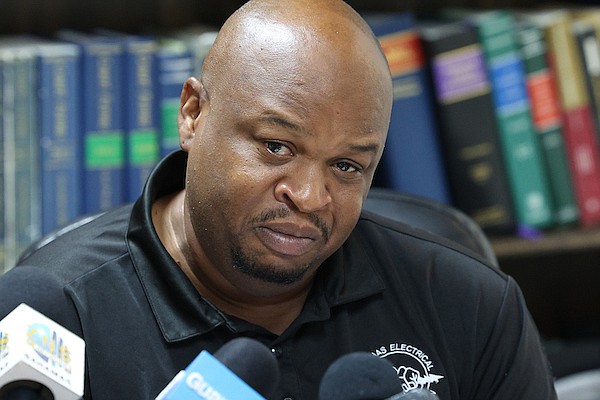
Kyle Wilson, the Bahamas Electrical Workers Union’s (BEWU) leader, said the sudden focus on overtime expenses was diverting attention from what he described as failures at Bahamas Grid Company (BGC), which now has responsibility for New Providence’s transmission and distribution grid, even though BPL continues to provide assistance with grid-related work.
“It is just an outright distraction from the failed policies and these third-party contracts that Ms [Christina] Alston, the chair lady, had given to all of these various companies that are failing the Bahamian people,” Mr Wilson said.
“So you're trying to look into BPL to create a distraction from all the failure and the Bahamian people suffering from massive power outages at the hands of Bahamas Grid Company, not BPL.”
Mr Wilson argued that the Government should instead be addressing the continuing power outages affecting consumers across New Providence and the performance of Bahamas Grid, the 60 percent private sector owned entity that was established to take over BPL’s transmission and distribution functions.
“BPL is no longer in charge of the transmission and distribution of the power. It is in the hands of BGC, who receives some $8m-plus of the taxpayers’ money, plus receiving help from BPL as we have to use all of what we gave them over,” he added.
“I added $100m in supplies plus all of our inventory, and we're still assisting with training and helping, all at the cost of BPL, to a failed entity that has yet to deliver on what it promised the Bahamian people over two years ago.”
Mr Wilson’s comments came as the Government asserted that an annual BPL overtime bill approaching $20m “places an unreasonable burden on BPL’s finances and, ultimately, on the Bahamian people”. It defended BPL’s new overtime policy as introducing tighter controls over how overtime is approved, documented and monitored.
The Davis administration said the reform was not intended to prevent legitimate overtime or deny employees approved compensation, but was necessary to ensure overtime is “necessary, fairly allocated, properly authorised and fully documented”.
“It is also intended to reduce excessive working hours and the fatigue-related risks they create for employees, their colleagues and the public,” the Government said in a statement. “Fatigue protections requiring relief planning after 12 continuous hours, a maximum of 16 continuous working hours and mandatory rest before an employee resumes duty” are among the reforms being initiated.
The new policy requires prior approval for planned overtime and at least two levels of authorisation for payment submissions, while emergency overtime must be supported by reports and documentation.
It also introduces monthly reviews of overtime expenditure against approved budgets, “overtime caps and management reviews” for employees who repeatedly reach those limits or exceed established overtime payment thresholds, and “accurate clock-in, clock-out and timekeeping requirements”.
The Government said the policy also establishes a clearer link between approved work programmes and overtime hours worked. Mr Wilson, however, maintained that the focus on overtime was taking attention away from the ongoing difficulties being experienced by consumers.
“The Bahamian people [are] suffering from massive power outages at the hands of Bahamas Grid Company, not BPL,” he said.
Mr Wilson’s comments come as the BEWU separately challenges BPL’s new overtime policy, which the union says was introduced without its agreement and which it argues could put additional pressure on workers who have declined to transfer to BGC.
The union filed a formal trade dispute with the Department of Labour over the policy and instructed members to work only their normal hours until further notice.
Mr Wilson has alleged that the overtime changes could be used to pressure BPL transmission and distribution workers into joining BGC, which has been seeking experienced technical personnel. However, the Government alleged that it has consulted with him and the two BPL unions over the plan for a “more transparent, accountable and sustainable overtime system”.
The Tribune revealed that three BPL employees in the fuel and performance department collectively received $601,295.16 in overtime between May 2025 and April 2026, with two workers receiving more than $200,000 each. The records also showed individual monthly overtime payments exceeding $20,000.
The Government said the review of BPL’s overtime practices identified “unusual patterns and anomalies”, and stressed that the exercise was focused on strengthening systems rather than targeting individual employees.
It said managers and directors would be specifically responsible for properly authorising, documenting, monitoring and reporting overtime within their respective areas.
“Where wrongdoing, negligence or a failure of oversight is established, whether involving an employee, manager, director or other responsible officer, the appropriate action will be taken,” the Government said.
“These measures are necessary to strengthen financial management, improve workforce planning and ensure that BPL’s resources are directed toward delivering safe, reliable and affordable electricity.
“BPL is seeking to ensure that the unusual patterns and anomalies identified during the review of overtime practices do not recur. The review is focused on strengthening the system and its processes, and is not intended to target individual employees. The existing system has allowed overtime expenditure to grow to approximately $20m annually, an unsustainable level that cannot be allowed to continue,” it added.
“The new policy therefore establishes stronger checks and balances, clearer reporting requirements and accountability at every level. Managers and directors will be specifically responsible for properly authorising, documenting, monitoring and reporting overtime within their respective areas.
“Any suspected irregularity will be examined fairly and objectively. Where wrongdoing, negligence or a failure of oversight is established, whether involving an employee, manager, director or other responsible officer, the appropriate action will be taken in accordance with the law, applicable industrial agreements, company policies and due process. BPL will not prejudge any individual or draw conclusions before the relevant facts have been properly established.”
Mr Wilson nevertheless argued that BPL employees were being unfairly placed at the centre of a problem that he said extended well beyond individual overtime claims.
He said BPL had provided significant assistance to BGC, including supplies, inventory, training and technical support, despite the new entity having responsibility for the transmission and distribution system.
He also pointed to the continued use of BPL workers for specialised work, arguing that their technical experience remains essential to maintaining the electricity network.
The Government said that, while union leaders and others have the right to voice concerns, it nevertheless has “a responsibility to protect workers, safeguard public funds and ensure that BPL operates safely, transparently and in the national interest”.
It added: “The approved overtime policy is therefore expected to be implemented consistently and fairly across BPL. The Government expects the co-operation of management, employees and union representatives in carrying it out.
“The Bahamian people rightly expect transparency, accountability and value for money from public corporations. The Government remains committed to those principles and to building a safer, fairer and more financially responsible BPL.”




Comments
birdiestrachan 1 month, 3 weeks ago
20 million could go a long.way with change to hire many.young people in need of employment.
Socrates 1 month, 3 weeks ago
i" m surprised at the gov't statement as these excessive benefits are always approved by them to avoid industrial action. gov't always at the table with a gun to their head. Leslie Miller drew attention to this year's ago. don't believe BPL is the only place thus is happening... guarantee you it's ar all the other SOEs too. now you know one of the reasons we are paying almost $0.50 per kilowatt hr for light that can't stay on.
birdiestrachan 1 month, 3 weeks ago
Mr Wilson does look sheepish.. some things are very wrong At BPL. It is causing much suffering. It maybe sabotage..intentionally. Who knows. An investigation is necessary.
Sickened 1 month, 3 weeks ago
Okay, okay. Who hacked Birdie's account????
rosiepi 1 month, 3 weeks ago
Wondering the same thing myself!!
Sign in to comment
OpenID