By JADE RUSSELL
Tribune Staff Reporter
jrussell@tribunemedia.net
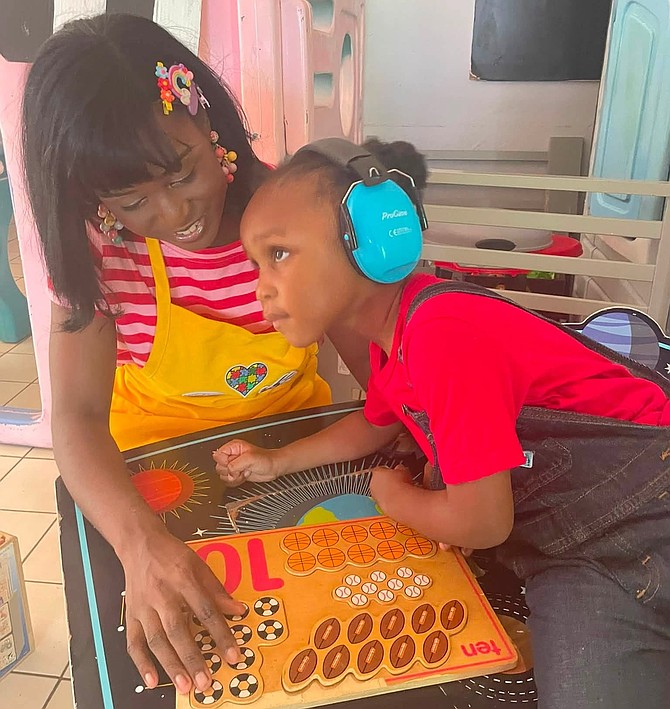
A GRAND Bahama mother who could not afford specialised programmes for her autistic son taught herself how to support him and is now building a digital platform aimed at helping Bahamian families facing the same gaps in special education services.
Willinique Wilson-Smith, 25, known as Miss Spectrum on social media, began researching autism after her son Asheene, known as AJ, was diagnosed with autism spectrum disorder at two years old.
Now four, AJ is non-verbal and is homeschooled by his mother, who provides his care around the clock.
Mrs Wilson-Smith said she turned to homeschooling after finding that programmes were available but beyond what some families could afford.
“There are programmes available,” she said. “Most of us were not able to afford these, and I was one of those parents.”
Rather than allow the cost to determine what support her son received, Mrs Wilson-Smith began educating herself.
“If I can't afford it,” she said, “it doesn't mean I'm not going to be able to educate myself to help him as best as possible.”
Her experience comes amid longstanding concerns about the availability of special education services in The Bahamas. Some families have travelled to the United States and Canada to have autistic children assessed.
In July, the Ministry of Education revealed plans for a national autism registry. At a town meeting, parents and guardians raised concerns about limited therapy and support after children leave school, warning that families were being left overwhelmed and uncertain about their children’s futures.
Mrs Wilson-Smith said Grand Bahama has schools offering special education programmes, but spaces are limited. She also identified a shortage of services providing early support to children diagnosed at very young ages.
She said more special education teachers are needed, along with earlier identification, affordable assessments and therapies and less expensive services for families.
Her own introduction to autism began after she noticed changes in AJ’s development.
Mrs Wilson-Smith recalled watching her son regress, become non-verbal, struggle to walk and develop repetitive behaviours. He would flap his hands repeatedly and could become frustrated when his routine was disrupted.
She said she did not initially suspect autism, but wanted to understand what was happening.
The diagnosis itself was not devastating, she said, because she comes from a family of educators accustomed to celebrating differences.
“When I got that response in the doctor's office,” Mrs Wilson-Smith said, “I say, ‘Okay, great. Let me start to educate myself.’”
Her days now revolve heavily around AJ’s care and education.
Mrs Wilson-Smith, who provides babysitting services, begins his homeschool day by getting him dressed and preparing breakfast, followed by devotions and learning activities.
Because AJ is non-verbal, she encourages him to communicate using picture cards and an augmentative and alternative communication device.
She said she has heard her son call her “mummy” only once and hopes to hear it again when he is ready.
“He hasn't said ‘mummy’ in years,” Mrs Wilson-Smith said.
What began as an effort to help her own child has since expanded online.
Using the name Miss Spectrum, she shares information about autism with Bahamian families, including guidance on managing meltdowns, understanding the spectrum and supporting autistic children.
Mrs Wilson-Smith said she is also interested in pursuing a degree in special education at the University of The Bahamas, if such a programme is available, so she can further help families struggling to find support.
She is now preparing another project aimed at making educational resources more accessible.
An animated subscription programme called STIM Pals is scheduled to launch next year and is intended to provide families with an affordable online educational option.
Its characters will address communication, sensory awareness, routines, emotions, inclusion, helping others, friendship and celebrating differences.
Mrs Wilson-Smith hopes the programme can help Bahamian families who, like hers, have confronted gaps in available services and the cost of obtaining support.




Comments
Use the comment form below to begin a discussion about this content.
Sign in to comment
OpenID