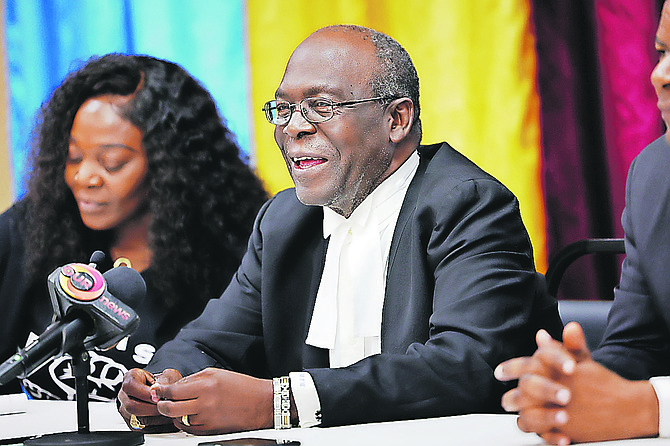
Obie Ferguson
By NEIL HARTNELL
TRIBUNE Business Editor
nhartnell@tribunemedia.net
Trade union leaders will meet today to determine how best to “intervene” in and resolve the dispute between taxi and livery drivers amid fears the situation will otherwise “take on a life of its own” and “seriously damage” the tourism industry.
Obie Ferguson KC, the Trades Union Congress (TUC) president, told Tribune Business that all the umbrella body’s affiliate unions will discuss how best to assist the Bahamas Taxi Cab Union (BTCU) and its members in resolving their differences with the Bahamas Livery Drivers Union (BLDU) over access to guests at the major hotels and Lynden Pindling International Airport (LPIA).
The dispute, which centres on competing rival claims that each side is encroaching on the other’s turf by soliciting passengers when not permitted to do so, resulted in a taxi driver protest that temporarily blocked access to LPIA’s international departures terminal one day before the Independence Day holiday - a major travel period.
Mr Ferguson told this newspaper that resolving the argument rocking the Bahamian public transportation industry is “right at the top of the agenda” for the TUC and its affiliates alongside outstanding pay and other industrial issues impacting the doctors union, nurses union and former Grand Lucayan staff.
“We are having a meeting some time tomorrow [today] and we are going to take a final position on how best we can assist the taxi drivers in achieving their objective,” he said. “We will have a meaningful discussion on how we can intervene, try to intervene and have a manageable understanding. What we do know, the law as we understand it, makes provision for livery, limousine drivers to interact with tourists by way of appointment.”
Mr Ferguson thus echoed the taxi driver argument that their livery rivals are restricted to serving guests who have booked rides with them in advance. However, they claim that livery drivers are also soliciting guests and fares on the spot, and not in advance, thus bringing them into direct unpermitted competition with taxi drivers.
“The taxi drivers, the legislation provides for them to be able to interact with tourists by going to the hotels’ front door and the airport front door,” the TUC president said. “What’s happening is that they are now mixed up in trying to deal with the tourists and passengers alike.
“That is not proper, that is designed to create mischief and possible physical altercations. The taxi drivers have legislation, the Road Traffic Act, which provides for them to do that, not the livery drivers. That is creating a problem, and will have a serious effect on the tourism industry and local people who may provide a certain amount of business for them.”
Describing the dispute as “a serious matter”, particularly if it is allowed to persist, Mr Ferguson added: “We do not want Bahamian transportation operators to be fighting each other in front of the tourists. If that happens, things can get out of line, and it could create a woeful experience or reduction in the quality of that offering.
“If we see something that can create problems for the tourism industry, we need to meet with them, sit down and work out something that’s livable. Other than that, it takes on a life of its own and affects our tourism industry. That is certainly not something we want to happen, but unless and until we have proper procedures, conflict will happen.
“I told the presidents and officers of the unions that something needs to be done swiftly, otherwise it will affect tourism and Bahamians who want to travel by taxi or limo. That’s the reason why the meeting has been set up for tomorrow [today]. We need to get a clear position on what we’re going to do, and how we’re going to go about bringing resolution and fairness to the process. That’s the objective. Tomorrow you’ll hear something from us.”
Mr Ferguson continued: “The TUC takes the view that every dispute, and disputes will arise because that’s human nature, but what we fail to do in this country is find the most suitable, rational and logical way of resolving conflicts or disputes. If you recall, I said this coming five years is going to be very proactive for the TUC.
“We want to make sure this country survives, but also make sure every Bahamian benefits from this country, this system, the economic system of the country. Every Bahamian should benefit, and that’s why we have decided to do everything we do together, collectively. I’m sure that if all my affiliates do what they decide to do, they will get results and make things happen.
“The livable wage is the sort of thing we ought to be able to resolve. It shouldn’t take ten years to do what is live and something we all know about. All of us are entitled to benefit from the fruits of the country. We cannot have three to four benefiting and nobody else benefiting. It makes no sense to me.”
Tyrone Butler, the Bahamas Taxi Cab Union (BTCU) president, previously confirmed that the union was seeking assistance in its dispute. “We will now speak with our Congress leader, Obie Ferguson KC, who will then convene a meeting with all the other affiliates, and then we’ll plan our next move, which will not just be taxi drivers, but it’ll be us and the Congress along with our affiliates,” Mr Butler said.
Asked whether that could result in wider strike action involving other unions, Mr Butler replied: “That’s our next move. And so we will be moving towards that from here on in. I don’t see any way that we can avoid going down that path because we obviously are not getting anywhere with the Government.”
The July 9 protest temporarily blocked vehicular access to the international departures terminal as taxi drivers accused livery operators of illegally soliciting fares inside the airport. During the demonstration, Leon Lundy, minister of transport, proposed establishing a dedicated transportation desk inside the terminal staffed by Nassau Airport Development Company (NAD) personnel to better manage ground transportation services and reduce conflicts between the two sectors.
Mr Lundy also said the Government was reviewing proposals from both taxi and livery operators while seeking a solution that would protect visitors’ experience and the country’s tourism brand.
However, Mr Butler said the absence of concrete decisions following subsequent meetings has left the union with little confidence that voluntary discussions will resolve the dispute. “From here on in, we’ll be guided by the president of the Congress now and what we should do,” he said.




Comments
AnObserver 3 hours, 35 minutes ago
Just throw the entire system out and welcome Uber and Lyft. No more taxi plates, no more cronies, no more silliness.
Sign in to comment
OpenID