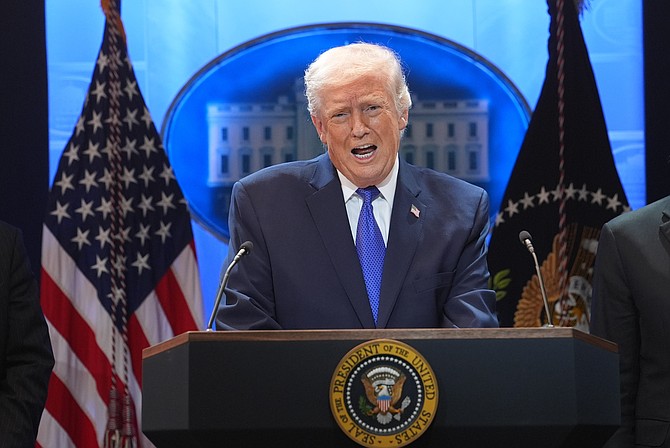
President Donald Trump speaks during a press briefing at the White House, Friday, Feb. 20, 2026, in Washington. (AP Photo/Evan Vucci)
By NEILL HARTNELL
TRIBUNE Business Editor
nhartnell@tribunemedia.net
Bahamian exporters have “a little bit more pain to endure” after the Trump administration yesterday made good on its threat to impose a 12.5 percent tariff on all products made in this nation that are destined for the US market.
The US Trade Representative’s Office, in a report released late afternoon, revealed that the border tax now faced by Bahamian exports such as crawfish, Polymers International’s styrene polymers products and other goods was due to go into immediate effect from 12.01am earlier today after finding this nation - and 59 others - have not done enough to combat imports made with forced labour.
The Davis administration’s efforts to ward-off the latest Trump tariff imposition, via recently-passed reforms to the Customs Management Act that ban the importation of goods made with forced labour, appear to have made no impact on the US position. The move could negatively effect up to $985m worth of Bahamian exports to the US, based on 2024 trade date, as the tariffs will make them more expensive for American consumers and thus less competitive against rivals.
The Bahamas was named by the US Trade Representative as being among 54 economies that allegedly “have failed to impose and effectively enforce a prohibition on the importation of goods produced with forced labour”.
Its report asserted: “Based on the findings in the investigation of The Bahamas, and considering the public comments, testimony and the advice of the Section 301 Committee, as well as the advice of advisory committees and in accordance with the specific direction of the President, the trade representative has determined to impose 12.5 percent tariffs on products of The Bahamas.”
Adrian LaRoda, president of The Bahamas Commercial Fishers Alliance (BCFA), told Tribune Business that the US move was “very disappointing, very disappointing” with the 12.5 percent “no doubt” affecting the competitiveness of, and consumer demand for, Bahamian crawfish exports moving forward.
Suggesting that fisheries processors, wholesalers and exporters will require several days to “find out where we’re at”, he voiced hope that an immediate impact will be avoided by US buyers having already placed orders with their Bahamian counterparts ahead of the crawfish season’s August 1 re-opening.;
Confirming that rock lobster exports to the US account for $50-$60m in annual fisheries industry earnings, thus representing a valuable source of foreign currency earnings for The Bahamas, Mr LaRoda said the search for alternative markets and diversification beyond the US had not progressed as rapidly as the sector would like.
He explained that the costs involved in exporting to more distant regions, such as Asia, effectively exceeded the impact of the 12.5 percent tariff on US consumers. Mr LaRoda told this newspaper that, in order to mitigate the fall-out from the Trump administration’s move, Bahamian fisheries exporters may have to reduce the price they charge US buyers to offset the tariff impact “if we want to stay competitive”.
Craig Simms, Polymers International’s top Freeport-based executive, yesterday signalled that the impact on the manufacturer and its annual $40m-$50m US exports will likely be less than for Bahamian fisheries as its goods were already subject to the earlier 10 percent border levy.
As a result, the increase from 10 percent to 12.5 percent will not be such a great “shock”, but Mr Simms acknowledged that any jump is “still not a good thing” and means Polymers and other Bahamian exporters to the US face having to absorb “more pain”. He added that, for the Freeport manufacturer, this week’s oil price increases - with the Brent Crude index back trading at over $100 at press time - will have more impact on its business than an increase in US border taxes.
Mr LaRoda, meanwhile, acknowledged that while the tariffs faced by The Bahamas paled in comparison to the 50 percent levies that the Trump administration is planning to inflict on Canada, yesterday’s move is “very disappointing, very disappointing, very disappointing news” for local fisheries.
“We’re going to need a couple of days to figure it out,” he told Tribune Business,” to find out where we’re at. I haven’t had any feedback yet from our exporters as to how they will deal with this. It’s no doubt going to affect us. I’m hoping US buyers have already placed orders for crawfish so that it doesn’t impact our exports immediately. We would have reached agreements with buyers long before that.
“But I’m sure, as we go forward, our exports will be affected by this additional 12.5 percent tariff. It’s disappointing. We were hoping it would not have happened. We now have to digest, grin and bear it.” Diversifying Bahamian crawfish and fisheries exports beyond the US will a lengthy process, Mr LaRoda added.
“As much as I hate to admit it, finding new markets has not been movinf as quickly as I’d like,” he told this newspaper. “We’d like to capture the Asian market, but there are other attendant costs that come with trying to export to those markets, which translates to more than the 12.5 percent that has to be born by the US consumer.”
Noting that Bahamian rock lobster already has to compete with cheaper, lower quality Maine lobster, Mr LaRoda said it now faces extra rivals in Belize and other Caribbean states that are seeking “a gateway” to the US and not subject to the same strict harvesting rules as imposed in The Bahamas.
“We have to look at what our price is at the harvesting end, and if we want to stay competitive we have to take into some serious consideration what we sell to wholesalers at,” Mr LaRoda warned. “It will be a bitter pill to swallow, but some revenue is better than no revenue.
“I don’t want to say it too loud, but our goal has always been quality over quantity. But we may now have to balance that consideration of quality to maintain quantity. There’s going to be some headwinds. It’s going to be a bit rough for us over the next six months but we have to weather it as best we can.”
Mr LaRoda also challenged why the US has seemingly singled out The Bahamas alongside the other 59 economies, given that this nation has not been shown to have any forced labour, nor tolerate or condone such practices. And, of The Bahamas’ $8.92bn worth of total imports in 2024, the US accounted for $5.59bn or 63 percent, with many originating from sectors identified by the Trump administration as “critical for securing the health of the US economy”.
The Fisheries Alliance chief argued that this reliance on the US sharply reduces the possibility of The Bahamas importing goods made by forced labour, and he questioned why the Trump administration would seek to disrupt a trade surplus - meaning the US exports far more to The Bahamas than it imports - that was measured at $4.25bn in 2024.
“Forced labour is not a component of The Bahamas’ labour market, and most of our goods are imported from the US,” Mr LaRoda said. “I don’t know that this is an issue. I think they are shaking the tree for whatever reason. It’s kind of scary.”
Mr Simms, though, said the tariff increase impact for Polymers paled somewhat against the current oil price spike. “Currently, we’re still paying 10 percent or our US customers are,” he told Tribune Business. “It’s another 2.5 percent on top. It’s still not a good thing, but it’s the regime we’re living under currently. It’s just a little bit more pain to endure.
“If we went from zero to 12.5 percent, that would be a shock to the system, but from 10 percent to 12.5 percent it’s kind of the same thing. It’s a marginal increase…. Customers talked about it when it was first implemented, but we make a good product here. We have a strong customer base, but people always make the comment when prices are higher.
“It doesn’t affect us as much as what’s happening with oil in the Middle East, which is more of an impact than anything else right now.”
Bahamas' exports went to the US out of total exports worth $2.38bn. The major export by far was refined petroleum, valued at $610m, while other categories included documents of title ($95.2m), styrene polymers ($55.7m) and pearl products ($39m).
Jamieson Greer, in unveiling the imposition of new and increased tariffs on The Bahamas and 59 other countries, said: “President Trump recognises that decades of moral suasion have not eradicated forced labour from global supply chains. The United States has had a forced labour import ban for nearly a century, and rigorously enforces it; it’s well past time for our trading partners to do the same.
“Today’s action will begin to correct what is both a human rights abuse and distortive trade practice to improve the welfare of workers everywhere. I am encouraged by the trading partners who have moved quickly to adopt forced labor import prohibitions, and look forward to ensuring their effective enforcement.”
The tariff threat arose because all these countries were deemed by the US Trade Representative’s Office (USTR) to have neither enacted, nor enforced, a legal and regulatory regime that bans the entry of imported goods made with forced labour into this country. This, in turn, is considered to give forced labour producers an unfair competitive advantage over US rivals.
The Bahamas is in good company because the likes of Canada, Australia, the UK, the European Union (EU), Israel, New Zealand, Saudi Arabia, the United Arab Emirates and Singapore are among the other jurisdictions also set to be hit with tariffs.
The move also appears to be a thinly-veiled attempt to crack down on the volume of Chinese goods imported by some of Washington D.C’s major trading partners. China has long faced accusations that it subjects ethnic minorities, particularly the Uighurs in Xinjiang province, as well as political prisoners and dissidents to forced or slave labour where they are forced to manufacture goods against their will and for no compensation.
Media commentators have also suggested that the ‘forced labour’ investigation may be a backdoor attempt by the Trump administration to implement last year’s so-called ‘Liberation Day’ tariffs that have been ruled unlawful by both the US Supreme Court and trade court. Those verdicts are now under appeal.




Comments
Use the comment form below to begin a discussion about this content.
Sign in to comment
OpenID