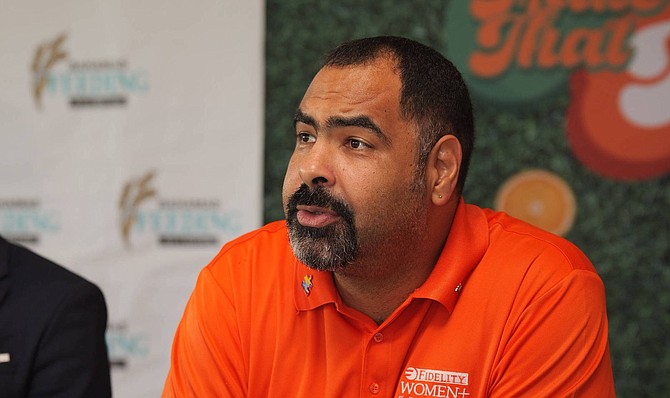
Gowon Bowe
BY NEIL HARTNELL
TRIBUNE Business Editor
nhartnell@tribunemedia.net
A BISX-LISTED bank has pledged it will not join the “folly” of its rivals by pursuing unsafe loans with its chief executive yesterday predicting that the Bahamian mortgage market will take another two years to recover to pre-COVID levels.
Gowon Bowe, Fidelity Bank (Bahamas) chief executive, yesterday told Tribune Business that multiple deep-rooted “structural issues” continue to hold back mortgage lending and, by extension, increased home ownership, construction, renovations and other productive economic activities associated with the housing market.
Speaking after the institution, in its 2025 annual report released just ahead of tomorrow’s annual general meeting (AGM), revealed that total outstanding Bahamian mortgage credit at year-end 2025 was still almost $77m below the $2.63bn mark hit six years previously, he identified the growth obstacles as including a lack of qualified borrowers, stagnant incomes and wages, a workforce yet to expand beyond pre-COVID numbers, and the overhang of distressed properties banks are unable to offload.
Given such an environment, Mr Bowe told this newspaper that demands for commercial banks to increase mortgage lending without first addressing these barriers are, in effect, calling on the industry to “throw good money after bad” and “gamble with other people’s money” - namely the savings of depositors. However, removing delinquent properties and other mortgage collateral from the industry’s books would free-up capital, and create an incentive, to once again resume mortgage lending.
With total outstanding Bahamian mortgage credit growing by $34m in 2025 to hit $2.553bn, but remaining 2.92 percent below year-end 2019 levels achieved some six years earlier, the Fidelity Bank (Bahamas) chief forecast: “Mortgage loans, to be perfectly honest, at the rate we’ve been going it will probably be another two years” before they exceed pre-COVID levels.
If that prediction comes true, it will have taken the Bahamian mortgage market around eight years to recover from the pandemic, and the delinquencies that resulted when the economy was locked down virtually overnight. “The growth in mortgages is really slow. That’s because of the structural issues just mentioned,” Mr Bowe added.
“Not only are persons not qualifying, but banks nowadays have an unwillingness, whether they want to acknowledge it or not or admit or not, to throw good money after bad. If I am holding significant distressed properties, why is there an incentive to lend when, as a fiduciary, I would be gambling with other people’s money?”
The Fidelity Bank (Bahamas) chief executive has long called for the banks, the Government and private sector to work together on a public-private partnership (PPP) solution that would involve creating a real estate investment trust (REIT), or investment fund, to acquire distressed properties from their mortgage lenders. These could then be repurposed and renovated for low-cost, affordable housing, thereby improving the supply of available homes while freeing-up banks to resume lending.
Describing this as the preferred outcome, Mr Bowe said two different options can be taken. “In one scenario, if I already have mortgage money that has been lost, and I am asked to throw more money at it, I’m in effect a gambler trying to make more bets to win back the money previously lost,” he explained.
“But if I’m in a situation where I can recover my investment first, then I can make a business decision to take on new investment - not to recover money lost, but make more money from it. Banks are asked to effectively be gamblers. They are being asked to throw more money at it, and it’s not a wise approach for any fiduciary agent.”
Mr Bowe, writing in Fidelity Bank (Bahamas) 2025 annual report, said the BISX-listed institution will stay try to its core risk management and underwriting principals, and not engage in risky or speculative lending in what it perceived as a “muted” credit market in the short to medium-term. And he promised that it will not follow or pursue commercial bank rivals down this path but, instead, seek out new avenues for growth.
“The environmental realities comprise, among others: Structural challenges in the lending environment, including a significant inventory of slow-moving distressed properties, high levels of consumer debt of existing borrowers and low levels of financial literacy and savings,” Mr Bowe wrote.
“The factors above can be summarised simply as volatility, which is exacerbated for commercial banks by the fiduciary responsibilities for brokering successful outcomes for all key stakeholders, including shareholders, depositors, borrowers, cardholders, merchants, employees community partners and other stakeholders….
“Fidelity Bank (Bahamas) has observed the folly of certain commercial banks in response to the impact of the volatility on the lending environment in The Bahamas and, as opposed to participating in the folly, the bank has held to its core principles of quality lending centred on a borrower’s ability to pay and providing financial coaching to improve the lives of its customers, and has devised and implemented strategies for expansion of the business, including investments in technology, personnel, products and services and communities.”
This was echoed by Alfred Stewart, Fidelity Bank (Bahamas) chairman, who told shareholders: “The lending environment in The Bahamas will likely remain muted for the short to medium-term, due in large part to the negative consequences of the global pandemic such as unemployment and consequential credit defaults. Employment numbers are growing and loans in default are being rehabilitated, but the pace does not provide for a rapid expansion in the lending environment.
“For financial institutions not wishing to race to the bottom for short-term profit, this requires targeting new markets, products and services. The bank has chosen the latter route favouring long-term sustainable financial performance by targeting revenues from non-traditional sources, and profits through recovering funds owed to the bank. The successes of these strategies peeked through in the financial performance of the current year.”
Consumer lending continues to dominate the Bahamian credit market, with this segment expanding industry-wide by $119.5m in 2025 - a slight decline on the prior year’s pace of $122m. As a result, the Bahamian commercial banking industry’s total outstanding consumer portfolio of $2.207bn at year-end 2025 was only $7m, or 0.32 percent, shy of pre-COVID’s year-end 2019 numbers.
“There was growth in the commercial banking sector in consumer loans and mortgage loans during fiscal year 2025,” Mr Bowe wrote. “However, the statistics evidence the required extended period to rehabilitate the structural challenges, and reverse the accentuated contraction during the global pandemic associated with the deterioration in the quality of borrowers and related borrowing capacity, particularly in the traditional markets of the bank.”
Speaking to Tribune Business yesterday, he acknowledged that consumer credit was likely to have surpassed year-end 2019 numbers this year - more than six years later. “I think the good news is consumer loans are just about equal with their pre-pandemic level,” Mr Bowe said. “I think I said it would take three years in 2022, so I was off by a year and some.”
Yet he warned that, even here, growth is likely to be muted. “When I look at the reality, consumer lending is not going to grow by any exponential amount for quite a while because persons have got themselves maxed out and that is going to take some time to recover from,” the Fidelity Bank (Bahamas) chief added.
“The lending won’t stop, but the dollar amounts will start to reduce. Where persons had larger dollar amounts for consumer credit, they will start with smaller dollar amounts because their borrowing capacity has been impaired and they are not in position to take out large credit.”
Mr Bowe said that, while some say he is “flogging a dead horse” by continuing to call for and promote the National Development Plan, it would provide a road map for addressing the “structural issues” facing The Bahamas. These include recent gross domestic product (GDP) growth, or economic expansion, failing to translate into increased wage incomes and living standards for Bahamians, and - while the unemployment rate has fallen - the workforce has not grown since before COVID.
Other challenges he identified include the widespread use of salary deductions, often to non-bank institutions, which consume more than 50 percent of a government employee’s wages and leave them taking home two-digit or three-digit sums per month, and the fact that the only wage growth has been in the minimum wage.
“From that perspective, if we don’t address these structural challenges, we can talk about all these wonderful things that exist, but have they reached the common man’s ability to purchase more and change their status in life?” Mr Bowe asked. “We have to pause, and not criticise ourselves, but ask the hard question: Are we doing enough here to make sure it gets to the persons who need it the most.”




Comments
Use the comment form below to begin a discussion about this content.
Sign in to comment
OpenID