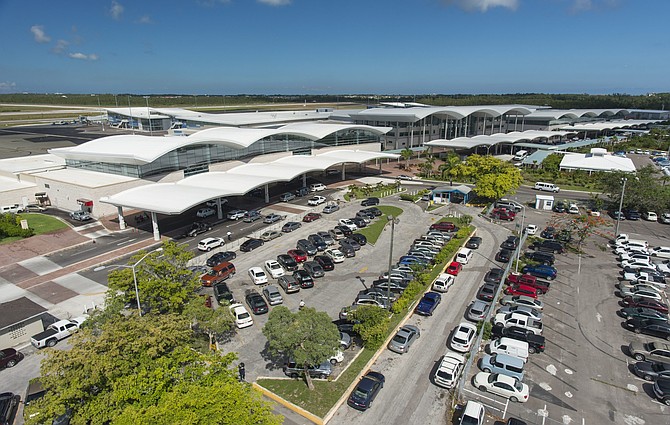
An aerial view of the parking lot at the Lynden Pindling International Airport (Photo: LPIA)
By LYNAIRE MUNNINGS
Tribune Staff Reporter
lmunnings@tribunemedia.net
PASSENGERS using Lynden Pindling International Airport’s domestic terminal are being urged to arrive at least two hours before departure as airport officials reject claims that a newly upgraded security system is responsible for longer lines.
Travellers have complained on social media in recent days about extended waits at the terminal, with some blaming the enhanced screening process for slowing movement through the airport.
However, Dr Raymond Wells, chief executive officer of Radiant Solutions Limited, the Bahamian company that developed and implemented the technology, said the system was designed to strengthen border security without increasing processing times.
“The mandate was that it should be done either the same or quicker than the manual process,” Dr Wells said.
He attributed congestion primarily to surges in passenger traffic, particularly between 5am and 6am, when large numbers of domestic travellers arrive within a short period for early morning departures.
“I always observe peaks and valleys,” Dr Wells said.
“If you go at five or six o'clock on a Tuesday morning, it's a very large influx of crowds for that 45 minutes to an hour. This has always been the case.”
Dr Wells said passengers may now be linking those longstanding bottlenecks to the enhanced screening process because the upgraded technology is new and highly visible.
The Airport Authority commissioned the system to modernise airport security and bring The Bahamas in line with international standards through automated passport authentication and facial recognition technology.
An earlier version of the platform, introduced in June 2025, primarily scanned boarding passes and monitored passenger movement through airports.
The upgraded system now authenticates passports from around the world, confirms passengers are departing from the correct terminal, checks whether passports have expired and compares a live photograph of each traveller with the image stored on the travel document.
“The system checks for the authenticity of passports,” Dr Wells said. “That's not just Bahamian passports. That's passports worldwide. It checks for a comparison of your face with the photo on your document, and it matches your name and your boarding pass with the name on your document.”
The process begins when a passenger’s boarding pass is scanned to verify the flight information and confirm that the traveller is at the correct terminal.
The passport is then scanned to authenticate the document, check its expiry date and compare its details with the boarding pass. The system subsequently captures a live image of the passenger and compares it with the passport photograph.
Dr Wells said the technology applies the same checks to every traveller, reducing the risk of mistakes caused by fatigue during manual inspections.
“So as opposed to a user having fatigue and missing something, the system is consistently doing it always,” he said.
The system can also recognise security features embedded in passports issued around the world, avoiding the need for individual officers to be familiar with hundreds of different document designs.
“If I give you a Brazilian passport, do you know what the features are on that Brazilian passport that makes it fraudulent?” Dr Wells said.
“If I give you a passport from Colombia, would you know? The system is actually performing these checks.”
Dr Wells acknowledged that airport personnel faced a learning curve after the system was introduced, but said they have since become proficient in operating it.
He said the Airport Authority increases screening capacity as passenger traffic grows. One station may operate during quieter periods, two are normally used and a third is activated when passenger volumes rise sharply.
Dr Wells declined to discuss staffing levels, saying those decisions rest with the Airport Authority, but said he has seen additional screening resources deployed when required.
He also rejected suggestions that the enhanced technology had forced passengers to begin arriving earlier.
Dr Wells said the Airport Authority has always recommended that domestic passengers arrive two hours before departure and international passengers arrive three hours before departure.
“When we got the mandate to build the system, it was never for one hour,” he said.
“We have always heard the Airport Authority speak of two hours.”
Dr Wells said many Bahamians had become accustomed to arriving about an hour before domestic flights because they were often able to pass through the airport quickly.
However, he said that was never the official recommendation, and airlines including Bahamasair and Western Air have long encouraged passengers to check in earlier because flights close well before departure.
“I think maybe as a practice, persons would get their boarding pass and go through quickly,” he said. “But from what I understood, the practice was always two hours.”
Dr Wells said the upgraded platform represents another step towards modernising airport operations and strengthening the country’s border security.
“This brings the Airport Authority in line with our international counterparts in terms of modernising the airport,” he said.
“We all go to Miami and Fort Lauderdale and come back, and we see this level of screening that is taking place.”
Radiant Solutions Limited developed and implemented the passenger screening system on behalf of the Airport Authority.




Comments
moncurcool 4 hours, 41 minutes ago
This tech developer is only trying to promote his product, rather than be honest about the reality.
I went through that line on Sunday and it takes them about 5 minutes to serve you. Before, it was less than a minute. And I went out on the first flight. While lines may have been long before as he claims, this new system is making them even longer. You stand in one lace without moving for an eternity.
Sign in to comment
OpenID