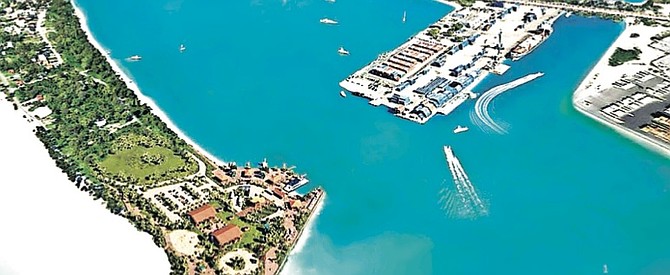
Bahama Rock Expansion
BY FAY SIMMONS
TRIBUNE Business Reporter
jsimmons@tribunemedia.net
RESIDENTS last night voiced frustration, anger and long-standing distrust of Bahama Rock's operations during a heated public consultation on the company's proposed 270-acre Freeport Habour expansion and acquisition of the former Bahama Cement Company site.
Several attendees argued that decades of blasting, dust, flooding and property damage to nearby homes and communities must be addressed before regulators consider approving the project.
The consultation frequently descended into tense exchanges as residents challenged company representatives, environmental consultants and government officials over the proposal, questioned the credibility of the environmental impact assessment (EIA) and, at times, interrupted presentations to voice frustration over what they described as years of unresolved complaints.
The meeting, hosted by the Department of Environmental Planning and Protection (DEPP), formed part of the environmental review process for Bahama Rock's proposal to acquire and mine around 269 acres of the former Bahamas Cement Company property at Southwest Point.
The project would involve excavating limestone aggregate before converting the site into new turning basins and deep-water berths to expand Freeport Harbour, a development the company argues is critical to sustaining its operations and supporting the harbour's long-term growth.
However, many of those who attended said the discussion should not focus solely on the proposed expansion, arguing Bahama Rock must first answer for the impact of its existing operations on neighbouring communities.
Dillon Knowles, a professional engineer and former Grand Bahama Development Company executive, said the EIA failed to adequately consider whether the operation should instead be relocated away from nearby communities.
"Where we can eliminate risks, we eliminate them. Elimination is always preferable to mitigation," said Mr Knowles. He argued that while aggregate mining remains important to The Bahamas, the project's location deserved greater scrutiny.
"We understand the country needs aggregate. We're not saying Bahama Rock shouldn't operate," he said. "We're saying it should operate from a location that's more suitable." Mr Knowles also questioned whether operational convenience had been given too much weight in the assessment.
"Convenience alone does not make this project viable," he said.
C Allen Johnson, senior spokesman for Preserving Paradise, said the size and complexity of the environmental impact assessment demanded greater public engagement than a single consultation.
"I've read this document five times," said Mr Johnson, adding that he had submitted hundreds of questions after reviewing the more than 600-page report. "One or two meetings are not enough," he added. "The community has to understand what they're being asked to accept."
Several residents recounted what they described as years of blasting impacts, noting cracks remain visible in their homes at Eight Mile Rock and in the surrounding area, and that previous complaints had never been adequately addressed.
One resident told the meeting that family photographs had fallen from walls during blasting while cracks that first appeared years ago remain unrepaired. Another described ceilings cracking and homes shaking during blasting, questioning what assurances residents could realistically place in future monitoring programmes.
Travis Williams recalled inviting former company representatives to witness the effects of blasting first-hand after repeated complaints from residents. "When they set off the blast, the whole house shook," said Mr Williams.
He said company officials acknowledged the severity of the vibration at the time but claimed little changed afterward. "After that, it became, 'Get your lawyer’," he said, drawing audible reactions from sections of the audience.
Dust generated by quarry operations was another recurring concern. A participant said residents continue to deal with dust settling on homes, vehicles and outdoor areas. "The dust is terrible," she said. "On paper it looks pretty because it sounds good, but the reality of it is different."
Others raised concerns over flooding, groundwater protection, marine habitats and the long-term implications of converting the former cement property into an expanded harbour basin.
Charles Bennet, while stressing he was not opposed to development, urged Bahama Rock and regulators to ensure water movement and drainage issues were fully understood before any approvals were granted.
"I'm not anti-development," said Mr Bennet. "I just want proper mitigation."
Questions were also raised about the project's broader economic benefits, with some residents asking whether Grand Bahama would receive sufficient long-term value in exchange for the loss of natural habitat and continued quarrying activity.
Throughout the evening, DEPP officials repeatedly reminded attendees that no decision had yet been made on Bahama Rock's application.
Dr Rhianna Neely-Murphy, DEPP director, stressed that the public consultation formed only one stage of the environmental review process and that the proposal had not been approved.
She said comments received during the consultation would form part of the Department's assessment and could result in requests for additional information or changes to the proposal before any regulatory decision is made.
Environmental consultants working on behalf of Bahama Rock also outlined proposed mitigation measures, including blast monitoring, pre-blast property inspections, dust suppression and ongoing environmental monitoring, but many attendees remained unconvinced, arguing similar assurances had been made in the past.
The meeting came just days after environmental activists launched a petition urging the Government and regulators to halt the proposal until an independent review of its environmental, social and economic impacts is completed.
The petition argues that the project would permanently alter part of south-west Grand Bahama through quarrying, dredging and harbour expansion, and calls for a broader assessment of alternative land uses before any irreversible work is approved.
Despite the sometimes combative tone of the meeting, DEPP officials encouraged members of the public to continue submitting written comments as the environmental review proceeds, stressing that the consultation process is intended to help inform - not pre-determine - the Government's decision on the project.




Comments
Use the comment form below to begin a discussion about this content.
Sign in to comment
OpenID