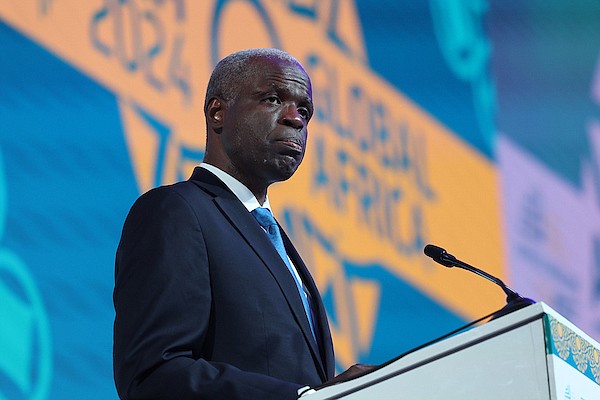
Central Bank Governor John Rolle speaks during the Afreximbank’s 31st Annual Meeting at Baha Mar on June 12, 2024. Photo: Dante Carrer/Tribune Staff
BY FAY SIMMONS
TRIBUNE Business Reporter
jsimmons@tribunemedia.net
THE CENTRAL Bank’s governor yesterday predicted The Bahamas will once again confound the International Monetary Fund (IMF) and other observers by outperforming their 2026 expectations through full-year economic growth set to come in “just below” last year’s 3.8 percent.
John Rolle, speaking at the regulator’s half-year economic developments conference, said the economy maintained healthy growth during the first half despite facing headwinds from higher inflation driven by rising world oil and fuel prices, ever-present geopolitical uncertainties and frequent and long-lasting power outages at home.
Presenting the Central Bank's latest assessment, Mr Rolle said growth during the first six months of the year closely matched the pace recorded in the same period of 2025, supported by stronger tourism, continued foreign investment, construction activity and improving employment.
"Based on available indicators, the Bahamian economy maintained a healthy growth rate during the first half of 2026, closely keeping pace with the estimated gains recorded in the first half of 2025," he said. Mr Rolle added that tourism performance strengthened compared with last year, with faster growth in stopover visitors alongside continued robust cruise arrivals.
He added that foreign investment remained concentrated in resort developments, residential real estate projects and private cruise destinations, supporting construction activity and creating both temporary and permanent jobs.
"For 2026, forecasted growth is on pace to come in just moderately below the estimated 3.8 percent recorded in 2025," Mr Rolle said, while acknowledging that stopover tourism trends remain below those from pre-COVID. The IMF and credit rating agencies have projected Bahamian gross domestic product (GDP) will grow in the low 2 percent range for 2026, below the Governor’s forecast.
“For tourism, this includes an expansionary year-to-date contribution from stopover earnings, benefiting from slightly recovered visitor volumes and further appreciated average pricing, but with constrained hotel room inventory still limiting overall performance,” he explained. “Although rebounded against 2025, monthly seasonal volumes still have not shifted significantly, on average, to the peak baseline headcount recorded before the COVID-19 pandemic.
“Otherwise, tourism performance also reflects a fairly robust uptake of vacation rentals, in place of constrained resort accommodations. In addition, vigorous demand growth from the Canadian market for the second consecutive year has been supplemented in 2026 by a more stabilised and incrementally improved outcome for the US market. In the meantime, cruise visitor inflows have remained strong.”
At the same time, Mr Rolle said inflation has accelerated because of higher fuel costs and rising prices for imported goods and services stemming from geopolitical tensions.
"Turning to inflation, recent firming was evident, owing to higher prices for imported fuel, impacting transportation costs and a range of elevated pricing on other imports," he said.
While domestic electricity prices have been partially shielded by Bahamas Power & Light's (BPL) fuel hedge, Mr Rolle warned that higher generation costs could eventually filter through once those protections expire.
"For the time being, some domestic energy costs remain sheltered by BPL's fuel hedge. However, adjustment in the fuel hedge is expected to occur before oil prices fall back to pre-war levels. This could pass higher costs through to electricity generation after 2026,” he added.
Looking ahead, Mr Rolle said the economy continues to face significant external risks, including the wars in Ukraine and the Middle East, persistent tariff uncertainty and weaker consumer confidence in key tourism markets.
Nevertheless, he said tourism, foreign investment, employment growth and domestic lending are all expected to remain supportive of continued economic expansion.




Comments
Use the comment form below to begin a discussion about this content.
Sign in to comment
OpenID