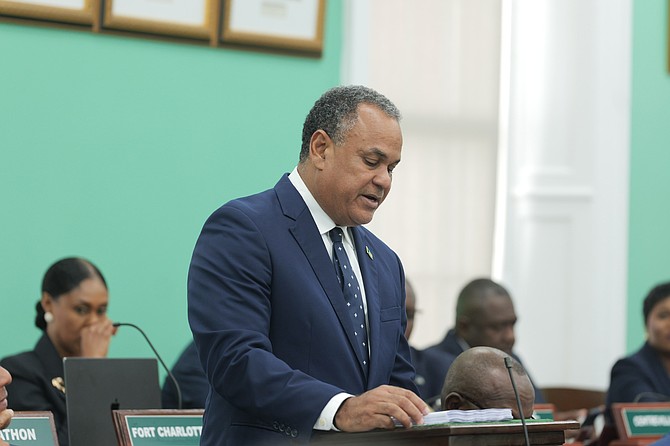
Minister of Finance and St Barnabas MP Michael Halkitis presents the 2026 Budget Communication in the House of Assembly on May 27, 2026. Photo: Chappell Whyms Jr
By NEIL HARTNELL
Tribune Business Editor
nhartnell@tribunemedia.net
Just 16 percent of the Government’s ministries, departments, agencies and business entities (GBEs) heeded the Ministry of Finance’s call to submit annual and business plans as part of the 2026-2027 Budget preparations, it has been revealed, sparking pledges of a compliance crackdown.
The Fiscal Strategy Report 2026, released alongside last week’s Budget for the upcoming fiscal year, promised that the Ministry of Finance will “strengthen its approach” to reporting compliance by all government entities - something that is legally mandated by the Public Finance Management Act 2023 - through what was described as “clearer escalation mechanisms” and “reinforced accountability” for failing to submit.
The warning comes after just seven of the Government’s 51 ministries and departments, and eight of its 42 agencies and GBEs, responded to the Ministry of Finance’s request to provide annual plans, business plans and statements of corporate intent to support planning and organisation structure, as part of preparations for the 2026-2027 Budget. This is the first time they will have had to fulfill this task, as the Act is understood to have given all public entities a two-year period in which to prepare for this.
“Across agencies and GBEs, reporting requests were successfully issued to 42 entities, representing full coverage at the initial stage. Of these, 14 entities (approximately 19 percent) provided formal written acknowledgement, indicating partial engagement with the reporting process,” the Fiscal Strategy Report said.
“However, eight submitted a completed annual plan, business plan or statement of corporate intent by time of this report, highlighting a significant drop-off between acknowledgement and delivery. A similar pattern is observed among ministries and departments. While all 51 entities received the reporting request, only 19 entities (37.3 percent) provided formal written acknowledgement and seven (13.7 percent) submitted reports.”
A further breakdown showed that, of 51 government ministries and departments, only six were fully compliant with the other 45 deemed non-compliant with the law as set out by the Public Finance Management Act 2023. Just four of the Government’s 22 agencies met the requirements, with 18 found to be non-compliant, while - of the 20 GBEs - five submitted a statement of corporate intent, and just eight a business plan for the upcoming fiscal year.
The Fiscal Strategy Report 2026 warned that the relatively low level of responsiveness and compliance, albeit at an early stage, undermines both transparency and accountability when it comes to the health of The Bahamas’ public finances.
“Strengthening the timeliness and completeness of reporting by ministries, departments, agencies (MDAs) and GBEs remains a central priority in advancing fiscal transparency, and aligns with the requirements of the Public Finance Management, as well as international assessment frameworks like the Public Expenditure and Financial Accountability (PEFA) framework,” the report said.
“For fiscal year 2026-2027 Budget preparation, the Ministry of Finance implemented a structured reporting process, issuing requirements to MDAs and GBEs via official circulars and letters. Emphasis was placed on compliance with MDA annual plans and GBE business plans and statements of corporate intent to support proper planning and organisational structure.”
Outlining how the Government intends to react, the Fiscal Strategy Report said: “In response, the Ministry of Finance is strengthening its approach to reporting compliance through enhanced follow-up protocols and clearer escalation mechanisms.
“Greater emphasis is being placed on reinforcing accountability for non-submission, while continuing to support entities through technical guidance and capacity-building initiatives. The Ministry will continue compliance measures for other Public Finance Management Act mandated reports.”
The need for improved response and compliance was highlighted by Michael Halkitis, minister of finance, in his 2026-2027 Budget presentation in the House of Assembly. He said: “During the 2026-2027 Budget preparation cycle, the Ministry of Finance sent formal, written communication to all public entities requesting their compliance with the preparation, submission and publication of the reports required under the Act.
“Each entity was also asked to return a signed copy of the letter from the relevant permanent secretary, chief executive and chairperson of the Board, as applicable. This was done to support a clear and accountable notification process.
“As guided by the Act, contents of the annual plan outline the key priorities, objectives, programmes, performance measures and service delivery standards for the period. It also addresses statutory requirements and operational priorities across core areas such as revenue management, expenditure control, debt sustainability, procurement oversight and capacity building,” the minister added.
“To support this initiative at the ministry, department and agency level, an annual plan template for fiscal year 2026-2027 was developed, circulated and revised. A workshop was also held to assist entities in meeting their statutory obligations. These efforts are intended to help public entities operate with clearer priorities, measurable targets, stronger financial oversight and greater accountability to the Bahamian people.
“Annual plans for ministries, departments and agencies, which have been completed, will be tabled during the second reading [of the Budget]. The business plans and statements of corporate intent for government business enterprises will be tabled during the presentations of their responsible ministers. The documents are expected to be published on the respective entity’s websites after tabling,” Mr Halkitis continued.
“Looking ahead, we will continue modernising the public financial management framework through stronger compliance monitoring, improved reporting standards and better co-ordination across the public sector. We will also continue to build capacity for formal planning and support ministries in providing the monthly and quarterly financial reports mandated by law.
“These efforts form part of the Government’s broader commitment to a stronger, more responsive and more accountable system of governance, while maintaining the fiscal discipline necessary to support long-term national development and continued economic progress.”




Comments
Use the comment form below to begin a discussion about this content.
Sign in to comment
OpenID