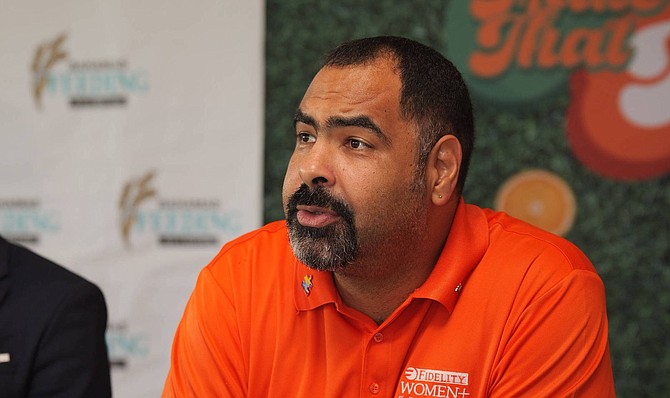
Gowon Bowe
By EARYEL BOWLEG
Tribune Staff Reporter
ebowleg@tribunemedia.net
CLEARING Banks Association chairman Gowon Bowe has warned that Bahamian commercial banks will struggle to provide services to cannabis-related businesses under existing banking rules, particularly those tied to the United States and the United Kingdom.
Mr Bowe said major US banks prohibit transactions with financial institutions involved in the marijuana industry. He said that creates a serious hurdle for The Bahamas, whose banking system relies heavily on US correspondent banks for international transactions.
“The United States, which is the largest clearing jurisdiction for The Bahamas because most of our transactions clear in the United States dollars, really has not changed the federal law relative to marijuana, and therefore is considered an illegal substance,” he noted yesterday.
“Accordingly, all of major banks in the United States, the Tier one correspondent banks — Citibank, JP Morgan, Bank of America and Wells Fargo — they prohibit transacting with financial institutions that bank any persons engaged in the marijuana industry
“When we put that into context, while in The Bahamas, the laws and regulations may permit the cultivation, sale, and use of marijuana, the financial transactions associated with that activity are still not going to be permissible to be banked in the Bahamian banking system, because the Bahamian banking system still relies on the US banking system in order to facilitate its credit card payments, to facilitate its international wires outgoing and incoming in order to facilitate commerce and trade.”
His comments come as The Bahamas Cannabis Authority reportedly expects to begin rolling out the country’s medicinal cannabis industry within weeks after signing an agreement with US-based tracking company Metrc.
The agreement clears the way for the public unveiling of the licensing platform, government website and application process before the end of June.
Metrc has been contracted as a platform provider and guide for the country.
Mr Bowe pointed to Canada, where cannabis is legal, but banks still face difficulties dealing with US counterparts. He said US institutions require strict separation of cannabis-related funds from US dollar transactions involving marijuana participants.
He said that kind of separation would be nearly impossible for The Bahamas.
Mr Bowe said the challenge is sharper because the Bahamian dollar is not globally traded and The Bahamas relies heavily on US dollars.
“In Canada, the Canadian dollar is a globally traded currency,” he said. “It is a country that produces exports and imports and so therefore it has a flow of its own currency that is on the global market.”
“The Bahamas does not have the same dynamic and so ultimately The Bahamas or the Bahamian dollar has only utility in the Bahamas, is not globally traded, it's not used for any imports. All of our exports are settled in United States dollars.”
“The reality is there's no commercial bank that can feasibly ring fence this activity to say that these particular persons or these particular businesses will have absolutely no activity that would involve correspondent banks and so in the absence of having that type of ability to ring fence, this is one of those practical hurdles that is going to take as we say, a significant amount of effort and geopolitical maneuvering in order to have any feasible chance of banking in the near term.”
Mr Bowe also cited Jamaica’s experience, noting that despite legal reforms, much of its cannabis industry remains cash-based because of banking restrictions. He said that leaves businesses holding large amounts of cash and increases their vulnerability to nefarious activity.
He said alternative banking options could include European financial institutions or non-traditional providers such as credit unions and postal banking services.
However, he warned that those entities often maintain relationships with commercial banks and could risk losing those relationships if they are found to be handling cannabis-related funds.
Mr Bowe said there have been no formal or substantive discussions between the banking sector and policymakers on how cannabis-related businesses would be banked, though there have been informal conversations about working together.
“It is largely been treated as one of those of the ostrich burying its head in the sand that it is with a viewpoint that if the laws are on the books, then the bank simply must comply, and this is one of those that is distinguishing between, as I said, a legal framework and a commercial framework,” he said.
He urged the government not to put its head in the sand or simply blame the banks, but to work collaboratively with the banking sector.




Comments
birdiestrachan 1 hour, 19 minutes ago
Yes Mr Bowe. Give the government good advice. Talk to them and help our Bahamas
Sign in to comment
OpenID