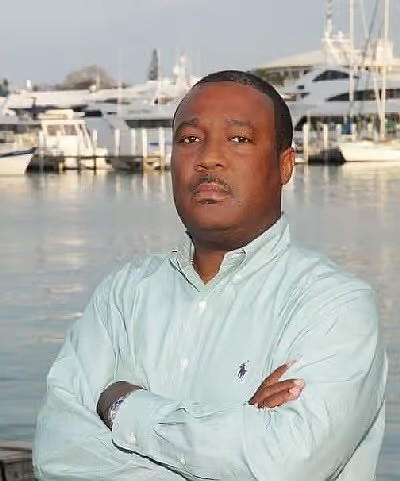
Adrian LaRoda
By NEIL HARTNELL
Tribune Business Editor
nhartnell@tribunemedia.net
A senior fisheries executive yesterday asked “where does it end” as the Trump administration threatened to hit Bahamian exports to the US with 12.5 percent tariffs after finding this nation is failing to combat imported goods made with forced labour.
Adrian LaRoda, president of The Bahamas Commercial Fishers Alliance (BCFA), told Tribune Business that imposing such US border taxes on spiny lobster threatens to place a key fisheries product “at a serious competitive disadvantage” and undermine a major portion of the industry’s annual $90m global exports.
Confirming that Bahamian fisheries would be “squeezed” if the Trump administration follows through with its planned action, he warned that prices are already at a point where the sector is “breaking even” and “in survival mode” due to a combination of US market trends and ongoing uncertainty over Washington D.C.’s tariff policies and whether they can withstand judicial scrutiny.
Mr LaRoda asserted that The Bahamas must now prioritise finding new markets for its fisheries products amid the Trump administration’s volatile trade policies. And he told this newspaper that - while any slowdown in US exports is unlikely to “have a catastrophic effect” on the industry’s employment by itself - there may be a knock-on impact on jobs if processors and wholesalers slash purchases if the local market is unable to absorb this extra product domestically.
The Alliance chief called for swift trade and foreign policy intervention after The Bahamas was named among 54 countries deemed by the US Trade Representative’s Office (USTR) to have neither enacted, nor enforced, a legal and regulatory regime that bans the entry of imported goods made with forced labour into this country.
The USTR, which promotes and enforces the US federal government’s trade policies, outlined its findings in a June 2, 2026, report that was released following an extensive consultation process involving both written submissions and public hearings.
“USTR found that The Bahamas has failed to impose, and effectively enforce, a prohibition on the importation of goods produced with forced labour,” the report said. “We found that the failure to impose and effectively enforce a forced labour import prohibition is unreasonable.
“We found that the failure to impose, and effectively enforce a prohibition on the importation of goods produced with forced labour, burdens or restricts US commerce. For the foregoing reasons, the results of this investigation indicate that the acts, policies and practices of The Bahamas related to the failure to impose and effectively enforce a forced labour import prohibition are unreasonable and burden or restrict US commerce.”
The Bahamas is in good company because the likes of Canada, Australia, the UK, the European Union (EU), Israel, New Zealand, Saudi Arabia, the United Arab Emirates and Singapore are among the other jurisdictions also set to be hit with tariffs. Those that have enacted prohibitions on forced labour goods, or made commitments to do so, will face a lower 10 percent tariff rate, but those who have neither laws nor enforcement - such as The Bahamas - face being subjected to the higher 12.5 percent rate.
The Bahamas, though, and other nations now have around one month to initiate further efforts to head-off, and prevent, the Trump administration turning its threatened tariff imposition into action. The planned measures must now undergo a further round of consultation in Washington D.C., with the deadline for written submissions to the USTR set as July 6, 2026, with public hearings set to begin one day later.
Based on feedback submitted by Ryan Pinder KC, The Bahamas’ former attorney general, in March to the first round of USTR consultation, up to $985m worth of Bahamian to the US could be hit by the proposed 12.5 percent tariff based on 2024 data. This nation’s major export was refined petroleum, valued at $610m, while other categories included documents of title ($95.2m), styrene polymers ($55.7m) and pearl products ($39m).
While these tariffs would increase the cost of Bahamian goods exports for both US importers and consumers, thus threatening to make them uncompetitive on price and losing sales and market share, it is not clear whether all will be impacted. The USTR signalled that some would be exempt given their importance to the US economy and the supply chain/production process, as well as on national security grounds.
Refined petroleum, which likely refers to products blended and composed at Buckeye Bahamas (the former Bahamas Oil Refining Company) in Grand Bahama, would be a potential exemption candidate given that California was last year sourcing up to 40 percent of its gasoline needs via this nation due to the loss of production capacity at its own refineries.
The Davis administration has taken the threat posed by the US government’s forced labour tariffs extremely seriously. Besides Mr Pinder’s submissions to the USTR, Danya Wallace, director of legal affairs in the Attorney General’s Office, represented The Bahamas at the public hearings on the issue and was one of the panellists to give evidence.
She conceded, under questioning, that The Bahamas has nothing in the Customs Management Act or other legislation “that directly addresses” the importation of goods manufactured by forced labour.
However, Tribune Business previously revealed that the Government has moved swiftly to correct this deficiency through reforms to the Customs Management Act - tabled in the House of Assembly last week with the 2026-2027 Budget - that ban the importation of goods made with forced labour.
The Customs Management (Amendment) Bill 2026 introduces a new section 208A which stipulates: “The Minister may, by Order, prohibit the importation of any goods, wholly or partially produced or manufactured, from any supplier, country or territory if there are reasonable grounds to believe that the goods are a result of forced labour.”
The Bill’s ‘objects and reasons’ section reaffirmed that the change is geared towards “prohibiting goods from suppliers, places or countries that produce forced (child) labour from entering The Bahamas”. What is unknown is whether this will be sufficient to satisfy the Trump administration, given that the USTR seems to be demanding enforcement evidence as well as the enactment of the necessary laws and regulations.
Mr LaRoda, speaking on behalf of the Fishers Alliance, told Tribune Business: “In terms of the economic effect, we would be concerned because adding 12.5 percent; in real terms, that’s 15 percent. That further impacts us in being able to really sell our product to US importers. That’s a major concern for us.
“We already have a challenge selling lobster in US stores at prices that are 70 percent higher than domestic Maine lobsters. That’s going to put us at a serious competitive disadvantage. We have to find new markets to maintain our competitive advantage. We like our proximity, and to be able to access the US market, but we still have to explore new markets further north like Canada and Europe.”
While a significant portion of The Bahamas’ crawfish/spiny lobster exports are already sold to Europe, and especially France, Mr LaRoda added: “We are strong, but need to be stronger, because we’re competing with Africa and other countries. We are worried. We all are. Where does it end? We could end up being as high as our other Caribbean brothers, being charged tariffs of 45 percent, which would really hurt economically.”
Mr LaRoda estimated that The Bahamas exports around 12 million pounds of crawfish annually, valued at close to $90m. Some four million pounds is sold to the US, which pegs the total value of that segment threatened by the tariffs at $30m, although Tribune Business has previously seen valuations as high as $50m-$60m for this category.
“Considering that spiny lobster is our main export, we are being squeezed,” the Alliance chief warned. “Some trade or foreign policy initiative needs to be introduced. We have to protect our industry. As much as we don’t want to say it, there are obviously other threats from the World Trade Organisation (WTO), so we need protection from a foreign policy initiative. That needs to be discussed.”
Voicing hope that the US will not follow through with its latest tariff threat, Mr LaRoda said: “The Government has shown it wants to do something. How much do we need to bend before we break or part-break? We’re showing we have the ability to put into legislation protections against importing forced labour goods. I don’t know how much we can be expected to do. The man with a big stick has the ability to affect us in terms of exports. We depend on the economic injection with that one export.
“We always don’t want to be burdened with additional taxes and tariffs. If this is passed, we would have to find ways to adjust. I’m not happy to have to do that. We’re already at a price point where fisheries is breaking even. We’re in survival mode really. It’s not because we’re unable to harvest product, but the economics of tariffs and US trends.
“I honestly don’t know how much more the Government can do. There’s product we can absorb locally, but finding other markets needs to be a big push. We need to find other markets.” Mr LaRoda said much of the employment at Bahamian fisheries exporters, processors and wholesalers is seasonal, so the direct impact of any tariff-induced slowdown in US exports would not be significant for jobs.
However, he added: “The issue is we would still need to be harvesting because we cannot absorb the product locally and, if the wholesalers cannot sell product, they will not be minded to purchase. The uncertainty is what is having the greatest effect right now. This is where our foreign policy needs to come into effect to head of this possibility. I hope they [the Government] stay on it.”
The present US probe is particularly interested in whether its products and manufacturers are being placed at a competitive disadvantage by other countries failing to crack down on rival goods made with forced labour. The Government’s position has been to “request” that the Trump administration find none of The Bahamas’ “acts, policies or practices” relating to forced labour are worthy of attracting sanctions under under Section 301 of the 1974 US Trade Act.
However, the USTR’s review has produced the opposite outcome. “The failure of our most important trading partners to address the importation of goods made with forced labour is unacceptable. This creates a dynamic where American workers are forced to compete globally on an unlevel playing field,” said Jamieson Greer, the US trade representative.
“We will no longer tolerate this disparity. Some trading partners have taken initial steps to prevent the importation of forced labor goods… However, each of our trading partners must do more to ensure that trade does not perversely encourage and entrench forced labour globally.”
The investigation also appears to be a thinly-veiled attempt to crack down on the volume of Chinese goods imported by some of Washington D.C’s major trading partners. China has long faced accusations that it subjects ethnic minorities, particularly the Uighurs in Xinjiang province, as well as political prisoners and dissidents to forced or slave labour where they are forced to manufacture goods against their will and for no compensation.
Media commentators have also suggested that the ‘forced labour’ investigation may be a backdoor attempt by the Trump administration to implement last year’s so-called ‘Liberation Day’ tariffs that have been ruled unlawful by both the US Supreme Court and trade court. Those verdicts are now under appeal.




Comments
licks2 1 hour, 23 minutes ago
This kind of needless panic comes when Bahamians fail to read widely! Yinna een read/hear when the US Supreme told Trump he could not place tariffs on goods coming to the US just because he feels like it?? What we are scared about has already been adjudged illegal for Trump to do!! Because if he do place tariffs on us. . .it becomes a tax for American consumers and only Congress has the power to tax Americans!! I even een ge talk about that forced labor nonsense coming outta Trump's "piehole". . .where in the Bahamas is there forced labour going on? What the hell we gat journalists them for??
licks2 1 hour, 23 minutes ago
This kind of needless panic comes when Bahamians fail to read widely! Yinna een read/hear when the US Supreme told Trump he could not place tariffs on goods coming to the US just because he feels like it?? What we are scared about has already been adjudged illegal for Trump to do!! Because if he do place tariffs on us. . .it becomes a tax for American consumers and only Congress has the power to tax Americans!! I even een ge talk about that forced labor nonsense coming outta Trump's "piehole". . .where in the Bahamas is there forced labor going on? What the hell we gat journalists them for?? And by the way. . .THERE IS NO APPEAL AFTER THE SUPREME HAS DECIDED!! Trump tariffs are illegal!!
ted4bz 57 minutes ago
They always up to something, and it's never what they running on about, it's always sinister. What is it this time?
Sign in to comment
OpenID