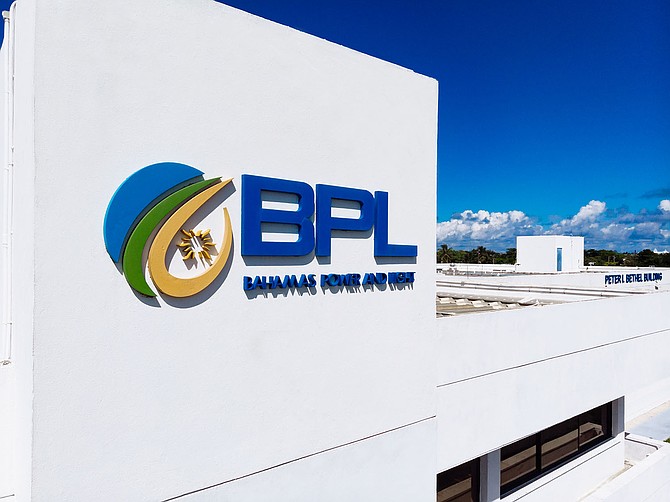
Bahamas Power & Light (BPL) headquarters
By NEIL HARTNELL
Tribune Business Editor
nhartnell@tribunemedia.net
Annual Bahamian household spending on electricity bills is “five times’ higher” than the Latin American and Caribbean average, a just-released Inter-American Development Bank (IDB) report has revealed, due to “structural generation and system inefficiencies”.
The multilateral lender, in its first quarterly Caribbean bulletin for 2026, said Bahamian energy costs cannot be blamed on oil price volatility alone and noted that the sustainability of Bahamas Power & Light’s (BPL) Equity Rate Adjustment tariff structure - which ensures the first 200 kilowatt hours (KWh) every month are free for residential consumers - depends on reducing generation costs and boosting efficiency.
BPL is mandated by the Electricity Act to submit a tariff review application to its regulator, the Utilities Regulation and Competition Authority (URCA), by 2027, and several energy sources - speaking on condition of anonymity - have suggested the state-owned utility will have to increase its base rate to ensure the Government’s energy reforms, as well as its financial health, remain commercially viable while potentially ending the free first 200 KWh.
However, the IDB report also acknowledged projections by the former Ministry of Energy and Transport that the Government’s total energy reform package - once fully implemented and executed - will generate up to $170m in annual electricity savings for BPL customers “without requiring central government financing”. It warned, though, that restoring BPL to financial health - given 24 percent operating losses - is critical given that it “sits at the centre” of the energy reform plans.
The study also appeared to under-estimate BPL’s present tariffs, pegging them at 29 cents per KWH when - based on latest residential electricity bills - the all-in cost ranges from 33.3 cents to 38.8 cents depending on consumption and the various base rates that are triggered. Fuel alone, which accounts for around 50 percent of the total bill, stands at more than 21 cents per KWh in the latest round of billing.
Still, asserting that “this places The Bahamas among the region’s highest cost systems”, the IDB said: “Average annual household energy expenditure is roughly $4,800, five times higher than the regional average, with households in the lowest income quintile spending about 7.3 percent of their income on electricity.
“This is well above the Latin American and Caribbean average of 4.4 percent, and exceeds the 6.5 percent benchmark designating a high energy burden. These costs reflect structural generation and system inefficiencies, not just temporary oil price spikes.” The Government, though, has asserted that the Equity Rate Adjustment structure - and the provision of the first 200 KWh for free - has significantly slashed electricity costs for the poorest households and most vulnerable Bahamians.
“The recent decline in global oil prices, along with low inflation in The Bahamas - 0.4 percent year-over-year as of end-May 2025 - created a temporary window for the Equity Rate Adjustment Programme, which zero-rates the first 200 kWh of residential consumption. However, the durability of such measures depends on structural efficiency gains and lower generation costs,” the IDB suggested.
Energy industry sources have suggested that the ‘free’ first 200 KWh is costing BPL several million dollars in revenue per month, with the utility also subsidising electricity costs on the Family Island by $50m per month to maintain one national, uniform tariff rate. The long-time strategy of using New Providence to part-cover Family Island generation costs is being ended under the Davis administration’s reforms, meaning businesses and residents there will now pay the true price for electricity.
However, the Government is hoping to still lower Family Island energy costs through the outsourcing of generation to private sector independent power producers (IPPs), with the use of solar and other renewable technologies, plus liquefied natural gas (LNG), ultimately eliminating the use of more expensive fossil fuels such as heavy fuel pil (HFO) and automated diesel oil (ADO).
The IDB, asserting that the integration of renewables into The Bahamas’ energy mix has “accelerated markedly”, said: “Prior to 2024, progress was slow, with renewable penetration staying near 0.2 percent. Since then, the reform trajectory has shifted from policy planning to implementation…
“LNG-solar hybrid microgrids were launched in outer islands - Abaco, Andros, Eleuthera and Exuma, with Eleuthera and Abaco breaking ground in April 2026. And in March 2025, a 20 mega watt (MW) utility-scale solar project power purchase agreement (PPA) was signed at the Blue Hills facility in Nassau expected to be completed in 2027.
“The introduction and planned increased use of LNG represents a major structural shift in the generation mix Compared to diesel and heavy fuel oil, LNG offers lower and more stable generation costs and reduced carbon intensity. While LNG remains a fossil fuel, it functions as a transitional stabiliser by reducing volatility and providing flexible back-up capacity for intermittent renewables,” the IDB said.
“When combined with the planned solar expansion and grid modernisation, the Ministry of Energy and Transport estimates this comprehensive reform package will generate up to $170m in annual savings without requiring direct central government financing. These substantial cost reductions could materially improve BPL’s operating margins and ease tariff pressures over time.”
The IDB report also voiced optimism that, through switching to the same combination of LNG and solar energy generation for the Family Islands, BPL’s costs will reduce. “Today, electricity supply in these markets is heavily subsidised - at approximately $50m annually - to maintain uniform tariffs,” it said.
“By shifting to structured PPAs supported by hybrid microgrids, and more efficient generation, BPL can significantly reduce the cost of service in these regions while maintaining reliability and improving transparency in pricing.” However, it warned that BPL’s cash-strapped condition will continue to impact the pace and timing of the Government’s energy reforms.
“The utility’s weak balance sheet remains a major limitation on investment capacity. The Government’s response - lower-cost LNG substitution and mobilisation of private capital (PPAs and IPPs) - aims to reduce cost pressures while avoiding additional public borrowing. However, financial restructuring is still in progress,” the IDB report said. “Nevertheless, important advances have been seen regarding capital expenditure restructuring……
“The core fiscal challenge for The Bahamas is to restore the financial viability of BPL, which sits at the centre of this macro transmission chain. With persistent operating losses of 24 percent and a -2.5 debt service coverage ratio in fiscal year 2023-2024, the utility represents a significant contingent liability for the Government. Continued under-performance could require fiscal intervention, increase total public debt ratios and potentially raise sovereign borrowing costs.
“Taken together, initiatives such as expansion of PPAs, debt restructuring and grid modernisation represent a fundamental restructuring of BPL’s cost base and operating model. The combination of reduced fuel and operating costs, elimination of legacy inefficiencies and more predictable long-term energy pricing positions the utility to potentially achieve financial stability and debt burden relief.”
Other constraints identified by the IDB report are the conditions of the energy grid and technical limitations, although this will have been addressed on New Providence via the $130m foundational upgrades carried out by Bahamas Grid Company and its contractor, Pike Electrical.
“System losses remain elevated above 10 percent, and the grid lacks ‘N-1 redundancy’, meaning the system cannot fully withstand the loss of a major generation unit or transmission component without risking service disruption,” the study added.
“This limits operational flexibility and requires conventional generation to remain online as back-up, reducing the system’s ability to integrate intermittent wind and solar energy at scale. Transmission reinforcement, digital monitoring and balancing capacity are therefore pre-requisites for achieving the 30 percent renewable target by 2030.”
The IDB document also signalled that there has been a subtle change in the Government’s energy PPAs, which are now focused on performance and delivery as opposed to construction. “Unlike earlier ad hoc approaches, the 2024 framework establishes a structured PPP model based on performance-linked contracts and innovative financial transactions,” it said.
“Contracts are now structured around service delivery rather than asset construction, with no government guarantees granted to private participants. Each agreement includes tariff ceilings, performance clauses and eventual asset transfer provisions to BPL.
“To promote the bankability of these projects, the Government is employing blended finance strategies, which include partial risk guarantees, liquidity support instruments and escrow-backed payment frameworks in collaboration with multilateral institutions such as the IDB and World Bank,” the multilateral lender added.
“The Government is also exploring the Green Infrastructure to fund projects that target climate goals and tariff affordability. Overall, the macro-fiscal impact of more PPPs will depend less on the volume of private investment mobilised and more on sustained contract discipline, transparency and monitoring capacity.”




Comments
Use the comment form below to begin a discussion about this content.
Sign in to comment
OpenID