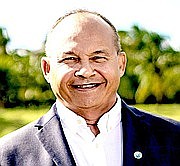
Mario Carey
By NEIL HARTNELL
Tribune Business Editor
nhartnell@tribunemedia.net
Private islands and foreign-owned homes worth more than $20m should not have their annual real property tax payments capped at a maximum $200,000, a prominent Bahamian realtor is arguing, calling for it to be set much higher.
Mario Carey, president and chief executive of Better Homes & Gardens Real Estate MCR Bahamas, told Tribune Business “it makes no sense” for the Government to limit real property tax yields from the wealthiest owners given that, on some private islands, “a bottle of wine is worth more than that” $200,000 cap that will be set for foreign owner-occupied property with effect from July 1.
Urging that “another tier” be created for those who own homes and private islands valued at more than $20m, he added that Bahamians will not be impacted by such a move as there are none “close to that price point”.
And Mr Carey also backed the Davis administration’s decision to switch the test qualifying foreign real estate purchasers as owner-occupied. Michael Halkitis, minister of finance, during the 2026-2027 Budget presentation revealed that such owners must use the property as their primary residence as he foreshadowed a move away from the current regime that mandates they spend a minimum 180 days in The Bahamas.
“That’s fair enough,” Mr Carey told this newspaper. “It’s too difficult for them to count days, and the person must show it’s their primary residence versus an Airbnb or vacation rental. It’s something they have got Investments Board approval on to qualify as their primary residence.”
Mr Halkitis disclosed that the Government is moving to create a “two-tier real property tax system that clearly distinguishes between Bahamian-owned and foreign-owned properties” through the creation of a new foreign owner-occupied tax-paying category. Those who qualify will pay a rate of 0.625 percent, with the amount of annual tax payable capped at $200,000.
Mr Carey, though, argued that the cap should be set much higher for the wealthiest foreign property owners in The Bahamas - and potentially even eliminated for those who enjoy the most valuable private islands. He argued that their means are such that they can afford higher tax payments and this will not be a deterrent to either foreign direct investment (FDI) or real estate sales.
“They should go above $200,000,” he argued. “If someone owns a property above $20m, there’s no Bahamian close to that price point. The cap should be higher. Islands should be taxed higher. If you are paying $100m for an island you should not be paying $200,000 in property taxes. It makes no sense. If they own an island, there should be another tier.
“If they own a home over $20m, no matter what happened in the past they should be paying $300,000, not $200,000. I know people that work on these islands, and they say a bottle of wine is worth more than that, or champagne, or cognac. It’s a joke to these guys.”
The Government is forecasting that it will realise $24m in real property taxes from the new foreign owner-occupied category during the 2026-2027 Budget year, with this figure increasing to $26.5m and $28.3m in the upcoming 2027-2028 and 2028-2029 fiscal periods, respectively. Not all of this will be ‘new’ revenues as many of these properties and their owners will have previously been included in other real property taxpayer categories.
Gavin Christie, managing partner at the Corcoran C.A. Christie real estate firm, told Tribune Business that the switch from ‘180 days’ to ‘primary residence’ as the test for determining whether foreigners fall into the owner-occupied category, together with the new rate and $200,000 ‘cap’, represents a “balancing act” where The Bahamas is seeking to still encourage FDI but, at the same time, create more opportunity for Bahamians.
“I think that, with the new category, it kind of signals a small policy shift, and it’s tied to the need to provide and create more access for Bahamians,” Mr Christie added, “but still wanting to welcome that foreign investment. As always, with FDI, there’s a thin line that we walk.
“We want to still encourage them to come into our market and invest in our market. I think it’s kind of a balancing act, and I think the Government are trying to simplify the system by removing the 180 days and moving it to more of a residency test. It’s a way of kind of modernising the system a bit, moving away from 180 days as to whether it’s a primary residence or non-resident.”
Mr Christie, though, warned that legislative and policy clarity are key. “With my experience with FDI, there are a few things,” he said. “It has to be very clear. There has to be a lot of clarity and execution has to be on point as well. It’s ease of doing business. If someone is paying for something they want to be 100 percent clear what it is and ensure they get value.
“It is a balancing act that comes back to clarity and also then the proper execution and value. People just want to ensure that whatever they are paying for there is value there. Overall, the Budget would be what I consider to be a positive step for the industry, but particularly for first-time home buyers. All in all, a positive Budget and a progressive Budget.”
Mr Carey also praised the Government’s decision to extend the VAT exemption for first-time home buyers to cover the entirety of duplexes, triplexes and larger complexes even if the owner is living in just one unit. Describing such accommodation as “the perfect model for Bahamians”, he urged the Government to incentivise their increased development and re-zone ‘single family’ areas to ‘multi-family’ where feasible.
“It’s a good start,” he told Tribune Business on eliminating 10 percent VAT on the purchase. “The banks are using that [rental] income to help qualify people for a mortgage, too. It’s good the Government are doing that. I like it.
“With that in mind, the Government should encourage developers to develop more multi-family properties because it’s the perfect model for Bahamians. The failure rate for multi-family property is lower. The development costs are so high. The Government can subsidise this activity by eliminating tax on the transfer. There’s ways they can make the developer subsidise some of that infrastructure cost to make it more affordable.
“There’s a formula there to be looked at. A Bahamian owning a duplex or something similar is a formula that works. That should be a priority. Any sound land owner in an area zoned multi-family should make the property more affordable. If there’s a rezoning ability to take an area in transition from single family to multi-family it should be a priority for the Government to rezone.”
Mr Halkitis, in the Budget presentation, said: “We are therefore extending VAT relief for first-time homeowners by expanding zero-rated treatment to include multi-unit properties such as fourplexes, triplexes, and duplexes; particularly where at least one unit is owner-occupied. To clarify, this VAT relief will be on the entire building rather than just the proportion where the first-time homeowner resides.
“This reform reduces the upfront cost of home ownership, supports small-scale investment and rental income, and reflects how Bahamians are increasingly entering the housing market today. This measure takes immediate effect, helping more Bahamians to own property, build equity and generate income.”




Comments
Use the comment form below to begin a discussion about this content.
Sign in to comment
OpenID