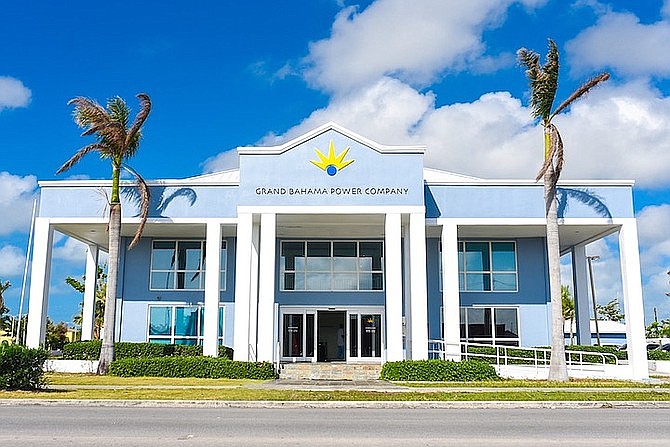
Grand Bahama Power Company
By NEILL HARTNELL
Tribune Business Editor
nhartnell@tribunemedia.net
Emera’s top executive says Grand Bahama Power Company’s sale has enabled it to “further de-risk” its business with a former Chamber of Commerce president warning “there are a lot of open-ended questions” on the utility’s and island’s energy future.
Scott Balfour, the Canadian utility giant’s president and chief executive, in a recent 2026 first quarter results conference call with financial analysts signalled its Grand Bahama exit will enable Emera to better focus on core energy operations at home and in Florida. And GB Power’s sale to the Government will also reduce the risks associated with operating in a small market that has suffered limited economic growth, and which remains vulnerable to devastation from major hurricanes.
Mr Balfour and his fellow executives declined to reveal the purchase price paid by the Davis administration (Bahamian taxpayers), although the Government has raised a $200m syndicated bank loan to finance the deal, but they said the GB Power sales proceeds will be used to pay down Emera’s existing debt.
“The transaction is expected to close by the end of May and, while not a material financial impact, it is a further example of our focus on optimising Emera's portfolio and focusing our efforts on our core utility operations in Florida and Atlantic Canada,” Mr Balfour said of Emera’s objectives.
“While it is never easy to part ways with a company and team that have been part of the Emera family for 15 years, this sale provides support for the Government's National Energy Policy while - at the same time - further simplifying and de-risking Emera's portfolio. We want to thank the Grand Bahama team for their unwavering commitment to delivering safe and reliable energy to customers.”
Rob Hope, a Scotiabank analyst, questioned Mr Balfour and his colleagues on “the expected proceeds from the Grand Bahama sale” and whether the sale had been included in Emera’s previous funding and financing plans for 2026.
Jared Green, Emera's chief financial officer, responded that the purchase price was confidential until the sale to the Government closed. “We haven't stated what the proceed levels are at this point in time. So, they are still confidential during the closing side. But you would be correct,” he said.
“The proceeds on that wouldn't have been in our original funding plan. We will use the funds, though, to just go into the normal corporate funding. So, it will go to repaying debt, and we will still be executing our capital programme and the rest of the funding plan as originally stated.”
It is unclear whether the $200m that the Davis administration has allocated to cover GB Power’s purchase is the actual sum that Emera will receive. It is more likely that this figure also includes funds to pay legal fees and other expenses associated with a commercial transaction of this nature, thereby meaning that the net proceeds received by Emera will be less.
However, Dillon Knowles, the Grand Bahama Chamber of Commerce’s immediate past president, told Tribune Business yesterday that - despite GB Power’s much-touted switch to the same rate and tariff structure as Bahamas Power & Light (BPL) - there are multiple unanswered questions surrounding the utility’s sustainability moving forward.
While the now-government owned utility last week unveiled projections that Grand Bahama residential consumers will enjoy savings of between 35.1 percent and 48.7 percent on their monthly base rate payments, via the switch to the same BPL rates paid by the rest of The Bahamas, Mr Knowles questioned how GB Power will remain commercially viable due to the reduction in top-line revenue income while costs remain unchanged.
Pointing out that Bahamian residents and businesses will have to cover GB Power’s costs regardless, whether as consumers or through taxpayer subsidies, Mr Knowles reiterated: “The last thing we need is to have a rate decrease but also a reliability issue both short-term and long-term”.
Noting that GB Power will no longer be able to rely on Emera’s support and provision of manpower, plus financial and technical assistance when needed, the ex-Chamber president said Grand Bahama’s status as an industrial hub with reliable energy - and minimal to no outages - was even more important than on New Providence and other Bahamian islands.
Voicing fears that GB Power could ultimately become another BPL, or loss-making state-owned enterprise (SOE) that burdens Bahamian taxpayers, Mr Knowles reiterated it was critical that the utility’s newly-appointed Board and management have freedom to operate as a business without “interference from the body politic”.
“There’s been no response to the sustainability of GB Power, and how that is going to be impacted by the rate change,” he told Tribune Business. “We know it’s going to be funded by GB Power and/or the taxpayer. There’s been nothing I’ve seen that explains that at all.”
GB Power, as with BPL under the Equity Rate Adjustment (ERA) tariff structure, will not impose a base tariff on the first 200 kilowatt hours (KWh) consumed by residential customers - a move that will benefit an estimated 25 percent of them from the June billing cycle onwards. And some 90 percent of residential consumers are estimated to fall into the VAT-free category.
Yet Mr Knowles, and others in the private sector, are questioning how GB Power can remain commercially sustainable due to the sudden drop in revenues caused by adopting BPL’s lower tariff rates - especially as no sources of replacement income have been identified, while costs remain unchanged.
As a result, concerns are being voiced that Bahamians, in enjoying the upfront benefits of lower energy bills, may find themselves paying extra on the back end to subsidise and cover GB Power’s losses in similar fashion to BPL.
Questioning whether GB Power will remain under its own fuel hedge or transition to BPL’s structure, Mr Knowles told this newspaper: “There are a lot of open-ended questions from my perspective that need to, and should be, addressed as to how exactly GB Power will operate. There are a lot of questions about how it’s going to be managed.
“I know they have appointed a Board. Does that mean it will operate totally independent from BPL, or will there be room for BPL involvement in making decisions about GB Power. There are many operational issues that we as an island would like to have addressed, and that we have an assurance that we are not going to shortly find ourselves in the same situation BPL finds itself in.
“We still have to pay the cost of producing the power regardless of what we charge for production of power,” Mr Knowles added. “There are lots of other things that we need to understand and appreciate. We no longer have the expertise of Emera available to us unless we have a contractual agreement for them to provide it and act upon matters that come up from time to time, like the need to bring in rental generation from time-to-time to ensure the reliability industrial operators absolutely need.
“One of the things that most people don’t seem to appreciate is that Grand Bahama is not a tourism-based economy. It is an industrial economy. While outages in New Providence are an inconvenience, a power outage in Grand Bahama is a real critical issue for industry.”
As for GB Power’s governance moving forward, Mr Knowles asserted: “We are extremely hopeful that GB Power is not run like a typical state-owned enterprise which has interference from the body politic and is allowed to run properly as a business with the necessary technical and commercial decisions being made…..
“My prayers are with the new Board because they have a hard task ahead of them to do what Emera was doing with the revenue it was generating. The new Board will have to do that work with less revenue. The Prime Minister said little revenue was trickling down to the bottom line, which suggests they were on razor thin margins to start with. The last thing we need is to have a rate decrease but also a reliability issue both short and long-term.”
Emera’s financials for the 12 months to year-end 2025 show that GB Power generated a $10m Canadian dollar contribution to the utility giant’s “consolidated adjusted net income” for the period - a figure that was slightly down on the prior year’s $11m. Using the current exchange rate, that $10m Canadian dollars translates into about US $7.3m.
Those profits were generated from $162m Canadian dollars worth of revenue, which represented a 16.5 percent year-over-year increase compared to 2024’s $139m Canadian dollar top-line. The increase is likely due to increased economic activity among GB Power’s 20,000-strong customer base, with Carnival’s $600m Celebration Key destination having opened last July. The exchange rate conversion means GB Power generated $118.26m worth of revenues in US dollars last year.
The value of the Grand Bahama-based electricity provider’s physical assets, namely property, plant and equipment, narrowed slightly last year from $371m Canadian dollars at year-end 2024 to $361m Canadian dollars some 12 months later.
To give an idea of what the Government has acquired, Emera said: “With $378m US dollars of assets, and approximately 20,000 customers, GB Power owns 98 mega watts (MW) of oil-fired generation, approximately 100 kilometres of transmission facilities and 1,000 kilometres of distribution facilities. GB Power’s approved regulatory return on rate base is 8.52 per cent.”




Comments
Use the comment form below to begin a discussion about this content.
Sign in to comment
OpenID