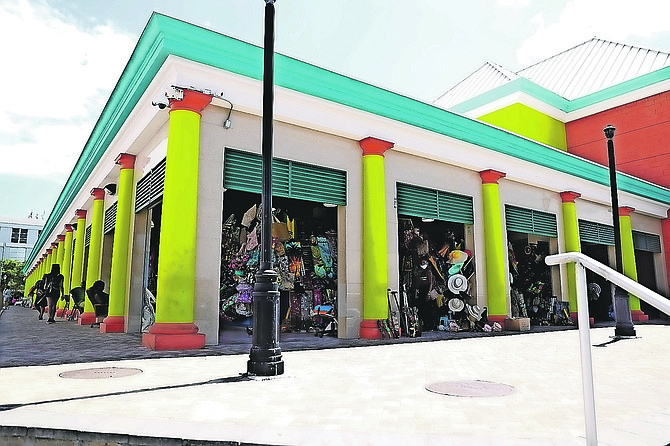
A view of the straw market
By ANNELIA NIXON
Tribune Business Reporter
anixon@tribunemedia.net
BAY Street straw market vendors are complaining that the summer heat is driving tourists away before they can make purchases amid the continued wait for a long-promised air conditioning and cooling system.
The lack of air conditioning is worsening what vendors describe as an already-difficult business environment, with tourists spending less and competition for visitors increasing.
Celestine Eneas, president of the Straw Vendors Advancement Association, said the heat has become so unbearable that visitors often leave the market within minutes of entering.
“When they do come in the market, and they feel the heat, they get out as quick as possible,” Ms Eneas said.
“We have a lot of tourists that are coming, but they’re not spending. See, that’s the problem. We can’t complain that we are not seeing the tourists, mind you. The tourists come, but they’re not spending like that.”
The cooling system has been under discussion for months. While the Straw Market was previously under the Ministry of Works, officials had explored temporarily closing the facility to install the system.
However, Ms Eneas said the proposed timing clashed with the busy Spring Break season, making closure impractical for vendors who depend on daily sales.
“When we were under the Ministry of Works, they were looking for a time to shut the market down to put the cooling system in,” Ms Eneas said. “That was around Spring Break time. They couldn’t close it down then because the people were looking to make their money.”
She suggested September, traditionally the slowest period for straw vendors, would be the most practical time for any temporary closure.
“You have to remember now, straw vendors, some of them work from day to day with little children with nothing to eat,” Ms Eneas said.
“You can’t just drop it on them. You have to give them time so that they’ll be able to put something aside when they close the market.”
Responsibility for the Straw Market has since shifted from the Ministry of Works to the Ministry of Culture, Arts and Heritage, leaving vendors uncertain about whether the air conditioning project remains on schedule.
“I have no idea,” Ms Eneas said. “We have no idea what’s going on with that. Since we’re under a new ministry, I guess we’ll have to wait and see what she brings to the table.”
Tribune Business reached out to Leslia Miller-Brice, minister of culture, arts and heritage, for an update on the cooling system and the project’s timeline, but did not receive a response up to press time.
In the meantime, vendors are bearing additional operating costs simply to make their stalls bearable. “I have about eight fans in my shop,” Ms Eneas said. “You have to try to keep your environment cool.”
Those fans, she added, often become gathering points for overheated tourists rather than paying customers. “They’re standing there trying to cool off, and sometimes three and four of them, five and six at a time,” Ms Eneas said. “They don’t want nothing, but they’re feeling the cool breeze, and they don’t want to move.”
Vendors often choose hospitality over immediate sales in hopes of protecting The Bahamas’ tourism reputation. “You can’t insult them because you need them to come back,” Ms Eneas said.
“If you tell them, ‘Excuse me, you have to move,’ they could speak about their bad experience and then tell their friends, ‘Choose another destination other than The Bahamas’.” The intense heat is also shortening the business day for many vendors.
“You could walk in the market, and by three or four o’clock, you would see more blue plastic,” she said, referring to the tarps vendors use to cover their stalls after closing early. “The market still closes at 7pm, but you might find one or two persons who stay until then.”
Although no one has collapsed inside the market, Ms Eneas said vendors frequently encounter visitors showing signs of heat exhaustion.
“Nobody never really faint and fall on the ground,” she said. “But you could see the tourists feel bad, and you could look in their face and see they’re ready to fall. Before they fall, you offer them your chair and tell them, ‘Sit here and catch a little bit of breeze.’ They are very grateful for it. And that happens all the time.”
The heat is only one of several pressures weighing on Straw Market businesses. Ms Eneas said increased retail offerings at the Nassau Cruise Port and other shopping locations mean visitors no longer need to visit the Straw Market to purchase Bahamian souvenirs.
“It’s really too much things that pull the tourists away from the market,” she said. “The Government have to find a way to get the people off the ship. When they do come, everywhere you go, they can purchase an item. So they don’t necessarily need to come to the Straw Market.”
She also pointed to broader economic uncertainty in the US, the Bahamas’ largest tourism source market, as contributing to softer consumer spending.
“I’m not just putting it on our government, because everybody knows America’s in a mess,” Ms Eneas said. “People are scrambling and don’t know what to do, whether they should spend their money or not. And we rely a lot on American tourists.”
Still, vendors hope the change in ministry oversight will deliver long-awaited improvements to one of Nassau’s best-known tourist attractions.




Comments
DWW 1 hour, 29 minutes ago
Why do my taxes have to pay for their profit? Why can't they pay for their own ac?
DWW 1 hour, 29 minutes ago
An' selling Asian crap too!
Sign in to comment
OpenID