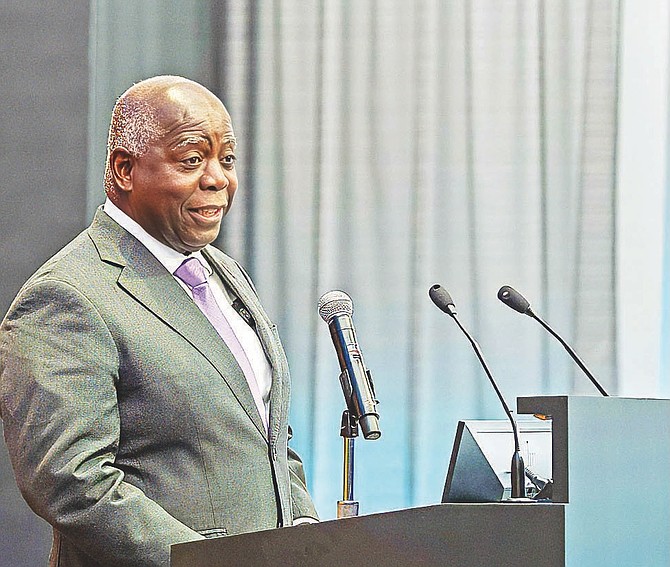
PRIME Minister Philip ‘Brave’ Davis speaks during the United Nations General Assembly in New York on September 25th, 2026
By EARYEL BOWLEG
Tribune Staff Reporter
ebowleg@tribunemedia.net
PRIME Minister Philip “Brave” Davis says he is personally “quite agnostic” about whether The Bahamas should remove King Charles III as head of state, although he is open to the country becoming a republic if that is the will of the Bahamian people.
In an interview with the British TV news channel Sky News, Mr Davis said holding a referendum on the issue was not currently under consideration. The interview was released on October 30, a day after the king left The Bahamas.
Mr Davis said: “I was just elected in May this year. My mandate did not include a referendum on whether we should keep the king or not. So that's not a question that I would I have on the table at this time.”
The prime minister’s personal position neither favoured or opposed The Bahamas being a republic."“I'm quite agnostic about it. I mean, we have, the country has thrived. From 1973, when the king was here to where we are today. We have a tremendous advancement, development, and you can see how we have developed. So I'm very agnostic to the question. Again, I'm guided by the will of my people.”
Asked directly whether he would be open to removing the king as head of state, Mr Davis replied: “I’m open to, yes”, but reiterated that he would be guided by the will of the people if the issue arose.
He acknowledged that Bahamians remain divided over the country's constitutional relationship with the monarchy.
“I think we have some very passionate Bahamians who say we should be a republic equally,” he said. “We have many passionate Bahamians saying that we ought not to rid ourselves of part of our history.
“For us to move to republic would require referendum. Referendum in this country is not fared well, but that question would be a question for our people.”
His comments came amid renewed discussions about Britain's historical involvement in the transatlantic slave trade and growing calls for an apology and reparations from the United Kingdom.
Mr Davis said he would personally like King Charles to apologise for slavery, although he acknowledged that the monarch acts on advice.
“I'd like to see him apologise again. That's a personal a personal decision on his part after advice. At the end of the day, how repair would look once that is satisfactory, how it comes, I will be satisfied,” he said.
He suggested that an apology could form part of a broader process of redress, but maintained that reparations should not be limited to financial compensation.
“I think acknowledgement, firstly, which we are, which has been the first step, which we have now recognized, acknowledgement, education, training, things of that nature. It could mean identifying.”
He pointed to the historical export of cotton from Crooked Island and Long Cay, particularly Moss Plantation, to Liverpool.
“The family might want to consider whether repair, but financial operation in and of itself I know could be challenging for a government.”
“I mean, as a citizen, I would question why my tax paying payment ought to go to satisfy the debt of my ancestors 200 years ago, for an act that was deemed at the time, it was deemed. I was told it was deemed, advisedly, lawful,” Mr Davis said.
However, the prime minister rejected the notion that slavery was lawful and said critics of reparations in the UK must appreciate the historical burden that descendants of enslaved Africans continue to bear.
Mr Davis suggested that the British Royal Family could consider its historical links to the slave trade as part of reparatory justice, pointing to scholarships offered through the King's Trust to Commonwealth citizens as one possible form of redress.
British Prime Minister Andy Burnham said over the weekend that he was open to a formal apology for his country's role in the transatlantic slave trade, but ruled out financial reparations.
He said he wanted a “dialogue with those affected” and was open to “calls for an apology”, but maintained that reparations were “not the right answer”.
Separately, in a statement, Mr Davis said the Bahamian government welcomed the UK government's expressed openness to discussions about an apology for slavery, describing it as a constructive development in the pursuit of reparatory justice.
He said the development should be viewed against growing international recognition of the historical injustices of slavery and their continuing consequences.
Mr Davis highlighted a March 2026 United Nations General Assembly resolution recognising the trafficking and enslavement of Africans as the gravest crime against humanity.
He said the resolution represented an important step in acknowledging the brutality of slavery and called for good-faith discussions on reparatory justice, including a formal apology and other appropriate measures of redress.
The prime minister also pointed to the 2024 Commonwealth Heads of Government Meeting in Samoa, where leaders agreed to pursue meaningful and respectful discussions on reparatory justice.
He said The Bahamas looked to the 2026 Commonwealth Heads of Government Meeting in Antigua and Barbuda as another opportunity to advance those discussions.
Reflecting on the country's history, Mr Davis noted that Long Cay and Crooked Island contributed significantly to cotton production for British mills during slavery.
He also referenced the death of Poor Black Kate, remembered as a national heroine, as a reminder of the suffering endured by enslaved people in The Bahamas.
“The Bahamas approaches this dialogue with a clear understanding that the issue is not simply one of historical remembrance. It concerns the enduring consequences of slavery and the importance of justice, acknowledgement and meaningful redress for the generations of Africans and their descendants who continue to live with its legacy.”
“We must all meet the moment. The international community has made important progress in acknowledging this history and establishing a framework for meaningful engagement. The responsibility now rests with us to ensure that these developments translate into purposeful dialogue, genuine understanding and substantive outcomes.”
He reaffirmed The Bahamas' willingness to engage constructively with the United Kingdom and Commonwealth partners on the issue.




Comments
birdiestrachan 1 hour, 30 minutes ago
A republic would be of no benefit to the average Bahamian. There are many more issues to spend tax payers money on.
Sign in to comment
OpenID