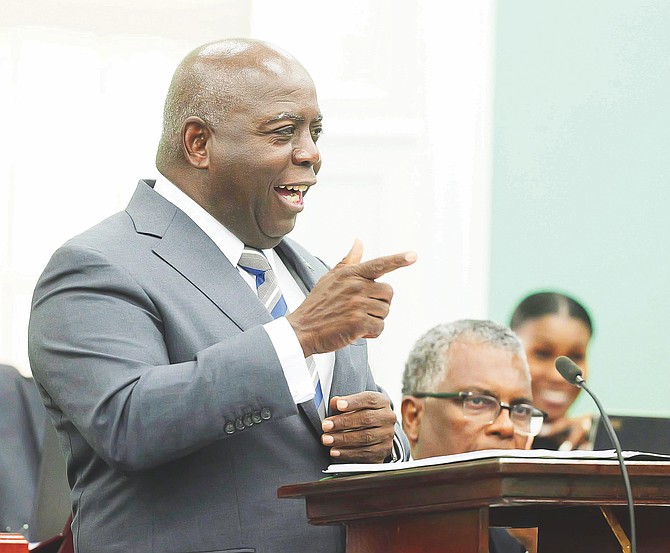
Prime Minister Philip "Brave" Davis
By LYNAIRE MUNNINGS
Tribune Staff Reporter
lmunnings@tribunemedia.net
PRIME Minister Philip “Brave” Davis has challenged Commonwealth leaders to stop allowing young people to graduate with qualifications but no job prospects, warning that governments must do more to ensure education translates into meaningful employment.
Addressing the 14th Commonwealth Youth Forum’s High-Level Intergenerational Dialogue in Antigua, Mr Davis said the longstanding promise that education would lead to employment had failed too many young people, with economies unable to provide opportunities for their skills and qualifications.
“For decades, my generation told yours: stay in school, qualify yourself, and jobs will be waiting for you.
“For many, it was true. For too many, it has not been,” he said.
Mr Davis said young people across the Caribbean were earning qualifications but struggling to find work, while governments faced growing pressure to prepare them for changes in the global economy.
He noted that six in ten people across the Commonwealth are under 30, while roughly one in four young people is not working, studying or receiving training. In some Commonwealth countries, two in three children also have no internet access at home.
Mr Davis warned that artificial intelligence was changing the nature of work faster than education systems could prepare young people, while hurricanes and other natural disasters continued to threaten the economic progress of small island states.
He said governments must equip young people to earn a living despite these challenges, rather than leave them to navigate changing economic conditions without adequate support.
To illustrate the barriers talented young people have historically faced, Mr Davis recounted the story of St Lucian economist Sir Arthur Lewis, who won the Nobel Prize in Economics in 1979.
He said Lewis initially wanted to become an engineer but realised that no government department or company in the colonial Caribbean would employ a Black engineer.
He subsequently changed his field of study, pursued economics and eventually became a leading academic and economist.
“Lewis succeeded despite the system he was born into. His story should inspire us. It should also trouble us, because too many talented young people today still have to succeed despite the system,” Mr Davis said.
“Our task is to make sure the next Arthur Lewis never has to change course to get through the door.”
Mr Davis outlined three priorities for Commonwealth governments: ensuring qualifications are recognised across member states, expanding affordable internet access and increasing investment in education and youth development.
He said qualifications earned in The Bahamas should be recognised in countries such as Jamaica, Ghana and Canada without requiring individuals to repeat their studies.
He also stressed the importance of reliable internet access, particularly for island nations where digital connectivity provides access to education, business opportunities and employment.
On financing, Mr Davis said small states should not have to choose between servicing national debt and investing in education.
He urged Commonwealth leaders to make education a priority during discussions on reforming the global financial system, warning that young people denied opportunities to learn or work could carry the consequences for years.
However, he said providing training alone was not enough, arguing that closing the “possibility gap” between what young people's skills allow them to do and what they aspire to achieve.
Mr Davis called on Commonwealth leaders to give their ministers clear instructions to develop agreements on recognising qualifications, establish targets for affordable internet access and identify funding to bring more young people into training and paid employment.
He also insisted that young people must help shape those plans and hold governments accountable for delivering on their commitments.
At the next Commonwealth meeting, he said, leaders should be able to report how many young people had gained internet access, had their skills recognised and moved from training into employment.
“Our young people have worked hard to earn that passport. We, as leaders, must ensure it takes them somewhere,” Mr Davis said.
“The next Arthur Lewis may be sitting in this room. Let us build a Commonwealth in which that young person can pursue their calling, with the opportunity and support to see it through.”




Comments
DiverBelow 5 hours, 2 minutes ago
Education & Job Prospects fall into the 'what comes first, the chicken or the egg?' dilemma. It breaks down to STANDARDS, both locally, national and across the Commonwealth, graduates with minimal skill are as much a burden on the economy as highly educated with no job prospects! 1. Standardize educational requirements & demand compliance across the Commonwealth, even if additional years in school demands it, otherwise their employers must educate, at a cost. 2. Those educated abroad on govt purse must return to practice their trade on island for a minimal period. Thus contributing to economy or education by their experience abroad. 3. Vocational education is as important as High Education, must be actively supported by govt & industry participants.
Sign in to comment
OpenID