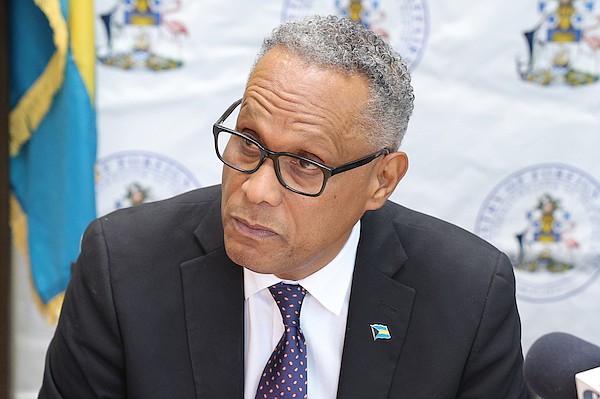
Dr Michael Darville
By KEILE CAMPBELL
Tribune Staff Reporter
kcampbell@tribunemedia.net
PATIENTS at Rand Memorial Hospital have complained of sweltering conditions, with some bringing their own fans into the ward, prompting Health and Wellness Minister Dr Michael Darville to acknowledge ongoing air-conditioning problems and promise repairs.
Dr Darville said yesterday that technicians had been sent to repair and replace faulty units, blaming ageing infrastructure.
A patient in the male surgical ward, who spoke to The Tribune on condition of anonymity, said they had brought a personal fan because the air-conditioning was not working. Other areas of the hospital seemed cooler, they said, though they could not say how long the unit had been out. They also found the mattress and bedding uncomfortable.
The patient said nurses were doing "what they can" in the circumstances.
"Little basic things they don't have," the patient said. "The staff look overwhelmed trying to deal with the patients. The nurses have done a wonderful job with what they are working with."
They said they had seen someone leave the operating room because of the heat, and felt let down and forgotten by those in power.
"They keep promising us here in Grand Bahama that they're gonna make things better for us – it's a boldface lie, spitting in our face every day and we have to live with it," the patient said, describing efforts to address longstanding health problems on the island as "mediocre".
Similar concerns were raised on social media by other Grand Bahama residents.
Central Grand Bahama MP Frazette Gibson raised the male medical ward in a post on Sunday, demanding repairs and answers from the minister and the Public Hospitals Authority (PHA). She said she discovered the conditions during a visit and was "shocked" to see patients bringing their own fans.
"How can this be acceptable? How can Grand Bahamians continue to be subjected to these conditions while seeking medical care?" she asked, adding that patients should not have to supply their own equipment to stay comfortable. "Our people deserve dignity, comfort and quality healthcare."
Calling for immediate action, Ms Gibson said healthcare was "a necessity, not a privilege".
One commenter under her post claimed to have spent a week in the surgical ward and said they felt sorry for "4 elderly ladies who kept waking up through the night out of discomfort". The commenter also alleged that another patient left the ward because a dressing kept falling off. Another user complained of inadequate resources, staffing and attention at the hospital.
Responding to reporters, Dr Darville said he had seen Ms Gibson's statement and that health officials had spoken to the hospital's administration and PHA management.
Technicians were already on site, he said, with parts having arrived. "To my understanding, from the administrator, teams are on the site today. It was planned, and the parts are in," he said.
He did not say which wards were being repaired, give a timeline for restoring cooling, or say how long the problems had persisted. Instead, he pointed to wider difficulties with ageing air-conditioning systems across public healthcare facilities, including clinics in Exuma and Abaco and Princess Margaret Hospital in New Providence. "We have had challenges at the Princess Margaret Hospital. We have challenges at the Rand Memorial Hospital," he said.
Many systems were nearing the end of their lifespan, he explained, but replacing them was complicated because large industrial units could not always be bought off the shelf and had to be manufactured and shipped to The Bahamas.
"When you're purchasing a 20-ton unit from any one of the major air condition manufacturing companies, it's an order that needs to take place, and it needs to be manufactured and then shipped," he said.
Replacement units had been bought and were being made, he said, with installation expected on arrival. He acknowledged that mechanical failures would occur, particularly in intense heat, but said the government had a duty to fix them promptly.
"Sometimes it's quick, sometimes the unit needs to be purchased, and there's a waiting line," he said. "But we intend to resolve the issue."
The complaints follow earlier failures at the hospital. In July, the PHA acknowledged that ageing air-conditioning in the operating theatre had disrupted surgery, with some operations postponed after a compressor malfunctioned. Dr Darville said at the time that the fault caused condensation and water to leak from the ceiling.
The PHA said it was replacing parts and working with external vendors to secure new equipment, which it expected to install within weeks. It also said it was exploring arrangements with outside providers so patients could still receive surgical care.
In October, Free National Movement leader Michael Pintard told Parliament that non-functioning air-conditioning was among shortages of equipment and resources affecting patient care in public hospitals.




Comments
Use the comment form below to begin a discussion about this content.
Sign in to comment
OpenID