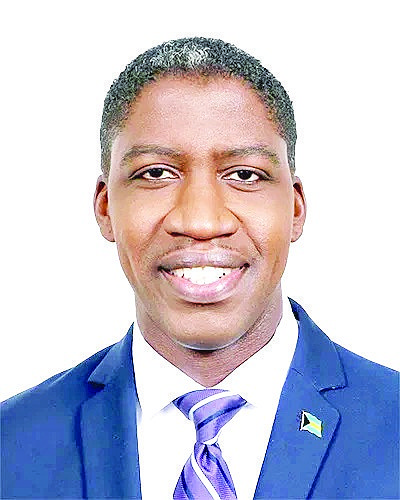
Zane Lightbourne
By KEILE CAMPBELL
Tribune Staff Reporter
kcampbell@tribunemedia.net
ENVIRONMENT and Natural Resources Minister Zane Lightbourne acknowledged that the government's efforts to remove derelict vehicles from communities were sometimes slow, describing the process as "very vexing" as he outlined the difficulties associated with relying on private wreckers.
According to Minister Lightbourne, the government depends on contracted private wreckers to remove the vehicles, admitting that they "need to find a more efficient way to get this done".
He explained that after vehicles are tagged by the Department of Environmental Health for removal, persons are given 14 days to have the vehicles removed.
"Environmental Health engaged private wreckers in order to move vehicles, and most of those wreckers, because of the price point of the service, choose to only if they can move multiple vehicles at a time, that's in excess of five at a time," Mr Lightbourne said.
Mr Lightbourne revealed that the government paid approximately $60 per vehicle for removal, but acknowledged that the work could be strenuous for wreckers, particularly when vehicles lacked wheels or had to be extracted from piles of abandoned vehicles.
"This is something that we're working on to cause it to be more attractive for more wreckers to move vehicles because we are finding that this is a very vexing problem," Minister Lightbourne said, adding that due to the sheer volume of vehicles being left abandoned and derelict, they are working with the Ministry of Works to deal with roadside garages in a stricter matter.
Mr Lightbourne said several Members of Parliament had complained that vehicles continued to be dumped in communities shortly after government cleanup exercises, with some areas becoming littered with abandoned vehicles almost overnight after being cleared.
Mr Lightbourne said the government was working with the Attorney General's Office to strengthen court enforcement against environmental offenders, expressing hope that the environmental court could become operational in a more efficient manner.
He said Commissioner of Police Shanta Knowles had provided a police prosecutor to help bring offenders before the courts, but could not provide a timetable for the court arrangements, saying he would have to consult the Attorney General. "Because this is a human problem," the environment minister said. "This is a problem created by people who have a disregard for neighbours, sometime for our laws, so we have to hit them where it hurts to stop piling up vehicles and bringing down the value of these properties," Minister Lightbourne said.
Mr Lightbourne said penalties for environmental infractions varied, with fines reaching several thousand dollars and, in some cases, $10000, however, he stressed that imposing fines alone would not resolve the problem, as authorities would still have to ensure that the vehicles were physically removed.
Mr Lightbourne said they are looking to get the vehicles off the capital due to insufficient space.
Mr Lightbourne acknowledged that derelict vehicles were also a concern in the Family Islands, saying the government was working with local government authorities to address the problem.
He noted that removing abandoned vehicles was more complicated than collecting regular garbage because of their size and the equipment required, while appealing to residents to take responsibility for the proper disposal of unwanted vehicles.
"There's a subcommittee created from cabinet, and we have been gifted a piece of land, but we found out that the land needs much consideration in order to get up and going, so we're working with lands and surveys to identify a next piece of land that can be ready in a short space of time so we can get roadside garages out of the communities," he said, encouraging Bahamians to continue to report derelict vehicle in the meantime.
The minister said the government was also seeking to establish a more efficient process for transferring collected vehicles into recycling operations, acknowledging that such facilities were not available locally. He said derelict vehicles were being accommodated at Ecology Park and on property used by the Department of Environmental Health Services, but stressed that the long-term objective was to remove them from the island and ultimately the country.
Separately, Mr Lightbourne revealed that a national cleanup campaign originally scheduled to launch on November 7 had been postponed for several weeks following the death of the mother of Parliamentary Secretary Obie Roberts, who heads the organising committee.
Minister Lightbourne said the campaign would seek the involvement of schools, churches, civic organisations and private companies in improving cleanliness across the country, stressing that the initiative was not intended as a bulk-waste collection exercise.




Comments
Use the comment form below to begin a discussion about this content.
Sign in to comment
OpenID