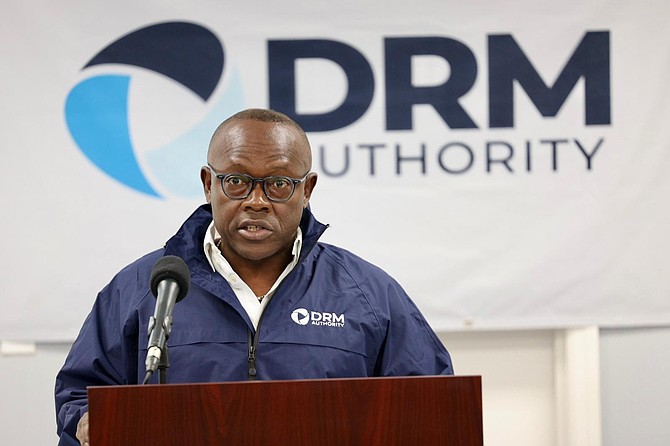
Deputy Prime Minister Chester Cooper at Saturday's briefing on Hurricane Oscar. Photo: Dante Carrer/Tribune Staff
By FAY SIMMONS
TRIBUNE Business Reporter
jsimmons@tribunemedia.net
THE DEPUTY Prime Minister has urged local government councils to spend their budgets “prudently”, revealing he was “distressed” to learn that some are leaving money unspent.
Chester Cooper, also minister of education, science and technology, said councils must demonstrate they are making effective use of existing resources if they expect central government to justify allocating additional funding to local government and Family Island development.
“I was distressed to hear that some districts are not spending the money. When you spend the money, you make our job easier to allocate more resources for local government and for the development of Family Island affairs,” he said. “So spend it prudently. Spend it for the communities, but spend it.”
Speaking at the Local Government conclave, Mr Cooper said the 2026-2027 Budget allocation for local government expenses increased by around $1.24m, adding that he and other Family Island MPs serving as Cabinet ministers had consistently advocated for greater financial support for local government.
“I, along with other Family Island MPs who are ministers, have been advocates to consistently increase the allocation for local government,” he said.
Mr Cooper also referenced around $16m in provisions for local government, while acknowledging that the country's 33 districts have differing needs and circumstances.
He said responsible spending is important not only for the communities receiving the allocations but also for demonstrating the case for further investment in local government.
Mr Cooper argued that the scale of The Bahamas' geography makes it impossible for central government to manage and develop the Family Islands without effective local administration.
He pointed to The Bahamas’ 100,000 square miles of territory, and said the work of island administrators, chief councillors and councillors is critical to expanding development opportunities across the country.
“It is impossible for the central government to manage and develop these islands all by itself, and that highlights the significance of local government,” he said.
Mr Cooper also called for stronger working relationships between island administrators and local government councillors, acknowledging that the two sides may sometimes disagree over how responsibilities should be carried out.
He added that disagreements were not inherently problematic provided they did not undermine the effectiveness of local administration.
“There's nothing wrong with disagreement, so long as it doesn't become dysfunctional. Indeed, you are not adversaries. You are partners serving the same people, and the people, as your minister said, expect results,” Mr Cooper said.
He also highlighted the role of local government in helping Family Island residents access opportunities in their home communities, saying residents should not have to relocate to New Providence to build a decent life.
“They don't want to come to Nassau, you know. Nor should we ask them to, or blame them for wanting to stay in their own ancestral homes,” he said.
The deputy prime minister said residents wanted opportunities for their children, properly maintained infrastructure, safe communities and reliable government services, adding that local government representatives understood the specific needs and challenges of the districts they served.
Mr Cooper also encouraged councils to continue involving young people in local government through junior local government councils, arguing these initiatives helped prepare future leaders by teaching them responsibility, compromise and public service.




Comments
Use the comment form below to begin a discussion about this content.
Sign in to comment
OpenID